Posted by: Omar C. Garcia | August 18, 2009

Honoring Parents | 1

   You are probably familiar with an I.R.A. or Individual Retirement Account. An I.R.A. helps people to prepare for a financially secure retirement. While many people make careful provision for their retirement through an I.R.A., many neglect to invest in their R.R.A. or Relationship Retirement Account. During our retirement years we will not only live on what we have invested in our I.R.A.’s, but on what we have invested in our R.R.A.’s as well. Every parent and child has a Relationship Retirement Account. God’s Word gives us sound investment counsel that, if heeded, can help us to increase our current R.R.A. account balance. This is the first of three posts that I pray will help you to take inventory of and increase your R.R.A. account balance.

   The fifth commandment communicates the first law relating to human relationships — “Honor your father and your mother, that your days may be prolonged in the land which the Lord your God gives you” (Ex. 20:12). This commandment expresses God’s concern for relationships in the home. The home is important to God because it is the setting in which children learn their value as human beings. As children interact with others in the home they either develop a positive or negative view of themselves. The home also is the setting in which children learn to relate to those in authority. Their experiences in the home usually determine the manner in which children relate to those in authority outside the home and ultimately to God. The home also is important to God because it is the place where children develop their values. As children observe what their parents hold important they too determine what is important.

   The home was very important in ancient Israel. That is why God instructed both parents and children regarding how to build stable and harmonious homes. God charged parents with the responsibility of providing spiritual instruction in the home (Deut. 6:4-9). Parents were to teach their children how to put their confidence in God, to not forget the works of God, and to live in obedience to God (Ps. 78:5-8). The children, in turn, were to teach these same lessons to their children.

   God also charged children with the responsibility of contributing to a stable and harmonious home. The fifth commandment specifically addresses how children (of every age) should relate to their parents. One thing is for certain, everyone reading this blog post has parents. How then, should we relate to our parents?

   The fifth commandment tells us to “honor” our parents. The word “honor” means more than just “be nice to your folks.” The word “honor” translates a word that literally means “to be heavy or weighty.” The concept of honor probably emerged from the idea of a person having a weight of possessions or great wealth. People with a weight of possessions were thought to have been blessed by God, hence honored. Conversely, the Hebrew word “dishonor” means “to be light, swift, trifling” (see Deut. 27:16). What a contrast! Do you treat your parents heavily or lightly? Do you count heavy their words or do you take what they say lightly? Do you count heavy their welfare or do you take their needs lightly?

   When the Hebrew Bible was translated into Greek, the translators captured the meaning of the word “honor” by using a word that referred to the value of a person or object. This gives us yet another perspective on what it means to honor our parents. Do you value or treasure your parents? For many of us it is easy to treasure our parents and hold them in highest regard, but for some it is difficult. A friend recently asked me how he could honor parents who had been abusive and neglectful. I suggested to my friend that he could honor his parents by expressing concern for them and their spiritual welfare. After all, Jesus also gave His life for parents such as these. To say “I do not care about my parents because…” is to ignore their worth as human beings and thus violates the spirit of the fifth commandment.

   Should children ever stop honoring their parents? Having recently suffered the loss of my beautiful mother, I now see another dimension to honoring our parents. We must never stop honoring our parents, even when they are in the grave. Instead, we should posthumously honor deceased parents by living in a manner pleasing to God. Although my Mom is now in heaven, I want to continue to honor her. I do not want to do anything that would tarnish her memory. So, regardless of our age or whether our parents are alive, we should never stop honoring our parents.

   Finally, the fifth commandment contains a promise — “that your days may be prolonged in the land which the Lord your God gives you.” The promise of a long life “in the land” referred primarily to the people of Israel and their existence in the land of Canaan (Deut. 4:40 and 32:46-47). The ability of the nation to survive “in the land” depended in large part on the stability of the home. According to Ezekiel 22:7, the failure of children to honor their parents contributed to the eventual captivity of Israel. Many other ancient civilizations also fell because of the disintegration of the home. Can America survive if our homes are not built according to God’s blueprint?

• • • • •

Please take a moment to read Honoring Parents |2 and Honoring Parents | 3.

Posted by: Omar C. Garcia | August 16, 2009

My Beautiful Mom | D

In Mom's Arms   I returned home from Cambodia last Thursday. This was the first international mission trip I have taken without my beautiful Mom praying for me at home. I mentioned in a previous post that after Mom died on May 30, I spent hours reading the notes she had written in the margins of her Bible. Mom had noted each of my international trips and the dates of those trips next to passages of Scripture that she was praying for me. I always knew that she was praying for my safety and success, but I never knew that she was recording these things on the pages of her Bible. She also noted the dates I had called home from overseas and initialed these notes with the letters TYL — Thank You Lord. These simple notes are a sweet legacy of my mother’s love. I will treasure the knowledge of her love and concern for me for a lifetime. Mom’s notes remind me that no matter how old we get or how far away from home we venture, a mother’s heart is never at rest until her children are safely home.

Running Away | I thought a lot about my beautiful Mom as I traveled throughout Cambodia. As I reflected on her concern for me, I thought back to the first and only time I ran away from home. I can’t recall why I did it, but it had something to do with not getting my way. At the time, I felt that my only recourse was to teach my Mom a lesson by running away from home. So, I mustered all of my sixth grade courage, stormed out of the house, and marched toward one of the two irrigation canals near our home in McAllen. These canals carried the water that irrigated the orange orchards near our home. They were wide, deep, dark, and fast-moving. I walked for several hours until it was just past dark. Finally, hunger prevailed and I started the long journey home.

When I walked through the front door, Mom ran to me with tears in her eyes and embraced me. I felt victorious and remember thinking, “Good. This will teach her to not deny me what I want!” And then, Mom spoke through her tears. The local evening news had just reported that the lifeless body of a boy about my age had been pulled out of one of the canals near our home. Mom was certain that it was me, burst into tears, and was getting ready to call the police. That’s when I walked through the front door. When Mom told me why she was crying I felt terrible. Tears streamed down my cheeks as I listened to Mom sobbing, almost choking on her tears. I no longer felt victorious. I felt selfish, childish, and stupid. I apologized to Mom and promised her that I would never run away from home again.

Lesson Learned: I caught a glimpse of my beautiful Mom’s heart on that evening when I returned home. Mom never punished me for running away. Instead, she did something I did not deserve or expect — she hugged me and cried. Even though I was the one who had acted in a childish and stupid way, Mom was happy to have me back in her embrace. I determined then that I would never run away again. I had caused my beautiful Mom unnecessary grief and pain on that night. She showed me unconditional love, forgiveness, and acceptance in return. Mom had a beautiful heart.

Ride Again | Not long after I had run away from home, I had another experience that rocked my world. Mom and Dad had bought me a red bicycle to ride to school. Later, Mom bought a wire basket to attach to the bicycle to hold my school books. I was proud of my bike and enjoyed riding it through the quiet streets of our neighborhood. One day, a group of guys I had never seen before stopped me as I was riding my bike near the irrigation canal west of our house. One of the guys pushed me to the ground and another took my bike and threw it into the canal. Then, they punched and kicked me a few times, laughed, and went on their way.

I walked home frightened, angry, and sobbing. When I walked into the house Mom took one look at me and asked me what had happened. I told her the whole story. Mom then walked with me to the place where the guys who beat me up had thrown my bike into the canal. She retrieved my bike and then said something unexpected. Instead of telling me to come home, she told me to get on my bike and to start riding it again. I protested and told Mom that I wanted to come home. I did not want to run the risk of a second encounter with those guys. But, Mom explained that if I did not ride the bike again now, that I would always be too scared to go out again. So, I got on my bike and rode up and down the otherwise quiet streets near our home. I never saw those guys again.

Lesson Learned: Mom did not want for me to live in fear in my own neighborhood. She understood that we all experience unexpected setbacks and troubles in life that can easily cripple and immobilize us with fear. Mom’s encouragement to me to ride again has served me well through the years. She taught me that giving up is not an option and that failure never has to be final. Over the years, my bike has ended up in the canal more times than I can recall. But, thanks to Mom’s wise counsel and with God’s help, I have always managed to get my bike out of the canal and ride again.

• • • • •

Read more posts about My Beautiful Mom filed under my Home and Family category.

Posted by: Omar C. Garcia | August 15, 2009

Deuteronomy 17

• Practices to Be Avoided | Deuteronomy 17:1-7

17:1-7 | Once again, Moses reminded the people that they were prohibited from bringing blemished sacrifices to the Lord (17:1). Idolaters were to be executed (17:2-7) so that the religious stability of the nation might not be threatened.

• Laws About True and False Leaders – Deuteronomy 17:8 — 18:22

17:8-13 | Moses was concerned about the fair administering of justice in the Promised Land (Deuteronomy 16:18-20). He made provision for judges to be helped when they had a difficult case before them (17:8). Moses instructed the judge dealing with the difficult case to “go up to the place which the Lord your God chooses” (17:8) and appeal to the Levitical priest or judge for help (17:9). Moses instructed the people to strictly abide by the verdict of the higher court (17:10-11). Anyone presumptuously refusing to abide by the decision of the higher court was to be put to death (17:12) and therefore serve as an example to others regarding the danger of refusing to abide by the judicial verdict of the higher court (7:13).

17:14-20 | Moses anticipated a time when Israel might want a king over them like the nations around them (17:14). He outlined the attitude and characteristics of one who might be chosen to serve as king.

First, the king was to be chosen by God (14:15).

Second, the king was to be an Israelite (17:15). A foreigner could not serve as king over the Israelites.

Third, the king was to trust in God rather than in horses (17:16). The key to military success was trust in God rather than the amassing of military strength. By trusting in God for victory in battle both the Israelites and their enemies would give God the credit for victory.

Fourth, the king was warned to not multiply wives (17:17). Solomon illustrates the wisdom behind this prohibition and the foolishness of ignoring it: “For it came about when Solomon was old, his wives turned his heart away after other gods; and his heart was not wholly devoted to the Lord his God, as the heart of David his father had been” (1 Kings 11:4). Kings often married foreign women to build strong political and military alliances. A king whose trust was in God, however, would have no need to trust in alliances.

Fifth, a king was to be a servant and not use his position to amass wealth (17:17).

Sixth, the king was to study and abide by the word of God (17:18-20). He was to write the words of Deuteronomy with his own hand and read and live by them.

Leaders must live and lead according to God’s instructions. | Moses instructed that kings over Israel were to have a high regard for God’s word. They were to make a personal copy of God’s word (Deuteronomy 17:18) and read it daily “that he may learn to fear the Lord his God” (Deuteronomy 17:19). Psalm 119:18 states, “Establish Thy word to Thy servant, As that which produces reverence for Thee.” How different the history of Israel might have been had the nation’s leaders actually followed this instruction. Abraham Lincoln said concerning the Bible, “This great book … is the best gift God has given to man … But for it we could not know right from wrong.”

Posted by: Omar C. Garcia | August 12, 2009

Signs of Life

   Our visit to the Choeung Ek execution site on Monday afternoon was a sobering experience. I wept as I lay in bed that night, feeling a bit overwhelmed by all that I had seen. What I found even more disturbing is the fact that Choeung Ek is just one of many killing fields in Cambodia. Almost two million people lost their lives in the span of a few years because a few people in positions of power had lost their minds. Pol Pot and his lieutenants turned Cambodia into a nightmare – a living hell. Whatever visions of grandeur Pol Pot and his cadres had, they were not realized. When Pol Pot mysteriously died on April 15, 1998, his lifeless remains were hastily cremated atop a heap of old tires and rubbish – a fitting end. Only eight people were in attendance at this ignoble occasion in a small village in the district of Anlong Veng.

Trapang Sdok   On Tuesday morning we drove past the darkness of Choeung Ek toward the province of Takeo near the Vietnam border. When we finally turned off the main highway, we bounced along a rutted dirt road until we arrived at the village of Trapang Sdok. Almost four-hundred people had come from the surrounding villages to hear a message of life and hope in Jesus Christ. Unlike the signs of death I had seen at Choeung Ek, I saw signs of life everywhere at Trapang Sdok.
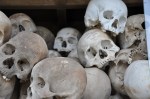
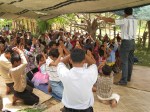
   When we visited Choeung Ek we were greeted by 8,000 human skulls, evidence of lives forever silenced by the Khmer Rouge. However, when we arrived at Trapang Sdok, we were greeted by almost four-hundred smiling faces, people enjoying one another’s company under the shade of colorful awnings. Friends and neighbors from this and other nearby villages had assembled without fear to worship the living God – something Pol Pot had tried to end. They treated us with respect and kindness and listened attentively as Barnabas and I preached the gospel. Sixty-three of those present that morning placed their faith in Jesus Christ. The expression of joy on their faces was priceless.

   When we visited Choeung Ek, we saw the Magic Tree, the place where the Khmer Rouge had mounted speakers to play loud music in an attempt to drown out the cries of those being brutally murdered. At Trapang Sdok, the speakers mounted under a lush canopy of shade trees played hymns and choruses and spiritual songs of praise to God. Those assembled joyously sang at the top of their lungs. My heart was warmed as I listened to and savored the beautiful sounds of life.

   When we visited Choeung Ek, we saw the Killing Tree, the place where the Khmer Rouge saved their bullets by dashing innocent children against the trunk of the tree. At Trapang Sdok, children played and laughed together. At Choeung Ek, children were torn from the arms of their mothers. At Trapang Sdok, mothers held their children in tender embraces. One mother and father brought their new baby girl and asked that Barnabas and I pray for her. We prayed that this child would grow up in a Cambodia free from the kind of fear that the previous generation had known, and that she would have an opportunity to hear and respond to the gospel of Jesus Christ.

   I am encouraged by what I have witnessed in Cambodia over the past week. The kingdom of God is advancing and bringing new life to the places where the Khmer Rouge once sowed death. In the parables of the kingdom recorded in Matthew 13, Jesus likened the kingdom of God to a mustard seed – something very small that grows into something very large (Matt. 13:31-32). The kingdom of God in Cambodia appears to be as small as a mustard seed, but it is beginning to grow. The signs of life are everywhere. Please pray for the Christ-followers in Cambodia as they sow the seeds of life that will one day result in a great harvest for the kingdom of God.

Posted by: Omar C. Garcia | August 11, 2009

Signs of Death

   After speaking at Phnom Penh Prison on Monday, we carved out some time to visit Choeung Ek Genocidal Center, located south of Phnom Penh. This bloody piece of real estate served as the extermination camp for Security Office 21 — the high school turned into a torture campus by the Khmer Rouge. Those who had already been detained and tortured at S-21 were transported by trucks to this killing field. Deceived into thinking that they were being transported to new quarters, these unfortunate souls were blind-folded and made to kneel in front of one of the 129 mass graves at the site. Then, they were bludgeoned and thrown into the pit where Pol Pot’s soldiers cut their throats.

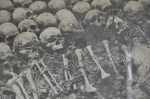
Cheoung Ek Skulls   Although Choeung Ek is now a peaceful and quiet place, the signs of death are everywhere. After all, almost 20,000 people were executed at this site. The most prominent building at the site is the Memorial Stupa, which was erected in 1988. More than 8,000 human skulls are arranged behind the glass panels of the building. Many of the skulls bear the visible marks of blunt-force trauma. These are the skulls of men, women, and children who knew nothing but pain and fear in their finals days. What crimes had they committed? The Khmer Rouge needed little excuse to kill. My friend Barnabas told us that one of his sisters was killed because she had kept a few sweet potatoes she had grown in her own back yard. Another sister was killed because she showed too much emotion when she sought permission to visit family members in another town. I can only imagine what senseless reasons resulted in the deaths of those buried in Choeung Ek’s communal graves.

Cheoung Ek Grave 7   Three signs in particular caught my attention at Choeung Ek. The first sign marked mass grave number 7 and said, “Mass Grave of 166 Victims without Heads.” These victims were among the 8,000 whose skulls were found separated from their bodies. I wonder about the individuals who were responsible for butchering these people and how they could possibly sleep at night and how they learned to live with what they had done to their own people. Unlike Hitler who killed the Jews, Pol Pot’s Khmer Rouge killed their own people. Barnabas related the account of one of these butchers who became a Christ-follower later in life. When asked what regrets he had about the killing fields he replied that he only had two. First, that he had killed so many. Second, that he did not know Jesus at the time. He said that he could not have possibly murdered others had he known and followed Jesus at the time of the killing fields.
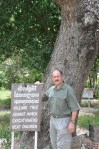
   The second sign that caught my attention was positioned in front of a tree and read (exact text and spelling): “Magic Tree — The tree was used as a tool to hang loudspeaker which make sound louder to avoid the moan of victims while they were being executed.” It’s interesting how sinful people always try to drown out the sound of their sin – or cover it up. Yet, no matter how loud the noise, it’s never loud enough to drown out the cries of the afflicted. The Bible reminds us that God hears the cries of the afflicted and will call their oppressors into account (Ps. 10:12-18). Dr. Martin Luther King Jr.said, “The moral arc of the universe is long, but it bends toward justice.” Someone else said that the wheels of God’s justice may move slowly, but when they come they grind finely. No one commits atrocities like these with impunity.

Cheoung Ek Killing Tree   The third sign that caught my attention was the saddest of all. This sign was also posted in front of a tree. The sobering words written on the sign said: “Killing Tree Against Which Executioners Beat Children.” Ammunition was more precious to the Khmer Rouge than the lives of children. Pol Pot’s henchmen took small children from their mothers, swung them by their feet and smashed them against the killing tree, and then tossed their lifeless remains into the adjacent mass grave. The sign that marked that grave noted: “Mass Grave of More than 100 Victims | Children and Women Whose Majority Were Naked.” Throughout the world today, the unborn, children, and the weak are still being smashed against the killing trees.
   Among other things, S-21 and the Choeung Ek killing field remind us that what we believe matters. Pol Pot’s worldview devalued human life and two-million people died as a result. Christ-followers and the church must not take a neutral or passive stand on matters of injustice. We must take sides. We must side with life against death and with justice against oppression. We cannot just say we are passionate about matters of injustice and do nothing. Passion must lead to action on behalf of the weak and oppressed. Anything less is a betrayal of our Christian worldview.

Posted by: Omar C. Garcia | August 10, 2009

Phnom Penh Prison

We left the relative comfort of our hotel early this morning and plunged into the river of morning traffic to travel to Phnom Penh Prison. This local prison is one of twenty-one Cambodian prisons that house fifteen-thousand inmates. A young man invited us to meet with a group of inmates, all of whom have found freedom in Christ since their incarceration. These Christian inmates are allowed to meet for worship every Monday.

Today, I had the special privilege of sharing a message from God’s Word with them. Barnabas served as my interpreter – one of the best I have ever had on any of my travels. We spoke as one. I shared a message of encouragement and reminded these Christ-followers that God will perfect the good work that He has started in them. Afterwards we sang hymns together and then enjoyed a delicious snack.

And now, a little background on how this particular worship and Bible study group was started. In 1998, our host was involved in a kidnapping. He ran from the law for two-years. During that period he lived out of the country and eked out a living as a rickshaw driver in Thailand. However, he constantly looked over his shoulder, fearful that he would be found out and sent back to Cambodia. “I had no peace,” he told us.

In February 1999, he met a Korean missionary who led him to faith in Christ. This young man became a deeply devoted follower of Christ and went to Singapore to study the Scriptures for a year. However, he still could not escape the feelings of guilt for his crime. Finally, he returned to Cambodia and turned himself in to the authorities. He was arrested, tried, and sentenced to fifteen years.

While in prison, an American missionary visited this young man and assured him that he had done the right thing. He encouraged him to cling to the promise of Romans 8:28 — “And we know that in all things God works for the good of those who love him, who have been called according to his purpose.”

At the time he did not understand how God could use a fifteen-year sentence for good. However, within a short period, the young man received permission to begin a Bible study, the first Bible study ever held in any Cambodian prison. God blessed his initiative as many of his fellow inmates came to faith in Christ.

After seven years, prison officials asked the King of Cambodia to grant the young man a pardon because of his exceptional behavior. They added that he had also contributed to making the prison a better place by leading inmates to follow Christ. The King of Cambodia granted the received.

Today, this young man continues to reach out to prisoners at Phnom Penh Prison. On Mondays the Christian inmates worship together. On Tuesday they have Bible study that focuses on discipleship. On Wednesday, he leads English classes and a computer lab for these inmates. Thursday is music day and Friday is devoted to literacy classes for inmates who cannot read or write.

Several of the men he has worked with have been transferred to other prisons throughout Cambodia. These men have successfully started Bible studies in their respective prisons. God continues to send these young disciples to other prisons with the life-changing good news of Jesus Christ. As a result – these inmates are redefining what it means to do life in prison.

Posted by: Omar C. Garcia | August 9, 2009

Rescued Lives

   Today is Sunday and I had the privilege of preaching at a church adjacent to an orphanage outside of Phnom Penh. There were about 250 Christ-followers present, including almost 100 orphans. Our hosts asked me to bring a word of encouragement to these believers. However, after spending the morning with them, they are the ones who encouraged me. The praise and worship team members were all young people from the orphanage – all self-taught on their respective instruments and very talented. Although I could not understand the words of the songs they sang in their native tongue, I did understand the joyful expressions on their faces. They warmed my heart and inspired me to give glory to God for His good work in their lives.

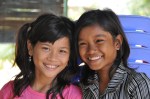
Orphan Girls   In the mid-1990’s, a single woman named Sakada started the orphanage called UNACAS, which stands for Unaccompanied Association. Sakada lost her family members in the killing fields and survived alone. She never married and never had children. When she encountered some orphaned kids, she was moved to do something to help them and others in need of a home. So, she started the orphanage and began to rescue kids. She was not a Christian at the time. Later, she heard the gospel and became a Christ-follower
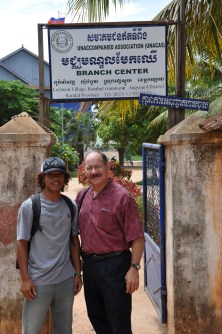
   When Sakada was making plans for the first Christmas celebration at her orphanage, she invited my friend Barnabas to share the Christmas story with the kids. Barnabas accepted her invitation and that Christmas 63 of the kids professed faith in Christ. Today, the orphanage is operated by a Christian staff and all of the children attend church every week. Sakada passed away in her sleep on a Sunday evening in December 2007, but her legacy continues as her staff rescues vulnerable kids in Cambodia.

Cambodia Orphanage   After worship this morning, one of the young men, a member of the praise team, gave us a tour of the orphanage. He is 21 years-old and has lived at the orphanage since he was 7 years-old. He spoke excellent English and is completing his second year of college. He also teaches English classes to the younger kids at the orphanage. I was impressed by his maturity, his polite disposition, and his determination to pursue his education and to honor God with his life. I shudder to think of what might have happened to him if Sakada had not chosen to rescue kids in crisis.
   So many children beg or hawk tourist stuff on the streets of Phnom Penh. This evening, Malcolm and I were approached by at least a half-dozen kids selling stuff, some as young as five years-old. One little girl told me that she must work from early morning until dark selling books and post cards. Like so many of Cambodia’s poor and orphaned kids, she will never get an education and will likely suffer abuse on the streets or at the hands of those who exploit children for profit. Every one of us can do something to help these kids, even from afar. Consider giving on a regular basis to support ministries and organizations that care for and rescue children, especially organizations like International Justice Mission. The folks at IJM work to rescue those who are abused, exploited, and trapped in the dark world of sex trafficking. Please join me in doing something to help. Every one of us can make a difference in the lives of kids at risk.

Posted by: Omar C. Garcia | August 8, 2009

Silenced Lives

   I have never forgotten a particular discussion we had in seminary when we studied the story of the woman caught in adultery. This story is recorded in the eighth chapter of John’s Gospel and, among other things, illustrates how sinners tend to treat other sinners. Our professor remarked that he would rather be a sinner in the hands of an angry God than a sinner in the hands of an angry sinner. The more I thought about his remark the more I agreed with him. The history of human atrocities certainly illustrates the truth of his conclusion. Angry sinners have the capacity to act without regard to any governing constraints. God’s actions are always consistent with His character and tempered by mercy and grace.

S-21 Skulls   This afternoon we visited the Tuol Sleng Genocide Museum in Phnom Penh. Once known as S-21, or Security Office 21, this terrible place was created on Pol Pot’s orders in April 1975. The buildings originally housed a high school and were a place of learning, the very thing Pol Pot feared, hated, and sought to destroy. The Khmer Rouge turned this place of learning into a horrific center for the detention, interrogation, torture, and murder of those deemed to be a threat to Pol Pot’s regime. Although the lives of thousands of men, women, and children were forever silenced here, they still speak and have a voice through this museum.
   The Khmer Rouge carefully documented every person who was brought to this center. Each prisoner was photographed, and in many cases, photographed again after being tortured and killed. They unwittingly left the world a bloody record of their inhumanity. As we walked through each room and looked at the cells and the torture devices, we also looked at the rows upon rows of photographs that captured the frightened and dazed looks of the people who died here. Even children were not an exception to the brutality. Instead of wasting bullets on babies and children, the Khmer Rouge soldiers found it easier to dash their small bodies against the compound walls or trees. This is the ultimate result of a world view void of any belief in God and without any regard for the sanctity of human life.

   Our friend Barnabas, a survivor of another of Pol Pot’s prisons, was an excellent guide. His insight was born out of personal experience. And, while walking through the rooms, we met another of the handful of survivors of S-21. He was 48 years-old at the time of his imprisonment here and showed us his photograph which is on display in one of the torture rooms. He told us that he comes to S-21 every weekend to talk to the visitors who come here from around the world. He wants for the world to know what happened here in the hope that it will never be repeated in Cambodia or elsewhere.

   Visiting S-21 is a sobering experience. The photography on display in each room is unedited, raw, and very graphic. There are human skulls and fragments of jaws piled up behind glass cases in one room. One survivor who is an artist painted the scenes on display in the building where prisoners were tortured. They depict babies being taken from mothers and prisoners being painfully tortured. Each painting tells a horrible tale of how thousands of people spent their final days in agonizing pain. S-21 is a monument to what happens when people find themselves in the hands of angry sinners. May we never forget what happened here and in other places where genocide has left its bloody signature. And, may we live with awareness and act with intention on behalf of those suffering similar atrocities today at the hands of angry sinners.

Posted by: Omar C. Garcia | August 7, 2009

The Village Church

   We left Siem Reap early this morning. After a quick breakfast, we loaded our bags into our Mitsubishi transport and made our way to Highway 6. As we slowly bisected the green fields toward the southeast, Barnabas shared a little more of his story about how he lost his father and six siblings, all Buddhists, to Pol Pot’s killing fields. Barnabas, who was the only Christian in his family, gives God the credit for sustaining and helping him to survive two brutal years of imprisonment. I hope to write more about his inspiring story later.

   Soon after entering Kompong Thom province, we met our escort who led us down the erosion-scarred back-roads to the village of Skun. When we arrived, Pisat, a slender and strong woman, approached our vehicle. Piseth had served as a commander in the Peoples Republic of Kampuchea army, which is now a part of the Royal Khmer Army. She is a Christ-follower who had heard about Barnabas’ church-planting initiatives. She enrolled in Barnabas’ training course for church-planters and has since used her administrative gifts to plant three churches. Pisat is committed to planting churches among Cambodia’s twenty-eight unreached people groups. She does not pastor these churches but instead gives oversight to their work. God recently led her to plant a church among the Kuay people who live in and around the village of Skun. This growing church is in the process of constructing a building that will also serve as a Christian school.

Skun Village Meeting   Piseth did an excellent job of preparing for our arrival. Since Malcolm and I are westerners, she had to arrange for policemen to be present to provide for our security. She also had encouraged the members of the Skun church to invite their families, friends, and neighbors to attend our meeting. And, they did! People from other villages in the area had walked several kilometers to Skun to hear the gospel. When we arrived the people were sitting patiently under awnings flapping gently up and down in the breeze. As we approached, they welcomed us with applause. Barnabas invited me to preach the first message and then he followed-up with the second. At the end of the morning 152 of those present had placed their faith in Christ for salvation.
   Piseth and her team of church-planting pastors interviewed those who professed faith in Christ and noted their home villages. Several village leaders were in attendance and asked that someone plant a church in their villages. The immediate plan is to start new churches in two of the villages that had large numbers of people profess faith in Christ. Piseth wasted no time in talking with the village leaders about the next steps. She and her team have already assigned responsibility to those who will start these new works.

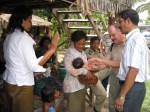
Baby Huat   Before we left Skun, a mother holding her infant daughter approached us. The two-month old girl named Huat was laboring to breathe. Her mother said that her child’s breathing has not been normal since birth. It hurt just to hear Huat struggle to draw a breath. The people of Skun are far from medical care, so the mother asked that we pray for her daughter, which we did. We took the time to talk with the mother and to pray for her baby girl. When I assured her that I would ask the people of Kingsland and other Christ-followers to pray for Huat, peace chased away the anxious look on her face.
   We spent the afternoon in the village of Tnal Bek where I had the privilege of speaking to a gathering of pastors from throughout Kompong Thom province. We met under a tin-roofed shed that serves as the building for the church there. I love meetings like this because they remind me of how vast the kingdom of God is. The kingdom of God is advancing in remote places because of the commitment, faithfulness, and determination of people like those assembled at Tnal Bek. Jesus said that “the kingdom of heaven is like yeast that a woman took and mixed into a large amount of flour until it worked all through the dough” (Matt. 13:33). God’s work is growing here through the leavening work of transformed lives – as one transformed life touches another and then those in turn touch others and so on. I am encouraged to learn about and to see how God’s kingdom is growing in Cambodia one person and one village church at a time.

Posted by: Omar C. Garcia | August 6, 2009

Three Temples

   After almost twenty-three hours of actual time in the air on three different flights, we finally arrived in Cambodia. We made our final approach to the Siem Reap Airport over the muddy tan-colored waters of Tonlé Sap Lake, bounced twice on the tarmac, and rolled to a stop near the pagoda-roofed terminal building. We quickly secured our visas, retrieved our luggage, and then met Barnabas, our host. Barnabas is a 59 year-old father of nine children with twenty-five grandchildren and six great-grandchildren. He is a tireless worker for the kingdom of God with a contagiously joyful attitude. Barnabas is responsible for training national pastors and workers and has also written and translated over four-hundred songs for the Cambodian church. He is committed to the vision of planting a church in every one of Cambodia’s fourteen-thousand villages.
 
   After we checked in to our hotel, we had our orientation meeting with Barnabas. We learned about the history of the church in Cambodia before and after Pol Pot’s killing fields. We also learned about church-planting initiatives. Since 1992, the year Christian churches were first allowed to worship openly, every new church is required to apply for a permit from the Minister of Religion. The Minister of Religion is a Buddhist. In 1992, before he was the Minister of Religion, this gentleman survived a serious air crash and spent twenty days in the hospital. Every day, Christians visited him without fail, prayed for him, and paid all of his medical bills. Although these acts of kindness did not lead him to faith in Christ, they softened his heart toward Christians. This gentleman has granted permits for new churches to meet since his appointment as Minister of Religion.

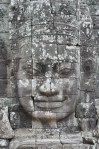
Bayon Buddha   After our meeting, we drove the short distance from Siem Reap to Angkor where we visited three of the ancient temples on the vast grounds. Amazing! We visited Angkor Wat, believed to be the largest religious structure in the world. We learned that Pol Pot sought to build a kingdom even more glorious than Angkor. He was inspired to imitate the brutality depicted in the many bas-relief stories of battles carved into the temple walls. However, Pol Pot did more than imitate the torture methods carved in stone – he exceeded them. We also visited the Bayon Temple, famous for its many four-faced Buddhas carved into the massive and ornate stone towers. Even for a non-Buddhist, the huge faces of Buddha, the enlightened one, are quite impressive. Finally, we visited Ta Prohm, one of the oldest sites in Angkor. This Hindu site boasts trees with massive roots entangled in the ruins and is a photographers’ paradise.

   The temples of Angkor are evidence that what the writer of Ecclesiastes said is true – God has “set eternity in the hearts of men” (Ecc. 3:11). The vast complex of temples testifies to the restless longing of the ancient Khmer people to connect with something or someone greater than themselves. And, as impressive as this World Heritage site is, these temples no longer serve the faithful – only tourists. There are no priests, no worship, no fellowship, no instruction, and no life.

   In the coming days, in addition to meeting and speaking to gatherings of pastors, I will speak in three churches. Unlike the three temples we visited in Angkor, these churches serve the Anointed One and are full of life. Those who attend these churches are engaging the people of their respective villages, serving the needs of their communities, addressing broader concerns like Cambodia’s sex trafficking, caring for the least of these, and more. I am grateful to God for Barnabas and for the relatively few laborers seeking to make God known among the Khmer people. Unlike the mildewed and fern-covered stones of Angkor’s temples, they are “like living stones” that “are being built into a spiritual house” (1 Pet. 2:5) that will last into eternity.

« Newer Posts - Older Posts »

Categories