
Posted by: Omar C. Garcia | August 4, 2009

Headed to Cambodia

Angkor Wat   I first learned about the Kingdom of Cambodia from my Uncle Phil when I was a young boy. Uncle Phil had visited the mysterious temples of Angkor in the years before the Vietnam War. The temples in this complex are the remnants of what once was the religious, political, and social center of Cambodia’s ancient Khmer empire. When Uncle Phil visited Angkor, travelers were permitted to make pencil rubbings of the bas-relief figures carved on the temple walls of Angkor Wat. Uncle Phil used large sheets of newsprint to capture the mysterious images. He later had them framed and then hung them in my grandparents’ home. As a kid, I was drawn to and fascinated by the simple yet beautiful images and wondered about who had carved them and what stories they told.

   A lot has changed since my Uncle Phil visited Cambodia. Once an exotic and charming tropical tourist destination, Cambodia is best known today as the home of “the killing fields.” Over two million Cambodians were brutally murdered by Pol Pot’s government between the years of 1975 and 1979. The Khmer Rouge killed former military and civilian leaders, the wealthy and the educated, and left the country in economic shambles. The Khmer Rouge also tried unsuccessfully to eradicate all religion, including Buddhism which has been the national religion since the 15th Century.

   I am headed to Cambodia today and hope to post from there as my schedule allows. My friend Malcolm McMullen and I will meet with a man named Barnabas Mam. I met Barnabas about a year ago and learned about his work with national pastors and church leaders in Cambodia. I also learned a little about Barnabas’ own story of how he lost his family at the hands of Pol Pot’s murderous Khmer Rouge. He survived the infamous killing fields and has worked to sow the seeds of life throughout his country ever since. I am looking forward to learning more about his work with hundreds of national pastors and church leaders. My hope is that we can partner with Barnabas and assist him in training these national leaders.

   The Cambodian people, known as the Khmer, make up about 86% of the population, with an assortment of tribal and other groups making up the remainder. The Khmer are largely unreached with less than 1% of the population claiming to be Christian. However, the ravages of war and the bloody legacy of the Khmer Rouge have helped bring about openness to the gospel. Christians, who have been allowed to worship openly since 1990, are diligently working to share the message of Jesus with their countrymen. This is a challenging task because of the hostility of the Buddhist establishment. Many Buddhist leaders would like Christianity banned from Cambodia. Please pray for the Khmer people and for the Christ-followers among them. “The harvest is plentiful, but the workers are few” (Matt. 9:37). Let’s “beseech the Lord of the harvest to send out workers into His harvest” (Matt. 9:38) in Cambodia.
Posted by: Omar C. Garcia | August 2, 2009

Deuteronomy 16

Three Festivals of Israel | Deuteronomy 16:1-17

16:1-8 | Moses reviewed, in summary fashion, the three festivals which the Israelites were to observe throughout the year. The first of these was the Passover which was to be observed in “the month of Abib,” which means “green ears” (which approximates our month of April). This festival commemorated the major event in the life of Israel, their deliverance from Egyptian bondage. It served as an annual reminder of their slavery in and deliverance from Egypt. It was to be celebrated in the place of God’s choosing (16:6). The people were to abstain from eating leavened bread (16:3). Instead, they were to eat “unleavened bread, the bread of affliction” to commemorate their hasty departure from Egypt (16:3). They were also to completely consume their meat during each night of the festival (16:4), cooking the meat in the vicinity of the sanctuary (16:5-7). The observance was to conclude with “a solemn assembly to the Lord your God” (16:8).

16:9-12 | The Feast of Weeks was an observance that celebrated God’s provision of the harvest. This one-day festival was also known as … Feast of Harvest in Exodus 23:16 … the “day of first-fruits” in Numbers 28:26 … and Pentecost (based on the Septuagint’s translation of “fifty days” in Leviticus 23:16). Notice the instructions of Moses in these verses …

First, “you shall count” (16:9). The people were to count seven weeks from the time their harvest began in March or April.

Second, “you shall celebrate” (16:10). The feast was to be celebrated with the giving of a freewill offering.

Third, “you shall rejoice” (16:11). The people were to rejoice “before the Lord your God.” C.H. Spurgeon said, “When we bless God for mercies we prolong them, and when we bless Him for miseries we usually end them. Praise is the honey of life, which a devout heart sucks from every bloom of providence and grace. We may as well be dead as be without praise; it is the crown of life.”

Fourth, “you shall remember” (16:12). God never wanted for the Israelites to forget their obligation to Him.

16:13-17 | The Feast of Booths was to be observed in commemoration of the wilderness wanderings when the Israelites lived in booths (Leviticus 23:42-43). It was celebrated after the fall harvest (Leviticus 23:39). The Israelites were to construct booths (Leviticus 23:40) and live in them for a week (Leviticus 23:39).

• The Principle of Justice | Deuteronomy 16:18-20

16:18-20 | The administration of justice in the new land was a matter of concern for Moses. He gave instructions for the appointment of “judges and officers in all your towns” (16:18). Moses declared that these judges and officers were required to “judge the people with righteous judgment” (16:18). In order to do this they would have to do at least four things that point to the fact that judges were to be men of integrity.

First, “you shall not distort justice” (16:19).

Second, “you shall not be partial” (16:19).

Third, “you shall not take a bribe” (16:19).

Fourth, “Justice, and only justice, you shall pursue” (16:20).

• Practices to Be Avoided | Deuteronomy 16:21-22

16:21 | Moses reminded the people that they were to avoid idolatry and anything that might tempt them to worship idols or participate in idolatrous practices. They were prohibited from setting up an Asherah (16:21-22).

Posted by: Omar C. Garcia | July 31, 2009

The Diesel Mechanic

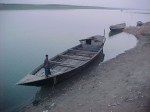
Bangla BoatIn February 2003, I led a group on an expedition down the Brahmaputra River in Bangladesh. This trans-Himalayan river has its origin in western Tibet, slices its way through the Himalayas and then tumbles into the subcontinent where it winds its way through the fertile fields of Bangladesh to the Bay of Bengal.

We began our journey in northern Bangladesh and made our way south, visiting remote villages along the way. My team distributed 10,000 copies of Luke’s Gospel and initiated dialogue with about fifty Muslim imams and village leaders. We lived, slept, ate our meals, and fought mosquitoes on our fifty-foot long wooden boat.

Jay Lowe, one of our team members dubbed our floating home “The Love Boat” because we used it to carry the message of God’s love to those who had never heard it. However, after one night on the boat we renamed it “A River Runs Through It” because it leaked and we had to regularly bail water from the bottom of the boat.

I love trips like this because they put you in a context where you see God do some cool things. On three occasions on our boat trip, people ran along the shore and stopped us, saying that they had had a dream that someone was going to come down the river to share an important message with them. “Are you the men I dreamed about?” they asked.

I have often heard people say that they want to see God do miraculous things and yet do everything they can to avoid the context in which miracles take place. When we step across the line that defines the farthest we’ve ever been and the most we’ve ever done for God and His purposes, we place ourselves in a context where miraculous things happen. A year after our visit and after very intentional follow-up, national Christ-followers identified over ninety small groups meeting along the river for Bible study.

Jay LoweMy friend Jay and his son-in-law Andrew returned to Bangladesh this month to complete the remaining portion of our 2003 boat trip. They distributed over 5,000 copies of Luke’s Gospel and made some great connections with people in villages that can only be accessed via the river.
Jay and Andrew had lots of conversations about Jesus and why He came and how He demonstrated His love for us. They found people today just as interested in hearing the good news about Jesus as the people we met in 2003. That’s a good thing. Jay sent me an e-mail about something that happened at the end of their trip. I love stories like this. Jay wrote …

“As you know weird things happen on these mission trips. Here’s one you’ll get a kick out of. We’re on the Brahmaputra River and it’s our last day. We’re in the middle of nowhere, not even a village in site, when the boat’s diesel engine goes out. The boat owner worked on it for 15 minutes and then told Mortuza he can’t fix it. We’re thinking it’s going to be a long paddle to the next town. The boat floats over to the east bank where there is a cane field. As soon as the boat hit the sand, a man walks out of the cane field and says something to the boat owner. [National guide] turns to me and says, “I can’t believe this!” Mortuza was in shock. The guy said, “I’m a diesel mechanic, can I help you?” The guy steps into the boat, fixes the engine in 2 minutes and then walks back into the cane field. Would one say that was a “God thing”?

   Some would call Jay’s experience a coincidence. I agree with Jay that what happened was a “God thing.” God is in the business of doing miraculous, perhaps weird and unexplainable things, when we go beyond — when we step across the line and venture into the unknown and the unfamiliar. Step across the line and join Him there. Adventure awaits!

• • • • •

PS | Read about Jay’s remarkable Dad in my post entitled No Limits.

Posted by: Omar C. Garcia | July 30, 2009

Deuteronomy 15

• Laws about Tithes and Release | Deuteronomy 14:22–15:18

15:1-6 | Deuteronomy 15 contains laws relating to the sabbatic year. This important year is mentioned elsewhere in Scripture. Exodus 23:10-11 emphasizes the importance of allowing the land to lie fallow every seventh year for the sake of the needy and the animals. Leviticus 25:1-7 emphasizes the importance of allowing the land to rest from production  every seventh year. Deuteronomy 15:1-6 expresses a humanitarian concern for various classes of needy people. According to these instructions, the Israelites were not to press those in debt to them to pay their debts in a sabbatic year. This likely meant that repayment could not be demanded during the course of the seventh year.

15:7-11 | These verses address the subject of loaning to the poor. Notice the use of the words “heart” and “hand” in these verses. Matthew Henry said, “If the hand is shut it is a sign that the heart is hardened.” Notice the following points in these verses.

First, those with wealth should not close their hearts to assisting those in need (15:7-8).

Second, those with wealth should not look for ways to avoid assisting those in need (15:9). Moses illustrated this point by referring to a case in which a man with means might consider withholding help from a man in need just prior to the sabbatic year.

Third, those with wealth should joyfully and generously assist those in need and so experience God’s blessings (15:10).

Fourth, those in need will always “be in the land” (15:11). Jesus said, “For the poor you have with you always … “ (Matt. 26:11). See also Jesus’ comments in Matthew 25:31-46 regarding the importance of how we are to treat those in need.

Those who have should assist those who have not. | As Moses instructed the people in the laws that were to govern their lives in the Promised Land, he did not neglect to mention the poor and needy. He instructed those who were blessed with means to assist those suffering misfortune. Billy Graham is quoted as having said that “if every church in America would take care of eight welfare families the problem would be eliminated immediately.”

15:12-18 | These verses address the treatment of servants who are members of the covenant community. Notice the following points in these verses.

First, a servant was to serve six years and released on the seventh or sabbatic year (15:12).

Second, the needs of the servant were to be generously provided by the master (15:13-14). The motivation for such generous treatment was three-fold. First, because of the generous treatment and provision of the Lord for the master (15:14b). Second, because the master’s forefathers were once slaves in Egypt (15:15). Third, because the master had received his “money’s worth” from the servant (15:18).

Third, provision was made for a servant to remain with his master in the sabbatic year. If the servant loved his master and his master’s family and personally chose to remain, the master was to pierce the servant’s ear with an awl. This was to serve as a visual indicator of the servant’s personal commitment to remain with and to continue in the service of his master (15:16-17 and see also Exodus 21:5-6).

• Consecration of the First Born | Deuteronomy 15:19-23

15:19-23 | These verses address the sacrifice of firstborn animals. They specify the conditions placed on the use of such animals as sacrifices. The theme of these verses is the importance of consecrating only the best to God. He deserves first-place in every aspect of our lives.

Posted by: Omar C. Garcia | July 28, 2009

Facing Your Fears

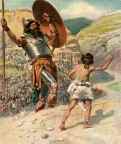
David & Goliath   Have you ever allowed your fears to keep you from faithfully standing for God? Have you ever avoided talking about your faith or hesitated to base decisions on your Christian worldview for fear of reprisal from others? Do you lack confidence in your ability to confront appropriately those who oppose God’s way? Have you ever been immobilized by fear in the face of Goliath-like difficulties? No one is immune from difficulties or intimidating people or circumstances. When we least expect it, we hear the thundering and defiant voice of Goliath — a voice that can make us feel small and helpless.

   The Valley of Elah, located west of David’s hometown of Bethlehem, was the setting of one of the most memorable and dramatic battles in the Bible. The Philistines, enemies of Israel, assembled for war on a hilltop overlooking the fertile valley. Saul and the Israelites occupied a hill on the opposite side of the valley. With the battle lines clearly drawn, these two armies took inventory of one another from their hilltop vantage points.

   The Philistine and Israelite armies seemed equally matched until the Philistines introduced their secret weapon — a man named Goliath who was over nine feet tall. The Philistines cleverly used their towering champion to wage psychological warfare against the Israelites. Goliath “stood and shouted” (1 Sam. 17:8) to the Israelites twice a day for forty days (1 Sam. 17:16). He challenged the Israelites to send a man against him in a winner-take-all fight to the death. No Israelite answered the challenge — not even Saul, who stood a head taller than his own countrymen. Saul and his army “were dismayed and greatly afraid” (1 Sam. 17:11).

   Goliath was not the first and certainly not the last person to oppose God’s people or God’s way. Christ-followers face increasing opposition in today’s world. In some places that opposition takes the form of actual physical persecution. In other places attacks come in the form of ideas and worldviews contrary to the teachings of Scripture. The reality is we live in a world that is hostile to the purposes of God and therefore should expect difficulties and opposition.

   The Philistine’s use of psychological warfare against the Israelites proved to be effective. Goliath’s intimidating presence and thundering verbal barrage sent Saul and his men scurrying for cover. Their fear only served to embolden the blasphemous giant. Those who oppose God still employ psychological warfare today. Attacks on the faith by skeptics and those hostile to the purposes of God can take on intimidating proportions. Some Christ-followers are easily intimidated because they feel ill-equipped to respond. Rather than take a stand for their convictions, they scurry for cover at the first sign of trouble. Others simply choose to remain silent and not respond.

   When David arrived on the battlefield to visit his brothers, he was puzzled by the cowardly behavior of Saul and his men. David approached Israel’s king and volunteered to do what no man in Saul’s army was willing to do — fight Goliath. Saul immediately protested that David was not qualified to fight the experienced giant. David however, related to Saul the accounts of his victories over a lion and a bear that had threatened his father’s flock. God had used these encounters to prepare David for greater battles in the future. Remembering past victories can fortify our faith and give us the courage to face present challenges. David was confident that God would give him the victory over Goliath, the predator threatening God’s flock.

   Saul said to David, “Go and may the Lord be with you!” (1 Sam. 17:37). Saul then tried to dress David in his own armor but David chose to rely on God instead. As David walked to the battlefield, he paused to select five smooth stones from a stream. I had the opportunity to visit the Valley of Elah earlier this year and to pick up five smooth stones from the stream bed there. Armed with only stones and his sling, David walked on to the battlefield to face Goliath. The Philistine and Israelite soldiers watched from the hilltops as the courageous boy and the arrogant giant walked toward each other in the valley below. God would use that courageous boy with a slingshot to accomplish His purposes.

   Fighting giants can be a lonely experience. As the Israelite army stood on the hilltops, a solitary figure walked toward the giant in the valley below. In the Valley of Elah and in other valleys throughout the centuries, solitary figures have stood courageously for God. Some have descended into the valley between the hilltops of truth and error to fight for God’s truth. Others have sustained the blows of ridicule and rejection. Still others have given their lives while holding fast to the confession “Jesus is Lord.”

   As Goliath approached David, he “cursed David by his gods” (1 Sam. 17:43) and boasted about what he would do with the boy’s dead body (1 Sam. 17:44). David told the arrogant Goliath that he was coming against him “in the name of the Lord of Hosts” (1 Sam. 17:45). David was confident that God would help him defeat Goliath. As David “ran to the battle line” (1 Sam. 17:48) to meet Goliath, he reached into his bag and armed his sling with a stone. David then skillfully released the stone from his sling and struck Goliath in the forehead. The giant, who only moments earlier had cursed David by his gods, “fell face first to the ground” (1 Sam. 17:49). The faith of the shepherd boy triumphed over the pride of the giant. Goliath’s death resulted in panic in the Philistine ranks and paved the way for victory for the Israelite army.

   While David killed Goliath in a short period of time on the battlefield, some battles we fight drag on for long periods of time. Sometimes the victory we claim is the victory God will ultimately secure over evil and death. Still, God empowers us in battles of long duration as well as short. The important thing we must do is to rely upon Him and claim the victory as David did.

   From the moment David saw Goliath and heard his defiant threats, he acted in ways that honored God. David’s faith honored God and God honored David’s faith by giving him victory in battle. We too must act in ways that honor God when facing opposition. Our behavior in the valley can encourage those watching from the hilltops to put their faith into action by standing courageously for God. Like David, you can count on God to empower you to face and overcome your fears.

Preparation | Develop the spiritual disciplines that can prepare you to face giants.
Perception | God is bigger than any giant you will ever face.
Perspective | Remembering past victories can help you face present challenges.
Perseverance | Some battles are not won in a single day or even in a lifetime.
Power | Rely on God and His strength in the battle.
Praise | Express your gratitude to God for the victories He gives.

Posted by: Omar C. Garcia | July 26, 2009

The Explorers Club

   My sister and I spent this past week with Dad. We helped him organize some things around the house — things that needed to be done since Mom passed away. Years ago, Dad had a storage building built in the backyard. We thought it was for his lawnmower and tools and things like that. But instead, Mom and Dad used it as a vault to store all of the random stuff accumulated through growing-up years and left behind by their five kids. Our task was to clean out the storage building, organize everybody’s stuff in boxes, build new shelves, and carefully repack everything into our backyard time capsule. Our hope is that each sibling will take their childhood stuff to their respective homes as they come for visits throughout the coming year.

Mother Teresa   As my sister worked her way to the back of the shed she uncovered my old Boy Scout foot-locker. It was exciting to kneel in front of it in anticipation of what I would find inside. I unlatched the rusty hinges and slowly lifted the top. The first thing I saw was my Boy Scout knot board and the hide of a rabbit I had shot with my .22 rifle. Underneath the knot board was a December 29, 1975 issue of Time magazine in mint condition. I had my own subscription to Time magazine during my freshman year of college and had saved several issues. This issue was titled “Living Saints: Messengers of Love and Hope” and featured the image of Mother Teresa on the cover. Even then I was impressed by Mother Teresa’s commitment to the least of these. However, I never would have imagined at that time that I would one day serve in her homes in Kolkata.

   The trunk was packed with all sorts of great stuff, including my stamp collection, post-cards sent by my Uncle Phil from around the world, newspaper clippings of high-school events, a stack of Boys Life magazines, my Cub Scout cap, a ledger where I tracked my odd-job earnings, and a cigar box with some of the miscellaneous items I had received when I was a member of Commander Whitehall’s Explorers Club. Looking at and holding these items brought back some enjoyable memories.

   When I was enrolled in Jackson Elementary School in McAllen, Texas, one of my teachers told us about Commander Whitehall’s Explorers Club and sent us home with membership information. She thought it would be a good idea for us to join the club so that we could learn about people in other countries. I brought the membership information home to Mom and Dad. Although the membership was $5.00 per month, which was a lot of money in the 1960’s, my parents thought it would be a good idea for me to join the club. In addition to the packages and post-cards sent by my Uncle Phil, they felt this would be one more way for me to learn about the world. So, I joined the club.

Explorer's Club   Every month, Commander Whitehall would send a package from some far-away place. Each package contained a map and information sheet, a small souvenir item from the country he was visiting, and a floppy record with his narrative about that particular country. It was always exciting to hear Mom call from the mailbox to tell me that my package had arrived. I wish I had all of the items Commander Whitehall sent, but it was fun to find even a few of them in my old trunk — things like pan pipes from Ecuador, a pair of sandals from someplace I can’t recall, a pipe from Italy with a face carved on it, worry beads from Iran, and more.
   The Psalmist said, “For all things are Thy servants” (Ps. 119:91b). Looking back through the years I now understand a little more about how God used so many people and things to shape my life and to prepare me for what He had prepared for me. I am grateful for the teacher who encouraged us to join Commander Whitehall’s Explorers Club and for Mom and Dad who agreed to let me join. Little did I understand at that time how God would use my Dad’s travel photos and movies, Uncle Phil’s post-cards and letters, a story in Time magazine, and Commander Whitehall’s Explorers Club to awaken my interest in the people of the world. I have never lost the wonder I had as a boy about interesting people and far-away places and pray that I never do. I am deeply grateful to God for Mom and Dad and the people and things He used to prepare me to serve His purposes among the nations.

• • • • •

Note | Please take a moment to read Travelers.

Posted by: Omar C. Garcia | July 24, 2009

Deuteronomy 14

• Idolatry Not to Be Tolerated | Deuteronomy 12:29–14:2

14:1-2 | God’s people were a holy people and were expected to act accordingly. They were to live their lives distinctively different from their heathen neighbors. As a holy people they were not to participate in any of the practices of their heathen neighbors. Moses cited as an example a superstitious heathen practice that involved shaving away a portion of hair as a symbol of mourning a death.

• Laws about Food | Deuteronomy 14:3-21

14:3-21 | These verses contain a specific list of clean and unclean animals. The Israelites were prohibited from eating any of the unclean animals. Some believe that health was the underlying reason behind the prohibition. However, the problem with the health or hygiene argument is that God still permitted the Israelites to give or sell unclean food to aliens (see 14:21). In addition, the Old Testament does not state that the Israelites considered the unclean animals dangerous to their health. Some argue that because God’s people were to be distinctive in every area of life, the dietary laws helped fulfill this purpose. What was permissible for others to eat was not permissible for the Israelites to eat. The dietary laws served to remind the Israelites of their status before God. The food laws also provided the Israelites with the opportunity to exercise faith and obedience.

• Laws about Tithes and Release | Deuteronomy 14:22–15:18

14:22-29 | These verses contain seven truths about tithing that are still valid today.

First, tithing is to be a regular exercise (14:22). Tithing would serve as a reminder to the people that their prosperity was the result of God’s provision.

Second, tithing is a spiritual exercise (14:23). The Israelites were to take the tithe and “eat in the presence of the Lord.” By placing our tithes before the Lord we are humbly reminded of His blessings. An unwillingness to tithe is the result of a deeper problem: God does not have us.

Third, tithing is a learning exercise (14:23). By bringing their tithes the people would “learn to fear the Lord your God always.”

Fourth, tithing is a flexible exercise (14:24-26). God made provision for how those who lived too great a distance from the place of worship were to bring their tithes.

Fifth, tithing is to be a joyful exercise (14:26).

Sixth, tithing is a beneficent exercise (14:27-29a).

Seventh, tithing is a blessed exercise (14:29b).

Giving to God should remind us of what He has given to us. | God gave the Israelites specific instructions concerning the giving of their tithes. These instructions were designed to remind the Israelites of the gracious provision of God. Every time we give to God it should serve as a reminder that He has first given to us. Tithing should remind us of both the presence and provision of God for our needs. God is not unreasonable in what He asks of us.

Posted by: Omar C. Garcia | July 21, 2009

Loneliness | Psalm 142

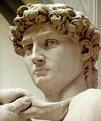
David  The book of First Samuel gives us insight into the events of David’s life. David’s psalms give us insight into his heart. David wrote psalms to God even in times of isolation and loneliness. The heading of Psalm 142 relates the psalm to a time when David was hiding in a cave. First Samuel describes a time when David took refuge in a cave at Adullam (1 Sam. 22:1-5) and in a cave in the wilderness of Engedi (1 Sam. 24). First Samuel 22:1-5 certainly describes the type of experience that led David to write Psalm 142. Persons experiencing loneliness will find that this psalm can speak for them as much as it speaks to them.
David knew where to turn for help in times of trouble. Frightened and confused, David cried aloud to God from the dark recesses of the cave. David’s urgent cries shattered the silence as he sought help and understanding from God. He took all his troubles to God (Ps. 142:1), because he knew that God is the God of mercy and care. He was confident the Lord would sustain and protect him from Saul’s murderous intentions. Like David, we can cry out to God in times of loneliness (see Heb. 4:16). We too can pour out our complaints to God and tell Him of our troubles (Ps. 142:2).

David was utterly exhausted and overwhelmed by his situation (Ps. 142:3a). He did not understand why he was being hunted like a dangerous animal (see 1 Sam. 20:1). The pressure of having to constantly run and hide from Saul eventually took its toll on David’s emotions. However, he confidently asserted that God was intimately acquainted with his situation. David believed that God knew of the injustice that had forced him to flee from Saul. The conviction that God knows all about our troubles can be a great source of comfort in times of loneliness and desperation.

In times of loneliness we can take every concern to God with the assurance that He will listen with an understanding heart. God is acquainted with every situation that touches our lives and every emotion that flows through our hearts (see Ps. 139:1-6). Knowing that God listens, understands, and cares for us can restore hope in times of loneliness. Fortunately, God is always available. We can call upon God at any time with the assurance that He hears and will respond to our lonely cries.

David knew what it meant to be popular and to be loved by the masses. When He returned from killing Goliath he was greeted with dancing and singing in the streets (1 Sam. 18:6-7). The nation shouted his praise. As a military commander, his popularity increased with every successful military campaign (1 Sam. 18:14-16). The Bible records, “all Israel and Judah loved David” (1 Sam. 18:16). But, on the night David secretly fled from Saul, he was utterly alone. He escaped through a window and quietly slipped away into the darkness (1 Sam. 19:12). No fanfare. No friends. Not a single companion at his side.

David knew that his path was plagued with danger. He was a wanted man and the object of Saul’s mad obsession (1 Sam. 19:1). Every stranger represented a potential threat to his life. As a fugitive traveling alone, David felt vulnerable. He complained to God that his enemies were out to trap him (Ps. 142:3b). He longed for someone to help him, but felt that no one was concerned for him. He looked to his right, the place where a person’s legal witness or council stood, but saw no one — not a single person to offer help or encouragement. I have no refuge, David lamented. “No one cares for my soul,” he complained (Ps. 142:4).

David knew God cared for him when no one else did. He found refuge or protection from danger in God — his only true hiding place and portion or hope (Ps. 142:5). David recognized that his pursuers were too strong for him (Ps. 142:6), but knew God was stronger than them. King Saul had the power of the government and the military at his disposal. David had God (see Rom. 8:31). David believed that God would see him through his difficulties. He cried to God from the dark recesses of the cave — “Bring my soul out of prison” (Ps. 142:7a). The word prison may be a metaphor for David’s desperate situation or may actually refer to the cave in which he was hiding. Regardless, David knew that deliverance from his prison could come only from God and would result in grateful praise (Ps. 142:7a). Like David, we can be assured that God cares for us even when the whole world seems to have turned on us. Life’s bleakest situations can become times of deep fellowship with God through honest, sincere prayer. When we find ourselves abandoned by others and facing desperate situations, we can count on God to care for us.

David promised to tell others about the rescue God would provide and to worship and praise God because of it. Answered prayer should result in expressions of gratitude. David expected God to deal bountifully with him and to allow him to again enjoy fellowship with others. He looked forward to the day when he would no longer be alone, but would be in the company of the righteous — God’s people (Ps. 142:7b). David’s period of loneliness led him to a new appreciation and understanding of the importance of fellowship with God’s people.

God desires that the Christian community becomes an ongoing representation of His love and care. Persons experiencing loneliness or suffering difficulties need to lean on the support of God’s people. And God’s people should give these individuals support. Someone wisely cautioned that Satan is a pirate looking for a vessel without a fleet. A lonely vessel is vulnerable to attack. Perhaps you know someone who is sailing troubled waters without the support of others. If so, determine to sail alongside them. Your support may keep them from drifting aimlessly on a sea of loneliness or drowning in a storm of difficulties.

Posted by: Omar C. Garcia | July 19, 2009

Move Beyond Failure

    Peter, also known as Simon, is one of the most well-known characters in the Bible. His brother Andrew introduced him to Jesus (see John 1:35-42). Jesus looked at Simon and saw more than a fisherman. He saw a man with the potential to become a dependable leader. Jesus therefore gave Simon the name Peter (John 1:42), an Aramaic word which means “rock.” This new name would serve as a reminder of what Jesus expected Simon to become — a dependable and solid individual. The Gospels and the Book of Acts record how God transformed Simon into a dynamic leader of the early New Testament church. However, he did not become a leader overnight. Ironically, the name Peter aptly describes Simon’s “rocky” journey. Jesus patiently worked to help the selfish and often impulsive fisherman learn the lessons that would help him to mature. Peter learned many of these lessons in the school of failure.

    Peter’s greatest failure occurred on the night before the crucifixion. On that night, Jesus and His disciples shared a final meal together (see Luke 22:7-23). Jesus solemnly warned His disciples that Satan had demanded permission to sift them like wheat (see Luke 22:31). Peter failed to grasp the significance of Jesus’ warning and boasted, “Lord, with you I am ready to go both to prison and to death” (Luke 22:33). Knowing that Peter would crumble under the pressures of the night, Jesus replied, “I tell you, Peter, before the rooster crows today, you will deny three times that you know me” (Luke 22:34). After their last meal together, Jesus led His disciples across the Kidron Valley to the Garden of Gethsemane (John 18:1). In the quiet of the garden, Jesus agonized in prayer concerning the events of the coming hours (see Luke 22:39-46). Soon, the silence of the night was broken by a mob led by Judas (Luke 22:47). The mob entered the garden “carrying torches, lanterns and weapons” (John 18:3) and arrested Jesus (John 18:12). Jesus was taken to the house of Annas, a former high priest and father-in-law of Caiaphas, the present high priest (John 18:13).

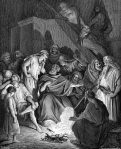
Peter Denying Christ    Simon Peter and another disciple (perhaps John) followed Jesus at a distance (Luke 22:54) into the high priest’s courtyard (John 18:15-16). As Peter entered the courtyard, the girl on duty suspiciously asked, “You are not one of His disciples, are you?” (John 18:17). Her question suggests she expected to receive a negative answer. Peter replied that he was not one of Jesus’ disciples (John 18:17). As Peter warmed himself by a fire (v. 18), another person asked the same question (v. 25). Peter emphatically denied a second time that he was a disciple of Jesus. Finally, a relative of Malchus, the man Peter had injured in the garden (see John 18:10), thought he recognized Peter. Again, Peter strongly denied that he knew Jesus (see Matt. 26:74). At that moment a rooster began to crow (John 18:27) and Jesus “turned and looked straight at Peter” (Luke 22:61).

   Following his failure in the high priest’s courtyard, Peter went out and “wept bitterly” (Luke 22:62) under the cover of darkness. The initial response of some people who experience failure is to withdraw from others. A period of solitude can give those who have experienced failure time to consider the impact and possible consequences of their failure. Withdrawing from others can also give people time to deal with embarrassment and regain their composure before facing others.

   Like Peter, everyone fails sometimes. People fail for several reasons. Some people fail because they lack confidence to stand up for what they know is true and right. Others fail because they ignore or despise the practical instruction that can keep them out of trouble (see Prov. 13:13). Like boastful Peter, some people fail when they are overcome by overconfidence (see Prov. 16:18). Others fail because they lack the strength or resolve to press on. Still others fail because they are overwhelmed by the frequency and intensity of life’s daily demands and trials. No one is immune to failure or out of its reach (see 1 Cor. 10:12).

   Failure can be a jarring and disorienting experience that robs people of their sense of worth and purpose. God however, understands that people fail and stands ready to help them rebound from failure. Someone wisely noted that failure does not consist in falling down but in staying down. Jesus did not let Peter remain a failure (see Luke 22:32). Before He ascended to heaven, Jesus appeared (John 21:14) to some of His disciples (John 21:4) as they fished on the Sea of Galilee (John 21:1-3). Jesus prepared breakfast for his weary disciples who had fished throughout the night (John 21:9,12). On this occasion Jesus asked Peter three searching questions (perhaps a reminder of Peter’s threefold denial) and then restored Peter to his ministry. Jesus’ questions hurt Peter’s pride but helped him realize he was forgiven and could again be useful in building Christ’s Church. Peter’s experience teaches us that failure does not have to be final. Failures can indeed open new opportunities.

   Failure gave Peter the opportunity to evaluate. I once heard someone say that we tend to celebrate in victory and evaluate in defeat. Peter’s failure caused him to remember the words Jesus had spoken to him on the night before the crucifixion (see Matt. 26:75). People who fail need an opportunity to evaluate and sort through the steps that led to their failure. Such evaluation can lead to renewed commitments to avoid the decisions and actions that will lead them to repeat that same failure in the future.

   Failure gave Peter the opportunity to learn lessons he might not have learned in any other way. Failure introduced proud and boastful Peter (see Matt. 26:33) to repentance and humility. Failure also helped Peter become more aware of his own weaknesses and of the need to rely upon God’s strength. Ultimately, failure helped Peter understand more of the meaning of grace and forgiveness. The lessons learned in failure provide mature foundations for new life adventures with God. As Jesus accepted Peter and gave him opportunity to reassert his love for Him, so God will open opportunities for people to move past failure into recommitment to God and His work. People who have experienced failure should look for and be open to these new opportunities.

   Failures can rob people of purpose and, in some cases, of the desire to go on. Peter was not the only person to fail Jesus on the night before the crucifixion. Judas also failed Jesus. Judas however, made failure the end of his life. Peter made failure a new beginning. With God’s help, people who experience failure can make failure a new beginning. Like Peter, we can renew our commitment to work with God and by so doing move beyond failure to become useful in God’s purpose.

You can move beyond failure if you will…

• Get up! Refuse to stay down when you experience failure.
Get real! Don’t sulk. Remember that everyone fails sometimes.
• Get away! Spend time alone with God. Evaluate the reasons for your failure.
• Get rid! Remove habits, actions, or attitudes that will lead you to repeat failure.
• Get help! Ask a trusted friend to hold you accountable.
• Get busy! Roll up your sleeves and get back to work.
• Get serious! Apply the lessons you learn from your failure.

Posted by: Omar C. Garcia | July 16, 2009

Samuel Zwemer

   In the opinion of Christian historian Kenneth Scott Latourette, “No one through all the centuries of Christian missions to the Muslims has deserved better than Dr. Zwemer the designation of Apostle to Islam.”

Samuel--Zwemer   Samuel Zwemer was born on April 12, 1867 in Vriesland, Michigan. He was the thirteenth of fifteen children born to devout Christian parents. Zwemer professed his faith in Christ at the age of seventeen. In 1887, Robert Wilder, a representative of the Student Volunteer Movement, spoke on the campus of Hope College during Zwemer’s senior year. Wilder displayed a map of India with a metronome set in front of it. He emphasized that each time the metronome ticked back and forth, one person in the Indian subcontinent died who had never heard the gospel. Zwemer was so moved by Wilder’s urgent appeal to serve as a missionary that he responded by signing the Student Volunteer Pledge: “I purpose, God willing and desirous, to go to the unoccupied foreign fields.”

   Following his call to ministry, Zwemer prepared for missions service by enrolling in the theological seminary of the Reformed Church in New Brunswick, New Jersey. As a student, he worked to help the poor living in the slums and urged them to embrace Christ. During these years Zwemer developed the habit of reading the Scriptures in a different language every day in order to sharpen his language skills. He also learned as much as he could about medicine and medical treatment, a decision that served him well on the mission field.

   During his first year in seminary, Zwemer befriended a young man named James Cantine. Zwemer said to Cantine, “I propose that you and I offer ourselves to go to some needy field and possibly start a new work.” These young men subsequently decided to go to the most difficult field they could find — Arabia, the homeland of Islam. They approached but were rejected by different missions agencies who told them it was foolish for them to want to go to such a fanatical people. Zwemer later commented, “If God calls you and no board will send you, bore a hole through the board and go anyway.” So, Zwemer and Cantine raised their own support and started the Arabian Mission, which was later adopted by the Reformed Church.

   Zwemer and Cantine served in Basrah in southern Iraq for six years. It was there that Zwemer met and later married Amy Wilkes, a nurse from Australia. Zwemer and his wife later moved to Bahrain, a British-held island in the Persian Gulf. There they offered the people simple medical care, preached the gospel, and distributed Bibles and tracts. Zwemer believed “No agency can penetrate Islam so deeply, abide so persistently, witness so daringly and influence so irresistibly as the printed page.” The only thing that stopped Zwemer from distributing Arabic leaflets and Bibles was confiscation.

   Zwemer remained faithful to his commitment to reach the Muslim world in spite of challenges, threats, dangers, and personal tragedies. In 1892, Zwemer’s brother, Peter, joined him on the mission field but died in 1898. And, he and his wife suffered the loss of two of their daughters to dysentery in 1904. His daughters are buried on the island of Bahrain. The sorrowing parents inscribed these words on their tomb: “Worthy is the Lamb to receive riches.”

   Zwemer loved the Muslim people and was passionate about sharing the gospel with them. He longed to see them gathered to Christ. In the course of his life, Zwemer traveled extensively throughout the Muslim world, authored or co-authored at least forty-eight books and hundreds of tracts on Islam, and became the world’s leading authority on outreach to Muslims.  He was instrumental in awakening, challenging, and mobilizing churches and volunteers to penetrate the Muslim world with the gospel of Jesus Christ. Robert E. Speer, a contemporary of Zwemer and authority on missions, commented that “not many men have lived who had the talent and drive of Samuel Zwemer. During his lifetime he exerted a tremendous influence on the Christian mission to Islam, as well as the worldwide advance of the Church and the Gospel.”

   Zwemer died on April 2, 1952. Ruth A. Tucker, author of “From Jerusalem to Irian Jaya: A Biographical History of Christian Missions,” wrote that Zwemer’s “greatest contribution to missions was that of stirring Christians to the need for evangelism to Muslims.” Zwemer challenged the Western church to embrace the glory of the impossible in the unoccupied fields of the world. Zwemer wrote: “The unoccupied fields, therefore, are a challenge to all whose lives are unoccupied by that which is highest and best; whose lives are occupied only with the weak things or the base things that do not count. There are eyes that have never been illumined by a great vision, minds that have never been gripped by an unselfish thought, hearts that have never thrilled with passion for another’s wrong, and hands that have never grown weary or strong in lifting a great burden. To such the knowledge of these Christless millions in lands yet unoccupied should come like a new call from Macedonia, and a startling vision of God’s will for them.”

   Zwemer’s words are still relevant today. We must heed the Macedonian call to do big and seemingly impossible things for the kingdom of God. “It was the bigness of the task and its difficulty,” wrote Zwemer, “that thrilled the early Church. Its apparent impossibility was its glory, its world-wide character its grandeur.” And, in the words of Bishop Phillips Brooks: “Do not pray for easy lives; pray to be stronger men. Do not pray for tasks equal to your powers; pray for powers equal to your tasks. Then the doing of your work shall be no miracle, but you shall be a miracle.” Will you embrace the challenge and glory of the impossible?

« Newer Posts - Older Posts »

Categories