Posted by: Omar C. Garcia | September 8, 2009

Blogging | Year One

   I officially entered the world of blogging one year ago on this date. However, I entered the world of personal journaling when I became a follower of Jesus Christ a little more than thirty-six years ago. Over those years I have enjoyed recording thoughts, insights, memories, and more. I also have almost fifty travel journals filled with my day to day reflections and experiences, recorded in various locations around the planet. I hope to tell more of those stories in the coming year. While I enjoy using a pen to compose words on a blank page, I must say that I have enjoyed my online blogging experience over the past year. It has not always been easy to find internet access in some of the places I visit. And when I have found internet cafés, tucked away in back alleys or along busy streets, the connections have not always been reliable. But, that’s part of the adventure of posting stories online from locations around the world.

   When I started blogging, I had an idea about the focus of my blog. I wanted to challenge my readers to Go Beyond — to live adventurously for God by stepping across the line that defines the farthest they’ve ever been and the most they’ve ever done for God and His purposes. One year later, my blog has evolved into a combination on-mission travelogue and devotional guide. I have enjoyed the discipline of posting almost every other day. The pressure to post is constant, but that’s ok because it has forced me to think deeply about things in order to communicate effectively and ultimately to live wisely. And, I have enjoyed your encouraging and insightful comments and e-mails regarding my posts. Your feedback has helped me to see and appreciate new facets of a variety of topics.

   One year later I am blessed to look back on 214 posts read by 37,391 guests from all over the world. Many of you are regular readers and some of you are occasional readers. Others have just stumbled onto my blog. Regardless, thank you for reading one or more of my posts this past year. I pray that you have been challenged, inspired, changed, or motivated in some way to Go Beyond — to live as Jesus did, to do more than you have ever done, to see something in a new way, and to make meaningful connections with others. May God bless you as you endeavor to live adventurously for Him. Thanks so much for your readership.

Posted by: Omar C. Garcia | September 5, 2009

Decapitated Pencils

Pencils   The office floor was littered with them. I had no idea what they were until I knelt down to pick them up. And then I knew. The tiny rubber objects were mute evidence that a vandal had been in the room. “Perhaps we should call the police and report the crime and have the tiny things dusted for finger prints,” I thought. “No, perhaps not!” I looked again at the cylindrical objects in my hand and shook my head. “Who would do such a thing?,” I muttered. “It just doesn’t make sense!” Upon further investigation I found additional evidence. There before me were several slender yet-to-be-sharpened Number 2 pencils — without erasers! Someone had entered our office, decapitated our pencils, and littered our floor with the tiny erasers!

   Now, I know that this is not the crime of the century nor is it likely to make the evening news. But it does bother me because pencils and erasers and I go way back. I remember the days when I learned to use one of those jumbo pencils with the jumbo erasers. I used those pencils to write jumbo letters on my Big Chief Tablet. And when I made mistakes, I made jumbo mistakes that could only be corrected with a jumbo eraser. As I got older the pencils got slimmer and the erasers got smaller, but somehow I always managed to make jumbo mistakes. No problem. I always had an eraser handy that was capable of erasing my erratum.

   Over the years I have developed an appreciation for the role of the humble eraser. The business and academic worlds could not function as effectively without erasers. Students would have a difficult time doing homework and taking Algebra without the help of erasers. And lest we think the eraser is obsolete, it is one of the few things in our society that has kept pace with our burgeoning technology. When I bought my first typewriter it came complete with a package of lift-off correction tape. And then in later years my clumsy typing was aided by White-Out Correction Fluid. And my personal computer not only has a delete key, it also allows me to use a spell checker that will correct my mistakes.

   Yes, erasers have played an important role in my life over the years. They have served to remind me that I am a human being with the potential to make mistakes. They have helped me to right countless wrongs. They have given me the opportunity to begin again. They have occupied a place on the ends of my pencils, not to criticize but to serve.

   Erasers also play an important role in my spiritual life. I am thankful that God made provision for the stain of sin to be erased from my life (Hebrews 9:22). I am thankful that God has made provision for me to begin again when my life becomes marked with the wrong things (Psalm 130:1-4). I am thankful that the Christian life comes equipped with an eraser that can handle even my jumbo sins (I John 1:9). So, if you know who the pencil vandal is, tell him or her to stop decapitating our pencils. I make too many mistakes to live life without erasers!

• • • • •

Written July 1991 | San Antonio, Texas

Posted by: Omar C. Garcia | September 3, 2009

Deuteronomy 18

• Laws About True and False Leaders

18:1-8 | These verses address the provision that was to be made by the people for the welfare of those who “stand and serve in the name of the Lord forever” (18:5). Because the tribe of Levi was not given an allotment of land in Canaan (18:1-2), they were to be sustained by the offerings the people made to the Lord (18:3-4). This provision was for both those serving at the central place of worship and away from it (18:6-8).

18:9-14 | Moses knew that the people would face many dangers in the Promised Land. One of the greatest danger was from the occult. Moses warned the people against investigating or participating in any occult practice. The Israelites were a holy people. They had the benefit of God’s words and instruction regarding how to live their lives and how to face the future. They had no need to consult anything or anyone other than God.

God’s people should look to Him for guidance. | Moses cautioned the people to look to God alone for guidance for daily living and hope for the future. They were not to consult other sources (of an occult nature) for guidance. In like manner, we are not to consult horoscopes or anything or anyone other than God and His word for guidance in understanding His will.

18:15-22 | The Israelites had no need for the occult mediums of the Canaanites. God promised to send the people another prophet like Moses to help them understand God’s word and will for their lives. Moses was to become the model or standard by which every future prophet was to be measured (18:15, 18 and 34:10). Moses however, spoke of a future prophet that would be like him. The Jews of Jesus day asked John the Baptist if he was that prophet (John 1:21). John replied that he was not the prophet referred to by Moses (John 1:21). Philip referred to Jesus as the prophet of whom Moses had spoken (John 1:45). Jesus told the Jews that He was the One spoken of by Moses (John 5:46-47). Peter told the crowd at Pentecost that Jesus was that Prophet spoken of by Moses (Acts 3:22-23). Moses also warned that false prophets were to be put to death (18:20). He proposed two tests to determine whether a prophet was speaking on behalf of God (18:21-22). First, the prophet had to speak “in the name of the Lord” (18:22). Second, the prophecy had to come true (18:22).

Posted by: Omar C. Garcia | September 1, 2009

Life’s Value | 4

   I recently saw this message on a bumper sticker: “Caution: I Drive Like You Do.” Two things came to mind as I reflected on this convicting message. First, I wondered how safe our nation’s roads would be if my driving were to become the standard. Second, I quickly thanked God that my driving is not the standard and purposed to become a more courteous driver.

   The bumper sticker started me thinking about people and relationships. What if the bumper sticker had read: “Caution: I Love Others Like You Do”? I wondered what the world would be like if people loved others the way I do. And again, I was reminded of the fact that I need to do a better job of loving, valuing, and caring for others.

   Sometimes we can be as reckless as inconsiderate drivers in our associations with others. That is why God’s Word cautions us against adopting the attitudes that devalue and destroy human beings (Lev. 19:16-18a). Instead, God calls us to live by a higher standard — love your neighbor as yourself (Lev. 19:18b). This simply means to love your neighbor as a person like yourself. Your neighbor is a human being, just like you, who wants to be treated with respect and who longs to be loved and valued. The care and concern you have for yourself are natural human attitudes, and these attitudes should extend to others as well. Jesus illustrated this truth by telling the parable of the Good Samaritan.

   Jesus told the parable of the Good Samaritan in response to a question asked by a Jewish lawyer (Luke 10:25). Jesus responded to the lawyer’s question by asking him to quote the summary of the Law as stated in Deuteronomy 6:5 and Leviticus 19:18b (Luke 10:26). The lawyer answered correctly (Luke 10:27-28). “But wishing to justify himself,” the lawyer  asked Jesus a second question (Luke 10:29) — “And who is my neighbor?” This question betrayed the lawyer’s narrow view of love. He was willing to love his neighbor as himself (Lev. 19:18b) only if he could limit the definition of “neighbor.”

   What about you? How do you define the word neighbor? The lawyer’s definition of neighbor probably was limited to fellow Jews and Jewish proselytes. His definition likely excluded tax collectors, sinners, and Samaritans. Is your definition of neighbor limited only to certain types of people? I will never forget the day I watched the events of 9/11 unfold. Hundreds of volunteers worked in shifts to rescue survivors buried in the rubble and to recover the remains of those killed in this terrorist attack. For a few days, human beings worked to rescue other human beings — regardless of their race, rank, or riches. For a few days, we all broadened our definition of neighbor and America became one big neighborhood. How big is your neighborhood?

   Jesus responded to the lawyer’s second question by relating a shocking story in which a despised Samaritan was the hero. In the story, a man on a journey was brutally attacked by robbers and left for dead (Luke 10:30). A priest traveling the same road saw the man but did not stop to render aid (Luke 10:31). Later, a Levite also saw the beaten man beside the road but, for whatever reason, also went on his way without giving aid (Luke 10:32). Fortunately for the beaten man, a Samaritan traveling down the road had a broader definition of neighbor than did the priest and Levite (Luke 10:33). The Samaritan stopped to assist the beaten man (Luke 10:34) at great personal expense (Luke 10:35). The Samaritan was interested in loving rather than in defining his neighbor. His response illustrates that love is expressed in actions dedicated for the good of others — regardless of who they are.

   At the conclusion of the story Jesus asked the lawyer which of the three proved to be a neighbor to the beaten man (Luke 10:36). The lawyer again responded correctly, although he could not bring himself to utter the word Samaritan (Luke 10:37). Jesus told the lawyer to “Go and do the same.” And, so should we.

Murder Prevention 101
Six questions to ask yourself based on my four posts on Life’s Value.

• Do I believe that human life is a gift from God?
• Do I believe that God alone has the right to number our days?
• Am I willing to allow someone to hold me accountable for my speech?
• Am I willing to allow God to search my heart and to remove any wrong attitudes toward others?
• Am I willing to enlarge my definition of neighbor?
• Am I willing to love my neighbor as myself?

• • • • •

Please take a moment to read Life’s Value | 1, Life’s Value | 2, and Life’s Value | 3.

Posted by: Omar C. Garcia | August 30, 2009

Life’s Value | 3

   Where does the outward act of murder begin? The answer to this question is important because it can help us avoid the path that can lead to murder. According to Leviticus 19:17, the outward act of murder begins in the heart. Jesus affirmed this in the Sermon on the Mount (read Matt. 5:21-22). Jesus helped people understand that wrong attitudes of the heart lead to wrong actions. Anger can and sometimes does lead to the physical act of murder, as in the case of Cain (Gen. 4:6). Anger and hatred also can lead to the character assassination prohibited in Leviticus 19:16. The Mosaic law warned against harboring hate, nursing grudges, and seeking revenge because these attitudes almost inevitably lead to violence.

   When was the last time you took careful inventory of the attitudes in your heart (read Ps. 139:23-24)? Does hate for another reside in your heart (Lev. 19:17a)? Hate is one of the worst tenants you can allow to live in your heart. Hate is an insomniac who will make noise at night and rob you of sleep. Hate is a trouble-maker (see Prov. 10:12) who will try to talk you out of settling differences in a responsible way (Lev. 19:17b). Hate is a pushy tenant who will try to run your life. Hate will not hesitate to bad-mouth some of your best tenants, like love and forgiveness, and insist that you evict them. Can you really afford to make room in your heart for hate?

   Hate does not enjoy living alone (Lev. 19:18a). If you allow hate to have room in your heart it is only a matter of time before the relatives move in. Grudge is among the first to arrive. Interestingly, Grudge has never been allowed to have a room in anyone’s heart without a reference from Hate. Grudge is a bookkeeper who records wrongs and demands payment in full at any cost (read Mark 6:18-28). Can you afford to bear a grudge in your heart?

   Hate and Grudge come from a close-knit family. Wherever they set up house it is only a matter of time before Revenge moves in. Revenge is the most dangerous member of the family. Revenge lives by the simple motto, “I don’t get mad — I get even.” Revenge always returns evil for evil and insult for insult (Rom. 12:17-18). Revenge will pressure you to take matters into your own hands and seek your own form of justice (Rom. 12:19). Revenge will look for opportunities and devise ways for you to injure others. Can you afford to make room in your heart for revenge?

   As long as we live and work with other people there exists the potential for conflicts and disagreements. We must resolve to settle such differences in a timely (Eph. 4:26) and responsible manner (Matt. 18:15). We must take practical steps to insure that wrong attitudes do not take up residence in our hearts. One of the most practical steps we can take is to allow forgiveness to answer the door when hate comes looking for lodging. Forgiveness will tell hate that there is no vacancy. Forgiveness will tell grudge that there is nothing to enter into the account books. And forgiveness will tell revenge that there is no cause for retaliation.

• • • • •

Please take a moment to read Life’s Value | 1, Life’s Value | 2, and Life’s Value | 4.

Posted by: Omar C. Garcia | August 28, 2009

Life’s Value | 2

   Perhaps you have thought, “The sixth commandment (Ex. 20:13) is the easiest to obey. I’ve never killed anyone and certainly don’t intend to.” The Bible however, tells us that there is more than one way to murder a person. Those who would never think of wielding a gun or knife against another are often guilty of murder with a different weapon — their words. We violate the spirit of the sixth commandment every time we murder the reputations or personalities of others with false and malicious words.

   The Mosaic law prohibited people from filing false accusations against their fellow citizens in a court of law (Lev. 19:16a). In addition, the law warned against endangering the life of another (Lev. 19:16b) by giving testimony based on false or inadequate information. A few years ago I grieved with a friend whose twenty-year career came to an abrupt and unexpected halt because of the slanderous speech of another. My friend suffered the humiliation of losing his job and home. Only after the harm was done did the slanderer repent of the lies that damaged my friend’s life and reputation.

   What steps can we take to insure that we do not harm others with our words? One way is to ask a trusted friend to hold us accountable for our words. We can make great strides toward greater verbal accountability by answering this simple question every day, “Have I spoken about anyone in a negative or inappropriate manner today?” This question reminds us of the worth of people and the power of words to hurt them. The question also reminds us of our responsibility to refrain from speech and actions that can harm others. What about you? Who can you ask to hold you accountable for your speech?

• • • • •

Please take a moment to read Life’s Value | 1, Life’s Value | 3, and Life’s Value | 4.

Posted by: Omar C. Garcia | August 26, 2009

Life’s Value | 1

   Murder is all too common in our world. We hear of senseless murders on the evening news. Movies graphically portray violent murders. Television programs present narrated recreations of unsolved murders and make appeals for information that might bring murderers to justice. We shake our heads at stories of drive-by shootings, revenge killings, children killing children, and horrible acts of terrorism. We observe the madness from the relative safety of our living rooms and wonder what the world is coming to. Human life has become devalued as evidenced by such ever-increasing acts of violence, destruction, and terrorism. I recently visited Cambodia’s infamous killing fields — a sobering reminder of what can happen in a society when human life is no longer valued. However, you don’t have to live in a dangerous place to wonder who will be the next victim?

   Murder is nothing new. The first recorded murder is described in Genesis 4. Cain, Adam’s firstborn son, rose up against Abel his brother and killed him. The earth had never before been stained with human blood. Never before had anyone witnessed the awful sight of human death. Never before had parents struggled with questions over the senseless death of a child. Sadly, as the world’s population has increased, so have the number of murders. Throughout history people motivated by anger, jealousy, greed, and hatred have used whatever means at their disposal to take the life of another. Regardless of the motivation however, there is no excuse for murder.

   The sixth commandment prohibits murder (Ex. 20:13). This prohibition is grounded in the assumption that life is sacred. The sanctity of human life is based on the biblical declaration that we are created in God’s image (Gen. 1:26). King David marveled at the thought of his worth and significance in God’s sight (see Ps. 8). He declared that human beings are crowned with “glory and honor” (Ps. 8:5). Because of the sanctity and inherent worth of life, we should cherish and protect this precious gift from God.

   There is more than one Hebrew word to describe the taking of a human life. The Hebrew word translated “murder” in this commandment generally indicated the premeditated taking of another’s life. This prohibition does not apply to all forms of human life-taking, such as the execution of murderers by the state (see Gen. 9:6) or defending one’s home from a thief (Ex. 22:2). However, this prohibition does apply to abortion, being an accessory to murder (see 2 Sam. 12:9), and to the taking of one’s own life.

   The sixth commandment reminds us that God is the source of life and that He alone has the right to number our days. People do not have the right to usurp the prerogative of God to end life. We should do nothing to endanger life through negligence, criminal intent, or other means. Instead, Christ-followers should actively work to protect and preserve life. And that’s exactly what the people of Kingsland Baptist Church are committed to doing. A little more than three-years ago we helped to start a pregnancy help center in Kampala, Uganda in partnership with Life International. Today, more than eight-hundred women have placed their faith in Christ for salvation and over six-hundred abortion-minded women have chosen to keep their babies. In a few weeks I will travel to Cambodia with Kurt Dillinger, President of Life International, to speak on the sanctity of human life. We will also look into opportunities to work together once again in order to start a pregnancy help center in Cambodia.

   One final thought. John Piper recently posted this thought-provoking comment about abortion on Twitter: “Would it bother us more if abortion doctors used guns?” Something to think about!

• • • • •

Please take a moment to read Life’s Value | 2Life’s Value | 3, and Life’s Value | 4.

Posted by: Omar C. Garcia | August 24, 2009

Barnabas of Cambodia

I recently traveled to Cambodia where I had the privilege of working with Barnabas Mam, the Ambassadors for Christ International Regional Director for Asia. Barnabas survived Pol Pot’s killing fields. However, his father and six siblings did not survive. Today, God is using Barnabas to sow seeds of life in Cambodia’s former killing fields. I hope you will take a moment to read this brief interview with Barnabas and that you will pray for Barnabas and those who labor to advance God’s purposes in Cambodia and Asia.

• • • • •
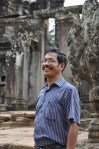
Barnabas MamOmar | Barnabas, you were the seventh of nine children born to a former Buddhist monk in Cambodia. What kind of man was your father and what do you remember most about him?

Barnabas | My father was a very disciplined, very hard working and very entrepreneurial man. He made sure that every evening I had finished my homework and had read a certain text he gave me to read before I said good night to everyone and went to bed. Every morning, he woke me up at 4:00 am to join him in chanting the Buddha’s dharma and then to go with him to the field to collect ripe palm fruit for my mother to make palm cakes so that we could make extra income in addition to the rice harvest. He grew a lot of fruit trees and herbal plants in our back yard. He taught me how to use herbs in traditional healing to help many people in the community.

Omar | As a young man in your twenties, you were a devout Communist indoctrinated to be anti-American and an atheist. How devoted were you to the Communist agenda in Cambodia?

Barnabas | At first I helped my communist mentor write the entire manuscript of his translation of Uncle Tom’s Cabin in the Khmer language. I also joined him in mobilizing students in Phnom Penh to protest or go on strike against the corrupted republican government. I also cautiously shared Marxist literature with some trusted friends in order to promote communist ideology among intellectuals.

Omar | How did a devout and active Communist like you become a follower of Jesus?

Barnabas | I was assigned by my communist mentor to spy on American Christians and Cambodian Christians who were organizing an evangelistic crusade at Chadomuk Convention Center in Phnom Penh in April 1972. I attended their crusade and heard Dr. Stanley Mooneyham of World Vision International preach on the story of “The Prodigal Son.”  It was my first time to realize that I was a lost sinner whom God loved and was longing to see me come back to God’s family. Irrespective of what I had done against God, in His grace and mercy God would not accept me as a servant but as a son. So I confessed my sin, repented and prayed to receive Christ as my personal Lord and Savior at the end of the crusade.

Omar | This news of your conversion to Christianity must have been a shock to your Buddhist parents. How did they respond to the news that you had become a Christian?

Barnabas | My Buddhist parents were not happy at the news of my conversion to Christianity. They thought that I would no longer honor them as my parents because they thought that only the Buddhist children would honor their parents. They came from the country to see me in Phnom Penh and asked whether I would still honor them. I told them I had heard a preacher say that all Christians are to honor their parents. My father who was a Buddhist scribe asked me to prove it from the Scriptures, not just to quote it from a preacher. He somehow did know something that saddened him in Luke 14:26,  “If anyone comes to me and does not hate his own father and mother and wife and children and brothers and sisters, yes, and even his own life, he cannot be my disciple.” I was then a six-week old believer and did not know a lot of Scriptures, but I knew one thing that I could do to find a verse to satisfy my father. I prayed that the Holy Spirit would help me find a verse that encouraged a Christian to honor his parents and I eventually found it in Ephesians 6:1-3, “Children, obey your parents in the Lord, for this is right. “Honor your father and mother (this is the first commandment with a promise), that it may go well with you and that you may live long in the land.” My mum looked at my dad and smiled saying, “As our son still honors us, I have nothing to say against his new faith. Let him be what he wants to be.” Then my dad looked into my eyes and said, “Son, be a good Christian, good son, good brother, good neighbour and good citizen.” 

Omar |You had served as a temple boy at the Buddhist temple in Phnom Penh until the time you became a Christian. How did you get connected with a Christian church in Cambodia?

Barnabas | Right after I gave my life to the Lord in prayer at the end of the crusade, the two ushers who helped me say my prayer asked me for my actual address and then they gave me the address of Bethany Church that was just about a 10-minute walk from the Buddhist temple where I lived. This was the place where I experienced God’s love and the brotherly love shared by Christians.

Omar | Who was the most influential person in your life as a young Christ-follower?

Barnabas | Major Chhirc Taing was the most influential person in my life as a young Christ-follower. Since I had attended my church I heard a lot of good comments and good reports given by missionaries and local believers on account of Chhirc’s life and ministry. Chhirc was a local church leader who had just got back from Scotland. I had never met him before, but I was longing to meet him so that I could build a personal relationship with him. I desired him to be my mentor.

One day, while standing at the entrance of my church, I was greeted by a middle aged man of fair complexion, short stature and smiling face. He asked if I was a believer and I told him I was. He said to me, “Brother, you made the best and greatest decision ever in your life to follow Jesus. I guarantee you that you will never say sorry to this decision.” Since then we became so close in personal relationship.

Chhirc never tried to conceal his emotion when he missed his wife and daughter who were so far away from him in Scotland. Chhirc never spoke bad things of others and he taught me not to think and speak bad things of others as well. Chhirc gave me the opportunity to lead a Sunday school class at my church, then an English class and then the privilege to translate for guest speakers at the annual conference of the Khmer Evangelical Church. Chhirc wisely engaged me in any event where I could activate my Romans 12 ministry gifts.

Chhirch spent a lot of time with me praying for ourselves, our church, our nation and other nations. We spent the entire night of April 16, 1975 together praying for the future of Cambodia. And the next morning, the Khmer Rouge victoriously marched the streets of Phnom Penh and declared their Democratic Kampuchea regime. Chhirch kissed me good-bye and gave me his last instruction based on Romans 13:1, “Let every person be subject to the governing authorities. For there is no authority except from God, and those that exist have been instituted by God.” I never saw Chhirc again since then.

Omar | You were in Phnom Penh when the Khmer Rouge seized the city on April 17, 1975. What was that day like?

Barnabas | I was in my office when young and ferocious Khmer Rouge soldiers came in on April 17, 1975. It was a gloomy day that brought forth death, arrest, family separation and massive devastation. It was a day of contradiction. They drove us out of the city but they said they had liberated us. They wanted to get rid of us but they said that the US Army would bomb the city shortly. They told us to stay away from Phnom Penh for a short while but that short while lasted almost four years. They told us that the Angkar (the Khmer Rouge administration) would supply all our needs, but they banned all the schools, shops, banks, offices and hospitals and let the people die of untreated and uncured sicknesses and starvation. It was not a well-planned evacuation and the people were not well prepared for the very hard trial and forced labor that would follow.

Omar | When were you first arrested by the Khmer Rouge and where did they send you?

Barnabas | After having left Phnom Penh, I wandered around outside the city for many days with a little hope that I would find some of my relatives, but I found none of them. Some of my Christian friends that I had come across asked me to join their company but I said no thank you to all of them. Finally I met my girl friend and her family in a village about fifty miles east of Phnom Penh. I planned to live there with them, but a kind Khmer Rouge commander suggested that it would be safer for me to go farther to a place where no one would know my background and stay there as long as I could. I joined her family going upstream in a big boat for a few days and walked quite a distance to the Vietnam border. One day after I arrived in a village near the border, I was arrested and sent to a detention camp where I was forced to hard labor and brainwashing.

Omar | How long were you imprisoned and what dangers did you face?

Barnabas | I was in three Khmer Rouge prisons near the Vietnam border for almost two years. I was forced to hard labor in the fields from dawn to dusk. I needed to work as hard as the Khmer Rouge did. After dinner, I was interrogated twice a week to give good comments on the current situation and to give a self-assessment regarding my fidelity to the Angkar in thoughts , speech and deeds. I was not encouraged to speak any foreign language because it was believed that it belonged to the enemy of the revolution. I was not allowed to speak of my past life for fear of defaming the revolution. I was not allowed to read any books for fear of being indoctrinated by the enemy’s concept. I was not allowed to write any paper for fear of communicating the facts about the revolution with the CIA. I could take a bath in the stream only when the Khmer Rouge guards brought the prisoners there. I could go to the latrine (open restroom) only after I sought approval from the Khmer Rouge officer of the day. As there was no medicine available, I needed to take wild herbs and traditional therapy for the cure of all my diseases.

Omar | What did you do after your release?

Barnabas | I was first released from the Khmer Rouge prison in July 1977. As the Communist leaders in the Eastern Region stood against Pol Pot and many of them fled Cambodia and took refuge in Vietnam, the population of the region was also suspiciously doubted by the government regarding their fidelity. Together with many thousands of people and cadres from the East, I was re-evacuated by boat and by train to Svay Don Keo in northeastern Cambodia. I faced a more tragic life there. I saw a lot of people slaughtered and thrown into mass graves. Phnom Penh was liberated from the Khmer Rouge regime on January 7, 1979, but as for us, we were released a month later. My relationship with my girlfriend broke apart right after the killing fields. I met Boury, a widow with six children, in 1980. Her husband was killed by the Khmer Rouge during the killing fields. After we were married, we joined an underground church in Phnom Penh until 1985.   

Omar | In January 1985, you fled Cambodia to a refugee camp in Thailand. How did God use you there?

Barnabas | In 1985, Boury and I took three of our daughters with us to flee Cambodia to a refugee camp in Thailand. We were arrested in Thailand as illegal migrants and we were transferred to Site Two Camp via three holding centers. I was sick most of the time. Due to Boury’s background as a nurse, she did very well in looking after me. Even though I could not sit properly I managed to write many songs and translate many books for the Picture Bible by laying on my belly on the bed. A spiritual leader from YWAM joined my family in prayer every afternoon. We prayed as a family at 4:00 PM every afternoon to seek God’s guidance, provision and protection.  Every morning I prayed for the same things with young leaders I had discipled. The Lord gave me a new song every morning for three months. I wrote them all and taught them all to those young leaders. Then I joined Campus Crusade for Christ in 1989. My team and I were very much involved in prayer mobilization and preaching the Word. Then we experienced the outpouring of the Holy Spirit upon his Church in the camp. As a result, fifteen churches were planted all over the camp and an English school was built next to each church with funds granted by a Catholic humanitarian organization established in Thailand to help the refugees in relief, emergency, and education.

Omar | Planting churches and training leaders is a passion of yours. How are you involved in church planting initiatives today?

Barnabas | The fire stops existing when there is no burning. The church stops existing when there is no evangelism. The church stops growing when the focus on church planting is no longer there. I mean the Great Commission church not just any ordinary church. I joined Ambassadors for Christ International in 2001 after my having led a proven ministry as founding and senior pastor of Living Hope in Christ Church in Phnom Penh with 40 satellite churches nationwide. The why behind the what of what AFCI is doing is all about teams of nationals accelerating the spread of the gospel through the local churches worldwide. Since I joined this organization I developed my own materials on discipleship and church planting to train local church planters, disciple-makers and pastors. So far more than three hundred churches have been planted all over Cambodia and in Southern Vietnam among the Khmer speaking people. 

Omar | What are other ways in which you have helped support the work of ministry in Cambodia?

Barnabas | I have helped support the work of ministry in Cambodia through my governance gift and skill and song writing gift and skill. I served as vice-chairman of the board of Evangelical Fellowship of Cambodia (1996-2006) to promote unity and synergy among the evangelical Christians. I have served as chairman of the board of the Bible Society in Cambodia (2001 to date) to promote the translation, the publication and the distribution of the Bible in Khmer Language and other major tribal languages.  I have served as member of the board of the Cambodia Community Bible Institute (2004 to date) to train Christian workers in the community by providing my recorded teaching on mega-voice and training manuals. I have served on the advisory council of World Vision Cambodia (2004 to date) to promote the rights and the protection of children at risk. I have served as chairman of the Strategy Committee of Mission Kampuchea 2021 to help the local church plant a church in every village in Cambodia by the year 2021. I have visited prisons to preach the gospel to and make disciples of the prisoners. I also have engaged my team in community development projects such as water-well drilling, water filter and livestock and education projects such as scholarship for poor children and poor young people to finish their education at good school.

Omar | What is your vision for the future of God’s work in Cambodia?

Barnabas | My vision for the future of God’s work in Cambodia is that God’s name will be glorified as His church is strong in unity and purpose to bring transformation to individual’s life, community, education, justice and economy through praying with God’s passion, the preaching of God’s grace, and the caring with God’s love.

Posted by: Omar C. Garcia | August 22, 2009

Honoring Parents | 3

   This is the third of three posts on the topic of honoring parents.

   Paul emphasized that honor is a two-way street. A two-way street means that traffic flows in two directions. In order for parents and children to avoid head-on collisions they must learn to heed the signs of the road. Paul posted a road sign to help children travel in the right direction and stay in their respective lane: “Children obey your parents” (Ephesians 6:1). The word “obey” means to listen attentively and respond positively.

   Children should obey their parents “in the Lord” or as a Christian should. Children should also obey their parents because “this is right.” Obeying parents is the right thing to do because it is in line with God’s will. In a parallel passage Paul said, “Children, obey your parents in everything, for this pleases the Lord” (Col. 3:20). The only exception to that obedience is in the matter of doing anything that is clearly against the teaching of Scripture.

   Paul cited the fifth commandment (Eph. 6:2) to emphasize that obedience is one of the basic elements of honoring parents. We honor our parents when we give weight or consideration to their words. We dishonor our parents when we treat their instruction lightly or blow it off. Paul noted two benefits of obeying and honoring parents (Eph. 6:3). The first benefit relates to the quality of life — “that it may go well with you.” I can certainly testify to the fact that things at home went well for me when I obeyed my parents. And, as a child I also learned that one minute of disobedience could get me hours of trouble. The second benefit relates to the quantity of life — “that you may enjoy long life on the earth.” This promise does not imply that those who have died young dishonored their parents. The general principle is that children who listen to their parents can avoid the sin and dangers that can easily shorten their lives.

   Paul posted a couple of road signs for parents as well (Eph. 6:4). The first sign warns parents to not “exasperate” their children. To “exasperate” means to provoke or irritate to the point of anger. What are some ways in which parents swerve out of their lane and exasperate children? Some parents exasperate their children by always saying one thing and doing another. Inconsistent and unfair discipline can also exasperate children. As one parent said, “You shouldn’t use a cannon ball to kill a fly.” Showing favoritism is another common cause of provoking children to anger. Humiliation, cruelty, and verbal and physical abuse can certainly exasperate children. When children are exasperated they become discouraged (see Col. 3:21) and frustrated.

   The second road sign encourages parents to educate rather than exasperate their children. The phrase “bring them up” (Eph. 6:4) means to nourish or feed. Children need more than physical food, shelter, and clothing. They also need emotional and spiritual nourishment. Parents can provide such nourishment to their children through fair and consistent training or “discipline.” Children also need nourishing “instruction.” The Book of Proverbs is a good source for parents who want to share wise counsel with their children. The phrase “of the Lord” reminds parents to offer training and instruction that is in keeping with God’s Word. If you want to raise a good driver then follow the manual, heed the road signs, and set a good example. And remember, honor is a two-way street.

• • • • •

Please take a moment to read Honoring Parents |1 and Honoring Parents | 2.

Posted by: Omar C. Garcia | August 20, 2009

Honoring Parents | 2

   This is the second of three posts on the topic of honoring parents.

   Jesus gives us additional insight into what it means to honor our parents through an encounter He had with the religious leaders of His day (read Mark 7:9-13). Some Pharisees and teachers of the law (scribes) confronted Jesus and accused the disciples of eating food with unwashed hands (Mark 7:5). The issue was not one of personal hygiene. The religious leaders, who were always looking for an opportunity to discredit Jesus, were upset because the disciples had not observed the “tradition of the elders” concerning “ceremonial washing” (Mark 7:3). The tradition of the elders consisted of hundreds of detailed rules and regulations concerning how to obey the law (see Mark 7:4). These meticulous rules, passed on from generation to generation, were burdensome to the people (see Matt. 23:4).

   The encounter of the religious leaders with Jesus turned out to be more than they bargained for. Jesus exposed the hypocrisy of the Pharisees and scribes (Mark 7:6-7) by pointing out that they had violated something much more important than tradition (Mark 7:8). Jesus accused the religious leaders of considering the traditions of the elders as more important than God’s Word itself (Mark 7:9). Jesus used the fifth commandment — “Honor your father and your mother.” — as a case in point (Mark 7:10).

   Instead of honoring their parents as commanded by God, the religious leaders used tradition to violate the fifth commandment (Exodus 20:12) and not feel guilty. They avoided using any personal wealth to assist their parents by declaring it “Corban” or dedicated to God (Mark 7:11). Once dedicated to God, these resources could no longer be used to help their parents (Mark 7:12). The religious leaders thus justified their neglect of needy parents by invoking tradition to shelter their money. Moreover, those who shouted “Corban” continued to personally benefit from their wealth until death. Upon death the temple would then receive the remainder of their wealth. Through reprehensible actions such as these, the hypocritical religious leaders had invalidated the word of God (Mark 7:13).

   The encounter recorded by Mark teaches us that the honor of parents encompasses giving weight or consideration to their welfare. As our parents grow older we must not take lightly their interests and special needs. Instead, we should look for opportunities to make their advancing years meaningful and happy (Phil. 2:3-4). I appreciate the example set by my parents in caring for their parents. Through the years I watched my Mom and Dad lovingly and cheerfully give of their time and resources to care for my grandparents. On many occasions my parents had to rearrange their priorities in order to meet the needs of my grandparents, but they did so with much joy.

   What are some practical ways in which we can lovingly honor aging parents? We can honor aging parents by helping to meet their basic necessities (read 1 Timothy 5:4, 8). Do they have adequate housing, clothing, and medical care? Do they need assistance with transportation or with routine household responsibilities? Providing financial assistance however, is not enough. Our parents need our emotional support as well. We can honor aging parents and provide emotional support by affirming their worth. We can let our parents know that we value them by including them in family activities during holidays, birthdays, and the ordinary everydays. Sometimes a simple act of kindness, a warm embrace, or a note of appreciation can do so much to enrich the lives of our aging parents.

   We must take advantage of every opportunity to love and honor our parents because one day we will no longer have opportunities to do so. So, seize the day and don’t neglect to honor your father and mother.

• • • • •

Please take a moment to read Honoring Parents |1 and Honoring Parents | 3.

« Newer Posts - Older Posts »

Categories