Posted by: Omar C. Garcia | September 23, 2009

Nunca Mas

   Thirty years ago the Tuol Sleng Genocide Museum in Phnom Penh was called S-21, or Security Office 21. Originally built as a school, Pol Pot’s Khmer Rouge took over the campus in 1975 and turned this place of learning into a place of unspeakable torture and death. Classrooms were subdivided into cells. Playground equipment was converted into instruments of torture. And, teachers were replaced by Pol Pot’s cadre whose pop quizzes were impossible to pass and were ultimately rewarded with various forms of torture.

   Today, the photos on display in the former classrooms of S-21 are of the thousands who were detained and tortured there. The graduation ceremony for S-21’s unfortunate alumni was held at the nearby killing fields. No caps and gowns, just a blindfold followed by a blunt blow to the back of the head and burial in a mass grave. It’s impossible to walk through S-21 without feeling a mixture of sorrow and anger. I was gripped by the same indignation I felt when I first visited this terrible place just one month ago.

Nunca Mas   As I walked up the steps to the second floor of Building B, I noticed something I had not seen on my first visit here last month. Sometime in the weeks between my visits, a Spanish-speaking visitor had scratched two words into the stairwell wall – Nunca Mas. These words simply mean “Never More” or “Never Again.” I paused and solemnly whispered, “Amen. May what happened at S-21 never happen again!” Today, S-21 stands as a testimony to the logical outcome of a worldview with an impoverished understanding of the sanctity of human life, a worldview that refused to acknowledge the existence of God.

   On Tuesday, our team met with over two-hundred pastors and church leaders for the first of three days of intensive training on the sanctity of human life and related issues. Team leader Kurt Dillinger addressed the sanctity of human life. Team member Matt Zainea addressed the topic of battling worldviews – Biblical versus Humanistic. I listened to these men speak — while images of S-21 and the Choeung Ek killing field were still fresh on my mind. I am convinced that a Biblical worldview is critical to the future of Cambodia. This country’s new killing fields are the dark places where babies are aborted and the hotel rooms where the innocence of young women dies every hour of the day. What will it take to scribe “Nunca Mas” on the walls of these places?

   Earlier today, Wednesday, I addressed the subject of Biblical Sexuality and Sexually Transmitted Infections. My new friend John Tabor spoke about pregnancy and reproduction. Tomorrow, we will address abortion, post-abortion issues, and forgiveness and healing. I am encouraged by the responses of the men and women in attendance. They have come from provinces throughout Cambodia. These men and women are committed to life and to working together to end the practices that harm the defenseless and exploit the weak and vulnerable. They are committed to working toward the day when the words “Nunca Mas” will be written across walls in places where the innocent and innocence dies every day.

Posted by: Omar C. Garcia | September 21, 2009

A Vengeance of Love

Steve Hyde, Director of Asia for Jesus, is our host and guide in Cambodia. He is a big man with a gentle disposition. Steve is married to a Cambodian woman named Noit. They have two very beautiful kids. But, beyond the surface of things lies an amazing story. Steve and Noit have more in common than their love for God and commitment to Jesus Christ. They both have suffered the loss of loved ones as a result of acts of cruelty, hatred, and violence.

Noit’s entire family died at the hands of the Khmer Rouge. She was eleven years-old when the Khmer Rouge marched into Phnom Penh in 1975 and forced the entire population of the city to evacuate. Her father was a school teacher and was executed. The rest of her family died over the next two years. She alone survived. Steve told us this story in greater detail as we stood in the shadow of the Memorial Stupa that houses more than 8,000 human skulls at the Choeung Ek Genocidal Center located south of Phnom Penh. And, Steve told us this story through his tears. Although he never had the opportunity to know his wife’s family, he feels their loss very deeply.

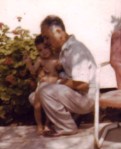
Steve Hyde and Dad

Steve’s father, Bill Hyde, was martyred on March 4, 2003. Bill was also a big man with a big vision for reaching the people of the Philippines with the gospel of Jesus Christ. Bill and his wife Lyn served as Southern Baptist missionaries in Davao City on the southern island of Mindanao. They effectively trained national Christians to plant churches in remote Muslim villages. Over their years of service among Muslims, Bill received many death threats. However, these threats did not deter him from traveling to and working in some of the most dangerous places in the Philippines.

On March 4, Bill went to the small airport outside of Davao City to pick up fellow missionaries who were returning from Manila. While at the airport, members of one of Mindanao’s Muslim rebel groups detonated a bomb hidden in an unattended bag. The explosion injured more than one hundred fifty Filipinos and killed twenty-one people – including Bill Hyde.

When Steve received word about the bombing and that his father was barely clinging to life at Davao Doctors Hospital, he arranged to fly to Mindanao. En route, sensing that his Dad had died, he unmistakably heard God’s gentle voice telling him to avenge his father’s death with love. Later, at his father’s funeral service in Iowa, Steve said: “I will avenge my father’s death. Not by killing or violence. I’ll go into this dark world and shine the light of Jesus into dark places.”

In the years since his father’s death, Steve continues to train indigenous Christians to reach their own people with the gospel of Jesus Christ. And, the men who came to Christ under his father’s ministry have planted hundreds of churches with almost 10,000 believers. Jerry Rankin, President of the International Mission Board, said: “Reaching all peoples for Christ will not be accomplished without the blood of the martyrs.” He is right. And, no act of terror will halt the advance of the gospel. The blood of the martyrs is indeed the seed of the church.

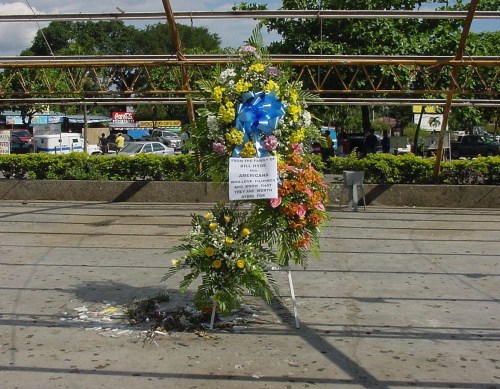
Steve Hyde Wreath

After his father’s death, Steve and his family placed a wreath at the site of the explosion that claimed the life of Bill Hyde. The banner on the wreath said: “From the Bill Hyde family and Americans who love Filipinos and know they are worth dying for.” Lyn, Steve’s mom, continues to serve and prays that her ministry might one day send Filipinos to reach those who killed her husband — and train them how to give life, not take it.

Posted by: Omar C. Garcia | September 20, 2009

Empty Streets

   As we made our final approach to Phnom Penh, I looked out the window at the lush green patchwork below. The tall palm trees looked like thumb tacks — randomly placed to keep the wind from blowing away the variegated green carpet. Cambodia really is a beautiful country and I am happy to be back for my second visit. We descended quickly, bounced hard onto the tarmac, and rolled our way to the terminal. Once inside, I secured my visa and then made my way to the luggage carousel. I’m always happy to reunite with my luggage.

   Once outside the terminal we met Steve Hyde, the Director of Asia for Jesus and our host. Steve is a big man with a big heart for Cambodia. He grew up the son of missionaries in the Philippines and received his education in Texas. He first came to Cambodia as a Journeyman with the International Mission Board in 1994. That’s when he learned the Khmer language – not an easy task when you consider the alphabet has forty-eight vowels and thirty-five consonants. Each of the consonants has two different sounds. And, then there are the irregular vowels and consonants and a cryptic few of each that apply only to some select words. It’s all very confusing and challenging. But, Steve learned the language quickly and speaks it fluently.

   What I found a bit strange as we made our way from the airport to our hotel was the relatively few vehicles and people on the streets. I was here just a month ago and remember the chaotic choreography of cars, motorcycles, and pedestrians. But today, the streets seemed empty by comparison. And, very few shops were open for business. I wondered if this is what Phnom Penh must have looked like after the Khmer Rouge invaded and evacuated the city in the mid-70’s.

   Steve cleared up the mystery of the empty streets. Today is a Buddhist holiday, locally called Bon Bpchun Ben. This is a day when people pray for their dead ancestors whose spirits may not be at peace. The people fear these restless spirits and believe that they capriciously cause accidents and all kinds of bad stuff to happen. So, it’s incumbent upon the living to pray for these spirits to be at peace. In order for this to happen, family members are required to pray at seven Buddhist temples. They also pay the monks at these temples to perform special chants on behalf of their restless ancestors.

   So today, the streets of Cambodia are empty. And, I am reminded that the hearts of so many Cambodians are also empty, filled with frustration and longing for answers to life’s most important questions. A distinctive of our Christian worldview is the understanding that we can know where we will spend eternity before we step across the threshold that separates the living from the dead. And, because of that understanding, we do not “grieve like the rest of men, who have no hope” (1 Thess. 4:13). Tomorrow, the streets of Phnom Penh will again throb with bustling humanity, many of whom will wonder if their prayers had any impact on their restless ancestors. I am thankful for guys like Steve who have planted their lives in difficult places like this in order to help the restless souls of the living find peace in Jesus.

Posted by: Omar C. Garcia | September 19, 2009

Chasing Rickshaws

   I am at Incheon International Airport in Seoul, Korea, having just completed two of my four flights to Cambodia. I am traveling alone to meet Kurt Dillinger, the President of Life International, in Singapore. We will meet other friends and a film crew there, and then we’ll fly to Phnom Penh where we will spend several days speaking to national pastors about the sanctity of human life and other related topics. Then we’ll make our way across the country to look at land that has been donated for a pregnancy help center and orphanage. It will take us a full day to drive to the location for the proposed new center and a full day to drive back to Phnom Penh. And then, back on a plane for the long journey home. I will enjoy four restful days at home and then off to Uganda.

   People often ask me if I still enjoy flying, how many frequent flyer miles I have, if I have ever flown first class, and lots of other questions about my travel. My answers are always the same. The thing I enjoy most about flying is meeting people from all over the world. An airplane is a great place to engage the nations. I do have lots of frequent flyer miles on too many airlines. And sometimes, because I purchase really cheap tickets from my consolidator, I am not eligible for frequent flyer miles. I have never flown first class and don’t intend to – that’s a matter of stewardship. Those seats are just too expensive. However, that does not mean that I have not looked enviably at a first or business class seat.

   On this flight across the Pacific, I started thinking about the different forms of transportation I have taken as I have traveled the world. You can’t get from here to there unless you use some form of transportation. So, here is a quick summary of the various forms of transportation I have used in order to get to the other end of the Great Commission.

   Airplanes | Airplanes are the primary way to get from home to anywhere on the planet. I fly on lots of really big planes and occasionally on small planes. I have flown on planes I thought would never get off the ground and on planes that never should have left the ground. I have had more than my share of scary moments in the air.

   Trains | I have been fascinated by trains ever since my Mom and Dad gave me a model train set for Christmas when I was a kid. I have traveled by train across the Gobi Desert, through the Andes Mountains in Peru, and across vast stretches of Ukraine, Bangladesh, and Mexico. Like airplanes, trains are a great place to meet and talk with people.

   Automobiles | I have traveled by taxi cabs in urban areas and wedged myself in to public buses crammed with humanity, animals, and overstuffed-bundles. I have bounced across the African bush in Range Rovers, crossed the frozen steppes of northern Mongolia in an old Russian jeep, nervously inched my way through the foothills of the Himalayas in a vehicle almost the width of the narrow mountain road, and once hired an old bus about to fall off its frame to take my weary team across Bangladesh. All this and more just to reach Macedonians crying out for help (Acts 16:9).

   Boats | I have spent days on a boat on the Brahmaputra River in Bangladesh in order to reach remote Muslim villages – and was robbed along the way. I have taken an old ship across the Bay of Bengal to visit people on a remote island who had not heard about Jesus. I once hired a motor boat to escape another interrogation by local officials in South Asia. That didn’t work — but that’s a story for another blog! I have traveled by ferry boats up and down the Padma River in Bangladesh and reclined on shikara boats in Kashmir.

   Rickshaws | I have profound respect for Asia’s hardworking rickshaw wallas. These guys are scrawny but muscular and can navigate with ease through the most crowded streets. Our missions ministry currently supports an initiative in New Delhi to reach 100,000 rickshaw drivers with the gospel of Jesus Christ by using a creative Bible-storying comic-book. When traveling in Asia, I look for every opportunity to ride rickshaws and to minister to the hard-working guys that power them.

   Horses | On occasion, I have found myself in situations where a horse was the best option for getting from point A to point B. I remember riding a horse across a frozen Mongolian lake in late winter in order to reach the Reindeer (Tsaatan) people. I don’t think I have ever been as cold. At the end of the day I took my boots off and put my frozen feet near the fire. My feet were so cold and I put my feet so close to the fire that I failed to notice that my thermal socks were melting.

   Walking | Finally, I have been in places where walking was the only option. In Pakistan, my friend Lee Pullin and I hiked to a mountain village at the insistence of a man who refused to take no for an answer. It was a month after the 2005 earthquake had claimed almost 80,000 lives. When we finally arrived at his village he took us to the rubble where his home had once stood. He pointed out the place where he and his small son had been buried. And then he asked us to tell the world about what had happened there. He was sure the world had not yet heard because no one had come to help.

   I will arrive in Cambodia at 8:55 AM on Sunday morning. Traveling to far-away places is long, hard, and often challenging and inconvenient. But, that’s ok. Regardless of how we get from where we are to the other end of the Great Commission, we need to get there. The people living in difficult and far-away places deserve an opportunity to hear the good news. So, I hope you will join me in chasing rickshaws – in other words, in venturing to the places where people are still waiting to hear the good news about Jesus Christ.

Posted by: Omar C. Garcia | September 18, 2009

Deuteronomy 19–20

• Laws Relating to Crimes

19:1-10 | Regarding justice for the one who unintentionally killed another. Upon entering Canaan the Israelites were to set aside three cities to serve as sanctuaries (19:1-2, 7-9) for those who had unintentionally killed another (19:3-6). These cities of refuge would serve as a haven for an unintentional killer so that his blood would not be shed by one seeking to avenge the death (19:10).

19:11-13 | Regarding justice for the one who deliberately killed another. In such cases the elders of the city in which the slain individual lived could have the killer extradited and handed over to “the avenger of blood, that he may die” (19:12).

19:14 | This is a one-sentence law prohibiting the removal of a “neighbor’s boundary mark.”

19:15-21 | Regarding witnesses in judicial proceedings. Provision was made for sufficient witnesses to corroborate a crime (19:15) and for malicious witnesses to be punished for their attempt to subvert justice (19:16-20). Deuteronomy 19:21 deals with the law of retribution (see also Exodus 21:23-25 and Leviticus 24:17-22). Read Jesus’ words on this issue in Matthew 5:38-42.

• Laws about War

20:1-4 | These verses deal with the matter of spiritual preparation for battle. Moses understood that people going into battle must first win the battle against fear in their own hearts and minds. Moses instructed the people that before going into battle against enemies whose numbers and military might were greater than their own (20:1), the priests were to speak to the warriors (20:2) and remind them not to be afraid for three reasons (20:4).

First, “the Lord your God is the one who goes with you.” The priests were to assure the warriors of the Lord’s presence with them in battle. God never intended for them to face their battles without Him.

Second, the Lord will “fight for you against your enemies.” The priests were to remind the warriors of the participation of the Lord with them in battle. While their enemies might have superior numbers and superior provisions of horses and chariots, the Israelites had the omnipotent God fighting with them.

Third, the Lord will “save you.” The priests were to remind the warriors of the Lord’s power to protect them and give them victory in battle. The Israelites needed the Lord in battle. John Maxwell comments, “God never makes us so strong that we no longer need Him. Never.”

Refer to my notes on Deuteronomy 7:17-26 for more information on preparation for battle.

God’s presence can give us the confidence to face life’s battles. | Before going into battle, Israel’s soldiers were to be reminded that God would not only be with them but would also fight with and protect them. This knowledge gave Israel’s soldiers confidence in going into battle. We too, can be assured that God is not only present with us but will also fight with us as we face life’s battles.

20:5-9 | The officers were instructed to make certain (20:5a) that the men going into battle were not only qualified, but not subject to being distracted by personal matters (20:5b-7). Certain exemptions were granted to men who had not yet had the privilege of enjoying certain undertakings. These were allowed to return home. They were to complete their undertakings and so contribute to the stability of the land. Fearful men were exempted from going into battle because they might have a demoralizing influence on their fellow soldiers (20:8).

Read Judges 7 regarding the reduction of Gideon’s army from thirty-two thousand men to three hundred. John Maxwell noted, “Gideon and all of Israel learned that God counts hearts, not heads, when He wants a great work accomplished.”

20:10-20 | These verses address the matter of military strategy. In cases where the Israelites were engaged in battles outside the borders of Canaan (20:15), they were to offer terms of peace to the inhabitants of the city (20:10). If the peace offer were accepted then the inhabitants were to become servants of the Israelites (20:11). If the peace offer were denied then the men of the city were to be executed (20:12-13) but the women and children spared (20:14).

In the case where the Israelites were fighting against cities within Canaan, absolutely no one was to be spared (20:16-17) lest any survivors lead the Israelites spiritually astray (20:18). Deuteronomy 20:19-20 give instructions regarding the use of trees in a siege. Fruit trees were to be spared (20:19) while non fruit-bearing trees could be used to make implements of war (20:20).

Posted by: Omar C. Garcia | September 17, 2009

A Shoe Box Full of Hugs

   I think everybody has a box nestled away in a corner of some closet, a sort of coffin for forgotten photos. On the last day of one of my annual visits with my folks, Mom produced just such a box out of the dark recesses of a closet. It was a shoe-box full of old pictures that never made it into the family photo albums for whatever reason. I have no idea how long this treasure box lay buried under comforters and sheets, but there it was, out of the closet and on the kitchen table. Seated around the table were the two individuals that must be present at such events, individuals capable of identifying the contents and trained in carbon-dating such artifacts, Mom and Dad! As we lifted the lid off the box that once contained a pair of black wing-tips, we were not disappointed to find what seemed like hundreds of glossy black and white photos, the old-timey kind with the serrated edges.

With my Grandad   What a find and what an experience — matching photos with memories and memories with photos. Even pictures of my grandparents when they were my age! And lots of baby pictures that were filed away to be placed in photo albums at some future date that never arrived. One of the things that impressed me the most was all the hugs, squeezes, and cuddles that were captured on film — real moments of warmth and intimacy preserved on a vulnerable sheet of glossy paper. And then I found it. A picture of my grandfather with his arms wrapped around two-year old me! On the back was my grandfather’s handwriting and the date, May 1958. Warm tears filled my eyes. That one picture opened a flood gate of emotion as I thought about my never-too-tired-or-embarrased-to-hug-and-kiss-me grandfather. I wanted to step into the picture and just feel his warm embrace one more time.
   I brought that picture home with me, along with several others, and determined that such valuable treasure would never again be buried and forgotten in an unmarked corner of a closet. I measured them carefully and then set about finding the frames that would hug and protect and keep them before me as reminders of my good fortune as a child. And so now they are displayed around our home, these photos of hugs gone by. And I have excavated the site where my wife and I have buried our hundreds of photographs of birthdays, anniversaries, holidays, and everydays. And I have selected photos of hugs and smiles and laughter and kisses and placed that generation of photos beside the old black and white glossies. I am more determined than ever to preserve these moments from the past to remind me of the opportunities of the present — opportunities to hug and kiss and laugh and enjoy the people who mean the most to me. And I am also determined to keep film in the camera at all times to record and preserve such moments for the next generation. A future generation that will one day look through old shoe-boxes full of hugs, buried under comforters and sheets in a forgotten corner of a closet, waiting to be discovered and appreciated and put on display. Proverbs 13:22a records “A good man leaves an inheritance to his children’s children.” Don’t neglect leaving a treasure box full of hugs!

• • • • •

Written May 1991 | San Antonio, Texas
Published in Home Life magazine | August 1995
Published in The Plus Years magazine | 1999

Posted by: Omar C. Garcia | September 15, 2009

Message on the Barn

   There is an old barn located outside of the town of Castroville. It’s hard to miss because it faces State Highway 90. I’ve driven by it dozens of times on my way to and from the Texas Hill Country. It has become one of my favorite landmarks. The old weathered barn has a message painted across its wide double-doors in large unevenly spaced letters: IT’S A GIRL! I smile every time I drive past the old barn. It stands as something of a monument commemorating a time of overflowing joy. It is obvious that the faded message was painted on the barn doors many years ago. In fact, it would not surprise me to discover that the girl is now a woman with kids of her own! But I’m glad that the daddy, whose joy found expression in a bucket of paint, left the message on the barn. It’s only right that such a message should remain and continue to inspire wonder and smiles. I wish that more of the old barns on life’s roads were as inspiring as the old barn outside of Castroville.

   There is another message that I find warm and inspiring. It is an illegible message scrawled in various colors of crayons on the walls of my garage. Soon after we moved into our home, I bought a couple of gallons of white paint and set about painting the interior walls of our garage. After painting the walls I carefully put up sheets of peg-board, also painted white, to hold my assortment of garden tools, hammers, and other garage-stuff. Upon completion of the project I left town for a week-long speaking engagement. During the week I called home to check on my wife, two year old daughter, and one year old son. That’s when I was informed that our daughter had made her way into the garage with a box of crayons and used my newly painted walls as a canvas for her artistic expressions. Interestingly, she scribbled circles of various colors all the way around the garage, even on the inside of the garage door! I didn’t get upset, I just laughed and smiled and felt good about being a daddy. After all, I still had enough paint to cover my daughter’s first mural. But when I got home and saw her work, something told me to leave it alone. And so I did. And I’m glad. And on occasion when I’m piddling around in the garage or doing yard work, the crayon-colored circles catch my eye and I remember and smile and feel good about being a daddy.

   As parents, it’s easy to get caught up in the struggle to cover all evidence that we have children or that children once actively resided in our homes. That’s understandable. But don’t cover all the evidence. Let the scratch on the coffee table or the crayon masterpiece scribbled in one of your favorite books or the message on the barn doors survive. Leave some signs to remind you that “children are a gift of the Lord” (Psalm 127:3a) and that your home is or was once-upon-a-time blessed by the presence of children.

• • • • •

Written May 1991 | San Antonio, Texas
Published in Home Life magazine | August 1993

Posted by: Omar C. Garcia | September 13, 2009

The Mouths of Babes

   Last Sunday morning, a mother with her two daughters approached me between services. She greeted me and then looked at her girls and said, “Girls, this is Pastor Omar. He likes to memorize Scripture.” And then she said to me, “Pastor Omar, my girls would like to quote some verses for you that they have memorized.” I smiled and knelt before the girls and told them that I wanted to hear their memory verses. With that, the girls quoted most of Genesis 1 in perfect sync with one another — without missing a word! And then, the youngest looked up at her Mom and said, “Can we quote the Shema from Deuteronomy 6 for Pastor Omar?” Again, without hesitation and without missing a word, the sisters quoted the Shema. I congratulated the girls and asked their Mom how old they were. “Four and five years-old,” she replied.

   Wow! I must admit that I was impressed by these two little girls. We talk a lot about helping our kids develop a biblical worldview. Teaching our kids to memorize Scripture is a great place to start laying the foundation for a strong biblical worldview. We are exhorted in Scripture to “love the Lord your God with all your heart, and with all your soul, and with all your strength, and with all your mind” (Luke 10:27). We do a great job of teaching our kids to love God with all their heart. However, we must be as intentional about teaching our kids to love God with all their mind and helping them to become Biblically literate.

   The Psalmist observed, “I have more insight than all my teachers, For Thy testimonies are my meditation” (Ps. 119:99). We might add that kids who are Biblically literate also have more insight than peers who are not. Consider the benefits of being Biblically literate when studying the Civil Rights movement. Martin Luther King, Jr. used Biblical language. He talked about being on the mountaintop, seeing the Promised Land, and “I may not get there with you.” And, consider the benefits of knowing the Bible when studying Milton’s “Paradise Lost,” or the Mayflower Compact, or Ronald Regan’s “Shining City on a Hill” address — to name but a few. Being Biblically literate is a good thing, regardless of whether or not a person is a Christian.

Father and Son   Christian parents should be proactive in memorizing Scripture and in leading their children to do the same. God’s Word can make our kids wiser than their enemies (Ps. 119:98), give them more insight than their teachers (Ps. 119:99), help them understand more than the aged (Ps. 119:100), restrain their feet from evil ways (Ps. 119:101), give them moral and ethical discernment (Ps. 119:104), and more. When you consider benefits like these, it’s worth the effort it takes to help our kids memorize Scripture.

   For practical help in memorizing Scripture, please read the following pages on my Bible Teaching Notes website …

   • Before You Memorize Scripture
   • How to Memorize Scripture

   Remember, kids have an amazing capacity to memorize. You may actually find yourself having to work hard to keep up with them! So, get started today, or better yet, get a head start today. And, enjoy this experience with your kids.

Posted by: Omar C. Garcia | September 11, 2009

Remembering 9/11

   I still remember the assassination of President John F. Kennedy on November 22, 1963. I was seven years-old at the time and lived in San Antonio, Texas. I was playing in our front yard when my Mom called to me from the front door of our home. I turned and saw that she was crying. “President Kennedy is dead,” she said. I knew that Kennedy was our President but had never before been told that anyone was dead. For the rest of the afternoon I sat with my Mom and watched the story of Kennedy’s assassination unfold on our tiny black and white television. Later, when our copy of Life magazine arrived, I leafed through the pages and looked at the photos of Kennedy and his family. I remember the sadness of that day.

   I also remember where I was when I heard the news of the coordinated suicide attacks by Al-Qaeda terrorists on September 11, 2001. I first heard the news on my car radio as I was driving down Irving Boulevard in Irving, Texas. I rushed to the church where I watched the rest of the story unfold on television. Our staff stood in stunned silence as we watched the second plane fly into the Twin Towers. A total of 2,993 people died in the attacks. In the days following the attacks, we heard many stories of unselfish acts of heroism — on the part of those who resisted the hijackers on board the airliner that crashed into a field in rural Pennsylvania, and on the part of those who risked their lives in attempts to rescue those trapped in the rubble of the fallen towers.

OsamaBinLaden   At the time of the attacks, I lived between DFW Airport and Love Field in Irving, Texas. I was accustomed to seeing airliners in the skies at all hours of the day and night. However, in the days following 9/11, the skies over the metroplex were silent. I was scheduled to fly to Bangladesh on September 16 but had to reschedule my trip to November. When I arrived in Bangladesh, I was shocked by what I saw. Every rural village I visited was saturated with Al-Qaeda propaganda. Osama bin Laden’s photo was everywhere. On more than one occasion hecklers shouted at me, telling me to go back home to America. Finally, I asked a small crowd of hecklers this question, “If I could give you enough money to go live in America or go live with bin Laden, which would you choose?” To a person and without hesitation, everyone said, “America!” That irony is fodder for another blog.

   For the past several years there have been no terrorist attacks inside our borders. Because of that, it’s easy to be lulled into a false sense of security and think that we are safe from the evil intentions of jihadists. In his book entitled “Inside the Revolution,” New York Times best-selling author Joel Rosenberg points out three reasons why we have not been hit again. First, because we and our allies have done a better job of identifying and intercepting terrorists plots. Second, because we and our allies have remained on the offense against the jihadists. Finally, and perhaps most frightening of all, we have not been attacked in these past years because Al-Qaeda is planning larger attacks. They are no longer merely interested in frightening us, but in annihilating us. Rosenberg’s book is thought-provoking, challenging, and worth reading.

   On this eighth anniversary of 9/11, may we remember all of the innocent people who lost their lives, all those who gave their lives in attempts to rescue or reach others in danger, and those who continue to live their lives with the absence of loved ones who died on September 11. And may we pray for our leaders, that they might be vigilant and have the courage to discover and disarm those who would seek to do greater harm to us than we experienced on 9/11.

• • • • •

Please take a moment to read my related post entitled Night of Fear and Faith.

Posted by: Omar C. Garcia | September 10, 2009

A Treacherous Bow

   “But turned back and acted treacherously like their fathers;
   They turned aside like a treacherous bow.”
  — Psalm 78:57
 
Archer   Psalm 78 is a marvelous account of God’s faithfulness in spite of the unfaithfulness of His people. It is a record of God’s steadfast patience in spite of an ungrateful and rebellious people. Verse 57 paints a graphic picture of one who has experienced the kindness of the Lord and yet turned aside to his wicked ways. The Psalmist likens such an individual to “a treacherous bow.” The word “treacherous” can be understood to mean “deceitful” or “slack.” Consider three things about a treacherous bow.
 
   First, a treacherous bow has no power. Some translations refer to a “treacherous” bow as a “slack” bow. The Amplified Bible refers to the bow as being “warped and deceitful” and unresponsive to the archer’s aim. A slack bow cannot properly discharge an arrow. An arrow discharged by a deceitful or slack bow will fall short of the target. Such an arrow has no penetrating power. Such is a believer who has tasted the kindness of the Lord and turned aside. He is powerless. He is impotent in the face of temptation and ineffective before the world. He fails to hit the target and falls short of the mark — and falling short of the mark is called sin.

   Second, a treacherous bow has no purpose. An archer has no use for a treacherous bow for several reasons. First, because it is unreliable. He cannot depend upon it to do what is expected or required. Second, because it is uncontrollable. An archer must be able to control his bow if it is to be of any use. Third, because it is unpredictable. A treacherous bow is likely to send an arrow in any direction. Such is the believer who has turned aside from the Lord. He is unreliable. He cannot be counted on to do what is expected or required. He is uncontrollable. He will not allow the Holy Spirit to govern his life. He is unpredictable. He is likely to go in any direction without the Lord.
 
   Third, a treacherous bow does not please. An archer gets no pleasure from using a slack bow because it is a defective and dangerous instrument. Such is the believer who has turned aside from the Lord. God is not pleased with the course of such a person’s life. And so it is when we turn aside from the Lord — we are without power and purpose and do not please God.

• • • • •

Written February 1991 | San Antonio, Texas

« Newer Posts - Older Posts »

Categories