I have never forgotten a particular discussion we had in seminary when we studied the story of the woman caught in adultery. This story is recorded in the eighth chapter of John’s Gospel and, among other things, illustrates how sinners tend to treat other sinners. Our professor remarked that he would rather be a sinner in the hands of an angry God than a sinner in the hands of an angry sinner. The more I thought about his remark the more I agreed with him. The history of human atrocities certainly illustrates the truth of his conclusion. Angry sinners have the capacity to act without regard to any governing constraints. God’s actions are always consistent with His character and tempered by mercy and grace.
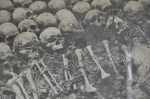 This afternoon we visited the Tuol Sleng Genocide Museum in Phnom Penh. Once known as S-21, or Security Office 21, this terrible place was created on Pol Pot’s orders in April 1975. The buildings originally housed a high school and were a place of learning, the very thing Pol Pot feared, hated, and sought to destroy. The Khmer Rouge turned this place of learning into a horrific center for the detention, interrogation, torture, and murder of those deemed to be a threat to Pol Pot’s regime. Although the lives of thousands of men, women, and children were forever silenced here, they still speak and have a voice through this museum.
The Khmer Rouge carefully documented every person who was brought to this center. Each prisoner was photographed, and in many cases, photographed again after being tortured and killed. They unwittingly left the world a bloody record of their inhumanity. As we walked through each room and looked at the cells and the torture devices, we also looked at the rows upon rows of photographs that captured the frightened and dazed looks of the people who died here. Even children were not an exception to the brutality. Instead of wasting bullets on babies and children, the Khmer Rouge soldiers found it easier to dash their small bodies against the compound walls or trees. This is the ultimate result of a world view void of any belief in God and without any regard for the sanctity of human life.
Our friend Barnabas, a survivor of another of Pol Pot’s prisons, was an excellent guide. His insight was born out of personal experience. And, while walking through the rooms, we met another of the handful of survivors of S-21. He was 48 years-old at the time of his imprisonment here and showed us his photograph which is on display in one of the torture rooms. He told us that he comes to S-21 every weekend to talk to the visitors who come here from around the world. He wants for the world to know what happened here in the hope that it will never be repeated in Cambodia or elsewhere.
Visiting S-21 is a sobering experience. The photography on display in each room is unedited, raw, and very graphic. There are human skulls and fragments of jaws piled up behind glass cases in one room. One survivor who is an artist painted the scenes on display in the building where prisoners were tortured. They depict babies being taken from mothers and prisoners being painfully tortured. Each painting tells a horrible tale of how thousands of people spent their final days in agonizing pain. S-21 is a monument to what happens when people find themselves in the hands of angry sinners. May we never forget what happened here and in other places where genocide has left its bloody signature. And, may we live with awareness and act with intention on behalf of those suffering similar atrocities today at the hands of angry sinners.
 Go Beyond
Leave a comment