Posted by: Omar C. Garcia | December 16, 2009

One Solitary Life

Dr. James Allen Francis (1864–1928) served as Pastor of First Baptist Church of Los Angeles from 1914 to 1928. He wrote a book entitled The Real Jesus and Other Sermons, published by Judson Press in 1926. He included a sermon in this book that he had preached to The National Baptist Young Peoples’ Union on July 11, 1926. In that sermon, Dr. Francis summarized the impact of Jesus’ life with a story that has since become known by the title One Solitary Life. Dr. Francis’ summary of Jesus’ life has been shared countless times through the years. I hope that you’ll take a moment to read it, reflect on its message, and share it with others this Christmas. This is a simple way to turn our thoughts back to Jesus during this busy season filled with so many things that distract us from Him.

Here is a man who was born in an obscure village, the child of peasant woman. He grew up in still another village where He worked in a carpenter shop until He was thirty. Then for three years He was an itinerant preacher.

He never wrote a book. He never held an office. He never had a family or owned a home. He never went to college. He never put his foot inside a big city. He never traveled two hundred miles from the place where he was born. He never did one of the things that usually accompany greatness. He had no credentials but himself.

While He was still a young man the tide of popular opinion turned against him. His friends ran away. One of them denied him. He was turned over to his enemies. He went through the mockery of a trial. He was nailed to a cross between two thieves. His executioners gambled for the only property He had while on earth, and that was his coat. When He was dead, He was laid in a borrowed grave through the pity of a friend.

Nineteen wide centuries have come and gone, and today He is the central figure of the human race and the leader of the column of progress. I am far within the mark when I say that all the armies that ever marched, and all the navies that were ever built, and all the parliaments that ever sat, and all the kings that ever reigned, put together, have not affected the life of man upon this earth as powerfully as has this one solitary life.

Some of the versions of this story include these concluding remarks: Over the centuries millions have found new life — forgiveness for sins and peace with God through faith in Jesus Christ. Today He offers this life to all who will believe in Him. “I am the way, the truth, and the life,” Jesus said, “no man cometh unto the Father, but by Me.” And He said, “He that heareth My word, and believeth on Him that sent Me, hath everlasting life, and shall not come into condemnation; but is passed from death unto life” (John 14:6, 5:24).
Posted by: Omar C. Garcia | December 13, 2009

A Simple Christmas List

Christmas is the one time of the year when even the non list-makers make lists. Even if hastily scribbled on a scrap of paper, we make lists and check them twice to make sure that we don’t forget to send a card or to buy a gift or to attend a party or to get everything we need for Christmas dinner. Here are a few of the things on my list as I strive to keep the true meaning of Christmas in perspective.

The Story | Rediscover the true meaning of Christmas by reading the Christmas story. Set aside time to read Matthew’s and Luke’s accounts of Jesus’ miraculous birth. Ask God to fill you with the wonder and excitement of a child hearing the story for the first time. After all, Christmas is about Him. And, don’t be a spiritual Scrooge by keeping the real news about Christmas to yourself. Share God’s story with others.

The Songs | Listen to the old carols and new songs about Christmas throughout the day. Focus on the message and meaning of the songs. Sing them out loud in the shower and in the car. Use a favorite song as a springboard to discussions about Jesus with family and friends. Christmas carols and songs are a great way for parents to add a little spice and variety to family devotions.

The Spending | Think deeply about what you will spend and why. Spend less money on yourself and keep a reserve to help those in need. Give your presence in place of or in addition to presents. Spend meaningful time with those you love and with those who are lonely. Ask God to help you connect with the least of these in your community.

The Stress | Christmas can be one of the most stressful times of the year. Do not let the stress of the season rob you of joy. Take control of the season by rethinking your priorities. Learn to say no to the temptation to overspend, to overindulge, and to over commit. Make choices about spending that honor God and that will keep you from starting the New Year drowning in a sea debt.

The Selfish | If you have young children, begin now to teach them to think of others at Christmas. Include them in thinking about practical ways to help those in need or those who serve our community. Something as simple as baking and delivering cookies to the homeless, to the lonely, or to the firefighters and police officers who keep our community safe can teach kids to be a little less selfish and much more thoughtful of others.

The Suffering | In 1984, Bob Geldof and Midge Ure co-wrote a song entitled “Do They Know It’s Christmas?” – a song about famine victims in Ethiopia. Geldof recruited the most popular musicians of his day, recorded the song, and raised millions for famine relief in Ethiopia. Today, millions of suffering people in our world will never know that it’s Christmas. However, we can make a difference in their lives by donating generously to relief initiatives that will help them to survive another day. In the words of Geldof’s song, “And there won’t be snow in Africa this Christmas time. The greatest gift they’ll get this year is life.”

The Savior | Christmas is the one time of the year when people have to think about Jesus. Even those who don’t normally think about Jesus are forced to think about Him, even if only for a moment. I wish that people would think about Jesus more than they do, but the fact of the matter is they don’t. Every year, Jesus is increasingly obscured by commercialism, attacked by secularism, and eclipsed by consumerism. Determine that you will not lose sight of Jesus this Christmas. Please take a moment to read my post entitled A Valueless Christmas, a reminder to look after Jesus first at Christmas.

Posted by: Omar C. Garcia | December 11, 2009

Looking Up | Psalm 123

The psalm bears no superscription regarding the identity of the writer or the particular event that might have prompted the writing of the psalm. Some have suggested that it was composed during the time of Nehemiah when the people engaged in the rebuilding of the walls felt the scorn and contempt of their enemies. Others suggest that it was written by King Hezekiah on the occasion of the Assyrian invasion of Judah under Sennacherib, particularly the contemptuous speech of Rabshakeh recorded in 2 Kings 18:17-26. While we cannot know for certain who wrote the psalm, we can apply it to any of the numerous trials we might experience in life. Its words can serve as a model for prayer and speak for us when we find ourselves in the midst of problems, perplexities, or painful situations.

123:1 To Thee I lift up my eyes,
O Thou who art enthroned in the heavens!

The opening of this Psalm is similar to the opening phrase of the Lord’s Prayer (see Matthew 6:9). Unlike the opening phrase of Psalm 121, the psalmist lifts his eyes to look beyond the hills to the Lord Himself (see also Psalm 115:3). The language suggests that the psalmist had already lifted up his eyes, was presently lifting them, and would continue to lift them. While looking up is the first thing we should do when we are faced with difficulties, it is often the last thing we do. Too often we fail to look up until it is the only remaining option.

Looking up is the best way to keep our difficulties in context. It is inevitable that we will face difficulties. When they come, difficulties have a way of appearing very ominous and imposing. They have a way of disorienting us and causing us much pain. If difficulties are not kept in perspective they can discourage and defeat us. That is why we must look up when we encounter difficulties. We must look to God and see our difficulties in relation to Him. When we see our difficulties against the backdrop of His power and majesty, they become less ominous, imposing, and intimidating.

We must look in the right direction when we encounter difficulties. The psalmist did not look in when he encountered difficulties. Had he looked in he would have seen fear. The psalmist did not look out when he encountered difficulties. Had he looked out he would have seen his problems. The psalmist did not look at others when he encountered difficulties. Had he looked at others he would have seen people with similar fears and inadequacies. Instead, he looked up to God who is the only reliable source of help.

123:2 Behold, as the eyes of servants look to the hand of their master,
As the eyes of a maid to the hand of her mistress;
So our eyes look to the Lord our God,
Until He shall be gracious to us.

The psalmist’s dependence upon God was like that of a servant to his master. The servant looked to the hand of his master for the slightest gesture, for guidance, sustenance, protection, correction, and reward. Similarly, the psalmist looked to God with an attitude of expectation. He knew that his destiny was in God’s hand. The psalmist continued to look to God and refused to buckle under the pressures of those who held him in contempt.

We honor God when we look to Him for help. God repeatedly invites us to trust him and to commit our cares to Him. When we look up for help, we acknowledge that we need more than the feeble arsenal of our human strength and understanding to deal with life’s difficulties. We acknowledge that we need God and the strength of His hand.

123:3 Be gracious to us, O Lord, be gracious to us;
For we are greatly filled with contempt.
123:4 Our soul is greatly filled
With the scoffing of those at ease,
And with the contempt of the proud.

The psalmist asked for God’s grace because he and the people of God felt the sting of persecution. They were weary of being objects of the scorn and abuse of lazy and proud men. They therefore looked to God to act on their behalf.

Posted by: Omar C. Garcia | December 9, 2009

A Tale of Two Kings

   One of my favorite Christmas carols is O Little Town of Bethlehem, written by Phillips Brooks and set to music by Lewis Redner. Brooks, an Episcopalian priest, served as Rector of the Church of the Holy Trinity in Philadelphia. He visited Bethlehem in 1865 and wrote the words to the carol three years later for the children of his church to sing at their annual Christmas program. Brooks asked Redner, the organist at his church, to set his words to music. Redner struggled to compose a melody but was inspired with the tune the night before the program. The following day, thirty-six children accompanied by six Sunday School teachers premiered Brook’s carol for the first time.

   I had the opportunity to visit Bethlehem earlier this year. As I stood inside the Basilica of the Nativity, I thought about Brook’s famous Christmas carol. As I stood outside of the church my thoughts turned to Herod who had built an impressive palace near where Jesus was born. Below is a portion of what I wrote and posted from Israel on March 15. It is a tale of two kings.

Bowing Low | The morning of March 15 greeted us with rain and a cold breeze. No matter — we boarded our bus and headed to the town of Bethlehem, “the city of David” (Luke 2:4). The name Bethlehem means “house of bread” and is located only a few miles from Jerusalem. Seven hundred years before Jesus was born, Micah prophesied that the Messiah, a descendant of David, would be born in Bethlehem (Micah 5:2).

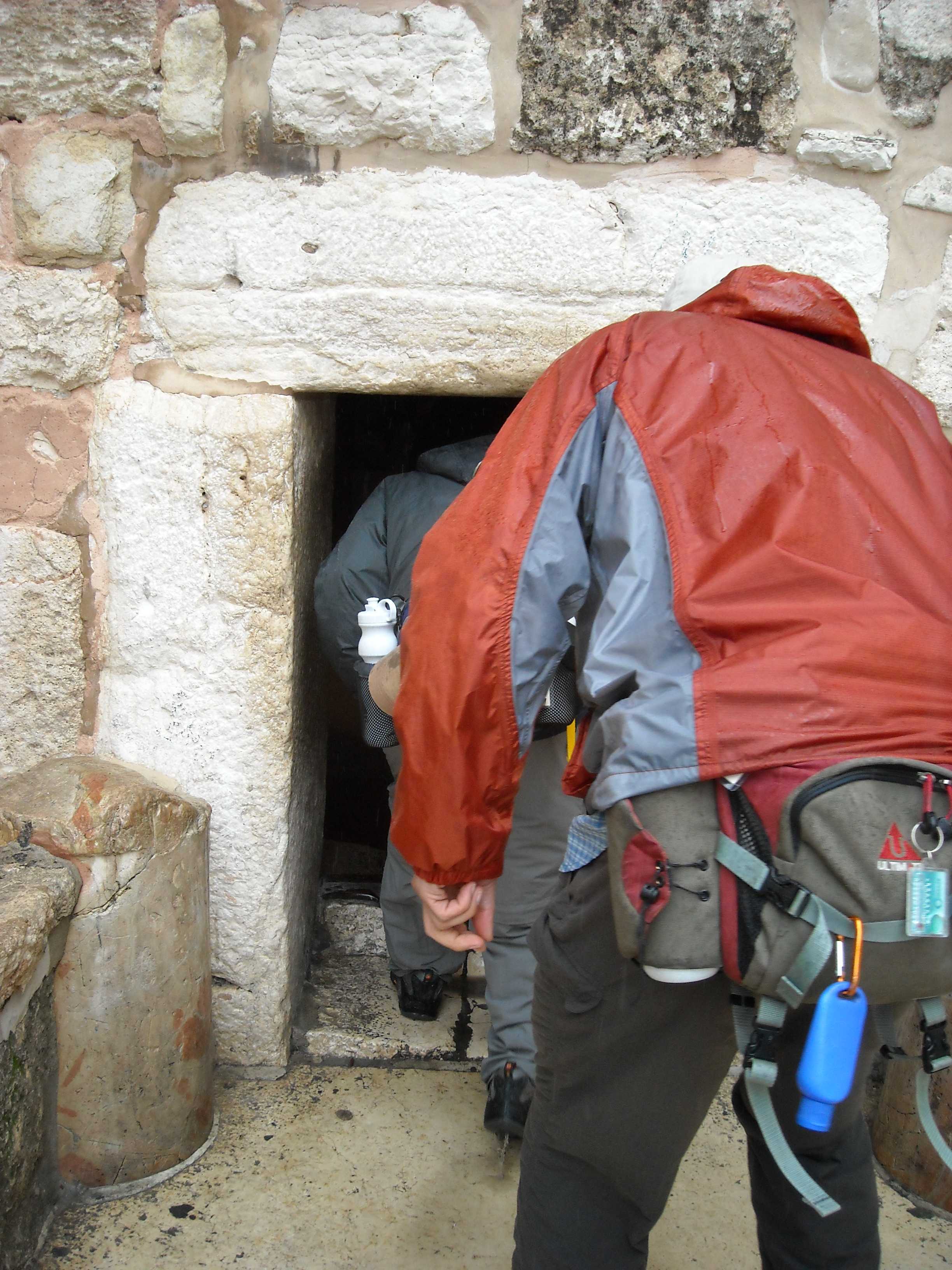
Door of Humility

Our first stop of the day was at The Basilica of the Nativity, built over the cave that tradition marks as the birthplace of Jesus. Guests must enter the basilica through a very low door called the Door of Humility. This door was created in Ottoman times to force even the most important visitor to bow low as he entered the holy place. We entered the basilica through the Door of Humility and stepped into the dimly-lit nave flanked by rows of columns. The smell of incense, the sounds of worship in progress, and paintings of biblical scenes and saints welcomed us into the old church. Our guide spoke in hushed tones as he reviewed the story of Jesus’ birth. He then escorted us to the traditional site of the Nativity enshrined in the grotto beneath the choir area of the basilica.

Looking down into the grotto I was reminded that Jesus was not born in this building but in the cave it enshrines, a place where animals were once kept. We have seen many such caves on our treks around the country. They are more common than I imagined and come complete with the filth and fragrance of the animals they house. At the time of Jesus’ birth there were no shortage of palaces and fortresses where He could have been born, including the imposing and impressive Herodium just a short distance away. “But when the fullness of time came, God sent forth His Son…” (Gal. 4:4) who “emptied Himself” (Phil. 2:7) and was born in the most unlikely of places and laid “in a manger,” a feeding trough for animals (Luke 2:7).

Building High | Just a short distance from the place where Jesus was born is the Herodium, a fortress-palace built by Herod on top of the highest real estate in the area. We hiked to the top of the hill to look at the ruins of this once-great palace. The Herodium is an active archaeological site. We took a moment to watch the painstaking work of those who continue to peel back the layers of history here. Josephus recorded that Herod was buried in the Herodium. His words were confirmed in 2007 when Israeli archaeologist Ehud Netzer and his team found Herod’s grave (see National Geographic, December 2008).

At the time of Jesus’ birth, the Herodium was one of the largest and most luxurious palaces in the world. Herod spared no expense to build the biggest and the best on the highest mountain so that the world would know there is a Herod. The Herodium was so imposing that the first rays of the sun painted its shadow across Bethlehem each morning. Imagine that! Jesus — the king of the universe — was born in an insignificant cave, probably amidst animals, in the shadow of Herod’s greatness.

Today, all of Herod’s palaces and fortresses lie in ruins. Herod is remembered as the megalomaniac who became paranoid and killed many people, including babies (Matt. 2:16-18), in an effort to maintain his power. Herod had wealth and lavish palaces in which to dine and sleep, but Jesus had “no place to lay His head” (Matt. 8:20). Jesus did not leave a legacy of palaces or architectural accomplishments. He left something much more lasting. And, what Herod the Great feared (Matt. 2:3) came to pass. The baby born in Bethlehem beneath the shadow of his palace became a greater king than him and changed the world forever.

Posted by: Omar C. Garcia | December 7, 2009

No God? No Problem!

   The American Humanist Association has launched its 2009 holiday advertising campaign that features the slogan — “No God? No problem! Be good for goodness’ sake.” This year’s slogan will be displayed on city busses in Washington D.C., San Francisco, Chicago, New York, and Los Angeles. Roy Speckhardt, the executive director of the AHA said, “We’re hoping this campaign will build awareness about the humanist movement and our ethical philosophy — particularly among the ‘nones:’ the rapidly growing percentage of people who claim no religion.” Humanists will undoubtedly make lots of folks aware of their movement and more than a few of those folks angry.

   Although I disagree with the AHA slogan, I am neither offended nor threatened by it. The reality is that we live in a country in which people have differing worldviews and the right to express those views. As a Christ-follower I have both the freedom and the responsibility to share the gospel of Jesus Christ. The AHA slogan actually serves as a good conversation starter that can lead to healthy dialogue about God and His existence. Perhaps the AHA campaign will challenge people to think a little more deeply and talk a little more intentionally about God and spiritual matters.

   Speckhardt asserts that “Humanists have always understood that striving to make the world a better place is one of humanity’s most important responsibilities.” Terrific. I’m all for making the world a better place. I hope that humanists will heed their own message and actually close the gap between understanding and action. A 2007 national survey by the Barna Group regarding helping the poor concluded, “Atheists and agnostics emerged as the segment of people least likely to do anything in response to poverty.” So, perhaps this humanist “be good for goodness sake” initiative will lead humanists to do more than talk a good game. That would be a good thing, especially for the prospective beneficiaries of that goodness.

   So, if you happen to see one of the AHA ads on the side of a bus, no problem! Use it as an opportunity to strike up a conversation with a friend or stranger. After all, you too have the freedom to share your views about God and His existence. And, make sure that you do more than talk about being good. Bless others through unconditional and practical acts of kindness — not just at Christmas but throughout the year.

• • • • •

Please take a moment to read my post entitled Probably No God.

Posted by: Omar C. Garcia | December 5, 2009

A Valueless Christmas

   I met Mortuza in Bangladesh almost ten years ago. He is a faithful Christ-follower who lives in one of the largest Muslim nations in the world. He is familiar with persecution aimed at silencing Christians in Bangladesh. He has seen the devastation caused by natural disasters and is often among the first responders, offering practical aid to those in need. Mortuza and I have shared some great adventures in Bangladesh — visiting remote villages throughout the country and islands in the Bay of Bengal. I am grateful for his friendship and for his selfless service to God’s kingdom.

   Mortuza is a regular reader of my blog. A couple of days ago I posted a blog entitled Worth Remembering in which I offered suggestions for making this Christmas one worth remembering. Mortuza posted a comment that is both insightful and convicting. Here is what he wrote:

When I beginning to reading your post this morning, first paragraph reminding me that a story. A parent had a child, and parents arranged great things to having festivals for their only child’s birth day. So many guests and pretty decorated was everything. But, only child went up to the roof. As child was so small and child fall down from the roof and died! Parents and guests were very busy with the festivals. All the activities became valueless. They did not look after their child. Many of us today, we are busy for our selves, to decorating our mental satisfactions. We do not looking after “where Jesus is?” we should look after Him! first.

   Mortuza’s story illustrates how easy it is for us to become so distracted by the trappings and noise of the season that we lose sight of Jesus. Gift lists generally include everyone but Jesus. People will amass lots of debt by accumulating more stuff but will do little or nothing to lay up treasure in heaven. Jesus may get a passing mention on Christmas day but will be quickly overshadowed by the latest gadgets and widgets. Mortuza is right. We are not looking after where Jesus is at Christmas. We should, as he suggests, look after Him first. After all, He is the real treasure of Christmas and the reason for the season. Paul referred to Him as God’s indescribable gift (2 Cor. 9:15). Anything else we give or receive this Christmas will pale by comparison.

   Don’t settle for a valueless Christmas — full of activity but void of Jesus. This year, determine that you will not lose sight of Jesus. Include Him on your lists, in your thoughts, and in your words. Talk about Him and how wonderful He is and why He came. Look for Jesus in the distressing disguise of those in need and when you find Him do something to help. Don’t get yourself in debt or deeper in debt by buying more stuff and junk that you really don’t need. Remember that all of our activities will be valueless if we fail to include and exalt Jesus. Keep Christ in Christmas and make this your most memorable and valued Christmas yet.

Posted by: Omar C. Garcia | December 3, 2009

Worth Remembering

Christmas! It’s the most wonderful time of the year — at least for some. But for others, Christmas is a painful time. Many will not hear the story of Jesus, nor have gifts under a tree, nor experience the joys of hearth and home. Americans will spend an estimated $450 billion dollars on Christmas this year. The irony is that billions of these dollars will be spent to purchase stuff for ourselves or others rather than for Christ, whose birth we observe at Christmas. Instead of buying more stuff we don’t need, let’s buy gifts for Jesus. Mother Teresa was committed to looking for Jesus in the distressing disguise of the poor, the hungry, the sick, and people in desperate need. This Christmas, determine to look for Jesus in His distressing disguises and when you find him, offer your gift.

The Nations | When the angel appeared to the shepherds, he said to them, “Do not be afraid; for behold, I bring you good news of a great joy which shall be for all the people” (Luke 2:10). Two-thousand years later many people groups are still waiting to hear this good news for the first time. Of these people groups, most are located in the 10/40 Window. However, Christians today invest 91% of their missions dollars in countries that are already more than 60% Christian but only 0.03% in countries where less than half the people have ever heard of Jesus (World Christian Trends, p. 81). This Christmas buy fewer gifts and then give the money saved to missions organizations that are targeting the world’s least reached peoples.

The Needy | More people than ever before are in financial trouble. Our church’s benevolence ministry and our local assistance ministries are overwhelmed with increasing numbers of people in need of food, rent or mortgage assistance, or help with utility bills. So, review your gift list and ask yourself whether you really need to buy more stuff for family and friends who already have lots of stuff. Consider giving a gift in honor of a family member or friend to a local assistance ministry. Or, purchase groceries or clothing or gifts for a family in need. If you know a single Mom, pay to have the oil in her car changed or buy a new set of tires for her car. Pray and ask God to guide you in doing something practical to help someone in need.

The Neglected | Last December, I posted a blog entitled Merry Stressmas. I wrote that those who feel lonely throughout the year tend to feel even lonelier at Christmas. Every year, hundreds of thousands of people spend Christmas alone. Whether separated from others because of death, divorce, or distance, the stress produced by loneliness during the holidays can be overwhelming. If you are lonely, consider volunteering at a local shelter or nursing home. Doing something for others will relieve some of the stress of loneliness. And, if you are surrounded by family, consider inviting someone who is alone to join you for a Christmas meal. Set one or two more places at the table and invite others to experience the warmth of family and fellowship in your home.

I hope that you will add the nations, the needy, and the neglected to your Christmas list. If each of us will make even small changes in our spending, we can help to make this a Christmas worth remembering “for all the people.”

• • • • •

For more ideas about how you can make this a Christmas worth remembering, please take a moment to read my Christmas Reflections.

Posted by: Omar C. Garcia | December 1, 2009

Kingsland’s Boys of Iron

Kingsland is committed to loving God, loving people, and equipping the generations. One of the best ways Kingsland invests in kids is through our Boys of Iron ministry. Leslee McWhirter directs this ministry that equips boys to love God and love people. Here is a brief interview with Leslee about our Boys of Iron and their recent Christmas initiative.

Boys of Iron Service Project

Omar | Leslee, who are the Boys of Iron and when do they meet?
 
Leslee | Boys of Iron are 1st through 5th grade boys. We have about 80 boys that meet on Wednesday nights from 7:00 PM to 8:00 PM.
 
Omar | What do the Boys of Iron study and how do you help them connect with missions initiatives and missionaries?
 
Leslee | Our focus for Boys of Iron is to assist parents as they raise their boys into godly men. Our leaders are men and we have lessons on virtues that are specific to males, such as being a gentleman, controlling anger and taking responsibility for your actions. Godly men are mission minded, so we spend a large portion of time studying about missions at home and abroad. We pray for missionaries, work on mission projects and have mission speakers. We try to involve the boys in missions at home, at the state level and to the ends of the earth.
 
Omar | What have the boys done to engage with an international ministry this Christmas?
 
Leslee | Over the last several weeks our boys collected money for Heifer International. Heifer International brings plants or animals to needy people around the globe. The families are taught to care for the resources and are asked to share with more families as their gift grows. Not only is the family’s life improved, but they have the chance to help another family. Even more importantly, the recipients are taught about the love of Jesus. Visit the Heifer International website for more information.
 
Omar | How much money did the boys raise to send to Heifer International and how did they raise the money?
 
Leslee | Our boys brought in money in small and large amounts totaling $490.35. While it’s nice to see large dollar amounts come in, I love counting out nickels and pennies! Some of the boys told me about jobs they did around the house to earn the money.
 
Omar | That’s fantastic! Our Missions Ministry is excited to match the money raised by the boys.
 
Leslee | The boys will be so excited to be able to buy even more animals! We were amazed to learn the impact even a hive of honeybees can make on a community.
 
Omar | What will our boys do next this Christmas season?
 
Leslee | Tomorrow night we will help God’s Girls fill stockings for families in Katy through Katy Christian Ministry’s Santa’s Sleigh program.
 
Omar | How can parents of grade school boys get their children involved?
 
Leslee | Parents can call me at 281.492.0785 or register online at Kingsland’s website. Girls can register for God’s Girls that meets at the same time.

Posted by: Omar C. Garcia | November 29, 2009

In Trouble | Psalm 20

This is “A Psalm of David” — or perhaps more accurately, “for” or “concerning” David. It is a prayer for the king’s protection and victory over enemies in battle. The king, after all, was fighting for the welfare of the nation. Verses 1-5 record the nation’s Godspeed to the king. Verses 6-8 record the king’s (or the worship leader’s) reply. Verse 9 is a final prayer for the king.

20:1  May the Lord answer you in the day of trouble!
May the name of the God of Jacob set you securely on high!
20:2  May He send you help from the sanctuary,
And support you from Zion!
20:3  May He remember all your meal offerings,
And find your burnt offering acceptable!  [Selah]
20:4  May He grant you your heart’s desire,
And fulfill all your counsel!

These verses are a prayer asking the Lord to answer the king “in the day of trouble.” The “day of trouble” is a day of impending battle as suggested by the reference to chariots and horses in verse 7. The pronoun “you” is singular and refers to the king, the Lord’s anointed (see verse 6). The petitioner asked the Lord to remember the king’s acts of religious devotion and grant success to the king’s plans. The petitioner prayed that God would “answer,” “set,” “send,” “support,” “remember,” “find,” “grant,” and “fulfill.”

No person is exempt from troubles. We all have experienced dark days and sorrowful nights. We all know what it means to grow weary from the constant and unrelenting pressures of life. It seems that there is always something threatening our welfare or security. It seems that there is always something bent on defeating and destroying us. Like the psalmist, we too should seek the Lord’s help in the day of trouble. We should look expectantly to God for help and assistance. We should put our trust in Him.

20:5  We will sing for joy over your victory,
And in the name of our God we will set up our banners.
May the Lord fulfill all your petitions.

This verse anticipates God’s answer and is the “Amen” to the prayer. The people looked forward to cheering the king’s success in a triumphal procession.

We should remember God in the hour of victory and triumph as well as in the hour of need. It’s easy to remember God when we are in great and desperate need. It’s easy to look to heaven when we are threatened on every side. It’s easy to earnestly voice our petitions when problems close in. We should be careful, however, to remember God in the hour of victory and deliverance. We should not be so elated by triumph that we forget to give thanks. We should not allow success to cause us to forget the source of our help.

20:6  Now I know that the Lord saves His anointed;
He will answer him from His holy heaven,
With the saving strength of His right hand.

This verse further accentuates the assurance of the deliverance and victory requested in the prayer. The words express the firm conviction that God had heard and would answer the prayer of the king.

20:7  Some boast in chariots, and some in horses;
But we will boast in the name of the Lord, our God.
20:8  They have bowed down and fallen;
But we have risen and stood upright.

The confidence of the king was in the Lord (verse 6). The confidence of his enemies was in their chariots and horses, which represented formidable military strength. Those who put their trust in anyone or anything other than the Lord will bow down and fall while those who trust in the Lord will remain standing in the midst of battle.

Confidence in God gives us courage for the battle. The king’s confidence in God gave him courage for the battle. He put his trust in the Lord rather than in armaments or coalitions. He remained standing while his enemies fell around him because he trusted in God.

20:9  Save, O Lord;
May the King answer us in the day we call.

This verse sums up the theme of the psalm and reminds us that we should pray for our leaders. Someone observed, “The well-being of a people is suspended on the character and doings of the monarch. Prayer should be offered for him continually that he might be guarded from evil, that he may be wise, equitable, and prosperous.”

Posted by: Omar C. Garcia | November 27, 2009

Give Thanks | Psalm 100

Although the writer of Psalm 100 is not identified, he was doubtless someone who understood the worship of God. This Psalm is a call to praise and thanksgiving and was probably sung antiphonally. Verses 1-3 were probably sung by worshipers approaching the temple for worship with verses 4 and 5 serving as the antiphonal response. According to Psalm 100, we are to “Shout joyfully,” “Serve the Lord,” “Come before Him,” “Know,” “Enter,” and “Give thanks to Him [and] bless His name.” These are proper responses of the creature to the Creator.

100:1 Shout joyfully to the Lord, all the earth.

God is worthy of our highest praise and adoration. The whole earth and all of its inhabitants are called to praise the Lord.

100:2 Serve the Lord with gladness;
Come before Him with joyful singing.

God is worthy of cheerful service. We should serve Him out of a heart overflowing with gratitude. God’s people should sing joyfully to Him in worship. Watts, the great hymn writer, wrote these words: “Let those refuse to sing who never knew our God; but favorites of the heavenly king must speak His praise abroad.” Lloyd John Ogilvie wrote, “Joy is the outward sign of the inner experience of grace. Gladness, not grimness, is the distinguishing mark of anyone who is truly thankful for the goodness of the Lord.” Our lives should reflect the joy of knowing the Lord and serve as letters of recommendation for Him. Our service should be rendered out of a heart filled with gratitude for who God is and what He has done for us.

100:3 Know that the Lord Himself is God;
It is He who has made us, and not we ourselves;
We are His people and the sheep of His pasture.

No one assisted or advised God in creation. He alone is God. He said to Job, “Where were you when I laid the foundation of the earth?” (Job 38:4). Isaiah 55:8-9 records, “‘For My thoughts are not your thoughts, neither are your ways My ways,’ declares the Lord. ’For as the heavens are higher than the earth, so are My ways higher than your ways, and My thoughts than your thoughts.'” God has made us and we are His. He shepherds us as His people, knows us intimately, and is concerned about our welfare.

100:4 Enter His gates with thanksgiving,
And His courts with praise.
Give thanks to Him; bless His name.

Those who have tasted God’s goodness should give thanks. Those who have been forgiven should give thanks. Those who understand who God is and who they are in relation to Him should give thanks.

100:5 For the Lord is good;
His lovingkindness is everlasting,
And His faithfulness to all generations.

The statement, “For the Lord is good,” sums up God’s character and is more than sufficient reason for us to praise Him. He indeed is good and we should always keep in mind that He allows us to serve Him because He is good, not because we are good. We should praise God because of who He is. He is not only good, He is also merciful (an expression of His goodness in relation to sinners) and absolutely trustworthy. God is faithful and just, right in all His dealings with us, and always keeps His word.

« Newer Posts - Older Posts »

Categories