Posted by: Omar C. Garcia | October 1, 2008

Calvin’s Tears

   Every now and then it happens — you meet someone whose life has a measurable impact on your own. It doesn’t happen often, but when it does, your mind easily convinces your heart that the encounter is something worth treasuring. That’s what happened when I met Calvin Fox in the Khondhamal Hills of India. Here was a man whose unassuming presence was the perfect cover for profound depth. The few days I spent in his company stirred my life and continue to ripple across the surface of my memory.

   Calvin was an Arkansas farm boy who sensed God’s call to ministry at an early age. A mission trip to the Philippines in 1962 solidified his call to become an agriculturalist — a missionary farmer. Calvin returned home, completed his studies, and married Margaret, a young girl from Paris … Arkansas. In 1967, with Margaret at his side, he returned to the Philippines where he served as the extension director for the Mindanao Baptist Rural Life Center. Calvin taught Sloping Agricultural Land Technology (SALT) to farmers trying to eke out a living on erosion ravaged hillsides.

   At the age of 55, Calvin and Margaret left their home in the Philippines and moved to one of the poorest and most difficult tribal areas of India. When I met Calvin and Margaret, they were living in a 320 square-foot house surrounded by Calvin’s outdoor classroom for tribal farmers — his small demonstration farm. Calvin compassionately taught these subsistence farmers how to increase their yield by using SALT methods. His incarnational life and practical work transformed countless lives.

   I had traveled to India to lead a team of prayer-walkers and was fortunate to have Calvin serve as our guide. That’s when I noticed something unusual about him. Every time Calvin would speak to us about the people in the hills, he wept. I am not talking about sobbing or wailing, just quiet tears glistening on his tanned and weathered cheeks. It happened every time. I remember thinking, “Wow! He’s been on the mission field for more than half my lifetime and he still weeps for the people. He has not grown accustomed to the lostness that surrounds him. Like Jesus, he feels compassion for these people who are distressed and downcast like sheep without a shepherd (Matt. 9:36).”

   The presence of Calvin’s tears caused me to question the absence of my own. I love God and I care about lost humanity too, but I do not weep like Calvin. In fact, I have never met anyone who does. Psalm 126:5-6 states, “Those who sow in tears will reap with songs of joy. He who goes out weeping, carrying seed to sow, will return with songs of joy, carrying sheaves with him.” Every good farmer knows the importance of watering his crops. Calvin’s tears watered a spiritual crop that yielded three church-planting movements that produced almost 1,000 new churches among three people groups. Amazing!

   Calvin died of a heart attack at his home in Gentry, Arkansas on December 14, 2003. I wept at the news of his death.

Posted by: Omar C. Garcia | September 28, 2008

Travelers

   My heroes have always been travelers. Simply defined, a traveler is someone who goes beyond. I come from a family of travelers — from the 16th century, when my ancestors traveled from Spain to the New World, to the present generation. Travel is in my DNA. As a kid, I loved the nights when my Dad would set up his slide projector to show us his black and white slides of places he’d visited and people he’d met. I loved hearing his stories of traveling light and of visiting places I would later read about in school books. But, best of all, I loved his stories of the connections he’d made with people. The people in his photos gave context and meaning to the places he’d visited and were always more interesting to me than buildings and things.

   I still recall how my heart would beat with anticipation when Mom would announce the arrival of a package from overseas sent by one of my traveling uncles. It was Christmas all over again. I would hold the package and examine every detail before opening it — the stamps, the handwriting, the weight. And then, with measured restraint, I would open the package. These gifts gave me the edge at show-and-tell: a leather wallet from Egypt, a small lapis-lazuli stone from Asia, a Chinese box, and even a vial of water from Antarctica.

   As a kid, my imagination was stirred by the stories I would hear around the family table and at family gatherings. My grandparents’ large home was the depository for treasures collected from years of travel. I’ve often told friends I was raised in a museum. And, I was. I especially loved to peruse the photos kept in old shoeboxes, the old timey kind with serrated edges and those first Kodak color photos, now faded, with the date stamped on the edges. I was fascinated. The best part was looking at the people, those who lived beyond my small South Texas town.

   As an adult, I am the beneficiary of my family’s legacy of travel. However, as a follower of Jesus Christ I am especially fortunate to travel with a purpose. My passion for going beyond is fueled by the last command of Christ. I love making connections with the people at the other end of the Great Commission. I have discovered that the greatest adventures await those who go beyond, those who go to the farthest edge of everything they know and then take an additional step. The rewards of new friendships are found on the other side of risk and await those who are willing to lose sight of the shore.

   Travel has undoubtedly enriched my life. But meeting people and making friends around the world have made the greatest difference. Mark Twain said, “Travel is fatal to prejudice, bigotry, and narrow-mindedness — all foes to real understanding. Likewise, tolerance, or broad, wholesome charitable views of men and things cannot be acquired by vegetating in our little corner of the earth all one’s lifetime.” Jesus calls us to be travelers. He said to His disciples, “…as the Father has sent Me, I also send you” (John 20:21). So, become a traveler. Take those first steps that will move you across the room or across the globe to make meaningful connections with others for the sake of His kingdom.

Posted by: Omar C. Garcia | September 25, 2008

Are You Going Bald?

   I received an invitation to lead a prayer-walk in India in 1998. I must confess that my initial response to the invitation was less than positive. I wanted to do something more than pray on my next trip. I resisted the idea of the prayer-walk for several days until a friend gave me a book on prayer-walking and asked me to read it. The more I read the more convicted I became. Finally, I asked God to forgive me of my wrong attitude and concluded that I needed the prayer-walk more than the prayer-walk needed me. So, I contacted three friends and my travel agent, and within a few months we were on our way to India. My friends and I traveled to Orissa, probably the most devout Hindu state in India. As we traveled through the villages, the sights, sounds, and smells of our journey seeped into my heart and ascended to heaven in the language of prayer. It was an amazing experience.

   I was again reminded of the need to continue praying after we returned home. Two months after our visit, I learned of the death of 58 year-old Graham Staines, an independent Baptist missionary from Australia. Graham and his two young sons, Timothy (age 7) and Phillip (age 10), were asleep in their old four-wheel drive Willy station wagon in Manoharpur village in Orissa’s Keonjhar district. While they slept, a mob encircled their vehicle, doused it with gas, and set it on fire. Graham and his sons embraced in a futile attempt to protect one other from the flames — an embrace memorialized in their charred remains.

   The violence against Christians in Orissa continues to the present day. Soon after visiting friends in Orissa in November 2007, Hindu extremists launched a 10-day rampage in an attempt to cancel Christmas in the Khondhamal district in Orissa. These radical Hindus destroyed 103 churches, burned or vandalized 819 homes of believers, displaced thousands of believers, and killed nine. These attacks make 2007 one of the worst years of violence against Christians in India’s history.

   I returned to Orissa a few months ago, accompanied by my pastor and some friends. We traveled to Orissa to encourage the believers there and to offer practical and financial assistance to churches that were either damaged or completely destroyed. Things seemed to be returning to normal. And then, on August 23, a Maoist group killed Vishwa Hindu Parishad (World Hindu Council or VHP) leader Swamiji Laxmanananda Saraswati and four associates. Although not committed by Christians, these murders resulted in an eruption of renewed persecution against Christians in Orissa.

   I receive news several times a week from my friends in Orissa — messages quickly dispatched from internet cafes. They tell me that according to reports by the local media, 127 church buildings in 94 villages have been destroyed, 4042 homes of believers have been burned, damaged, or destroyed, a nun was gang raped, and 32 people have lost their lives. Sadder still, approximately 200 people have renounced their faith in Christ in order to escape painful torture and death. These individuals have been “reconverted to Hinduism,” wrote one friend, and have had their heads shaved as mute testimony to their reconversion. Imagine that! Having your head shaved so that everyone in your village will know that you have renounced Christ and returned to Hinduism and its multiplied millions of gods.

   It is easy to criticize these frightened apostates. But, honestly, what would we do in the same situation? What if we lost one strand of hair every time we denied Christ by changing the subject at the office or using bad language or telling coarse jokes in order to blend in with the crowd? When was the last time you allowed conveniences and compromises to escort you to the barber to take a little off the top? What if we were to lose just one single strand of hair every time we behaved as though we were ashamed of our faith or hid our light under a basket? If that were the case, we might be surprised by the number of bald people in the pews.

   Things are tough for believers in Orissa. Let’s pray for our brothers and sisters there and for those who, like Peter, have denied that they know the One who gave His all for them. And while we are at it, let’s make sure that we are not going bald in the process.

Posted by: Omar C. Garcia | September 19, 2008

We All Stink!

A few years ago I met a couple who serve as missionaries to the Ayizo people in the country of Benin. This little country is located in West Africa and is the ancestral home of voodoo. The Ayizo people of Benin speak a tonal language called Fon (pronounced “phone”). A tonal language is a language that uses tone to distinguish words. So, words that are spelled the same can have a variety of meanings depending on the intonation of the word. For example, in the Fon language, the word “yi” (pitched high) means to receive. However, when this same word is pitched low it means to reject.

I have always enjoyed learning how to say common phrases in other languages. So, I asked my friends from Benin to teach me how to say “I love you” in the Fon language. The phrase “I love you” is (phonetically spelled): “ugh (mid pitch) yi (high pitch) wan (low pitch) nu (mid pitch) way (low pitch).” However, literally translated, this phrase means “I receive your smell.” For the Ayizo people, the most intimate way to say that you love someone is to tell them that you receive their smell. Wow — I’ve never seen that on a Hallmark card!

Travel has introduced me to a world of unusual and unpleasant human smells. On numerous occasions, I have been held hostage by villainous odors and struggled to free myself from malodorous manacles forged in the furnace of human filth. Honestly, some human smells are inhumane and indescribably repulsive. But, none of this is unusual given the fact that water is often scarce and bathing is a luxury in many of the places that I visit. Nevertheless, it’s not always easy receiving other people’s smell. Yet, among the Ayizo people, to love someone is to receive their smell — unconditionally.

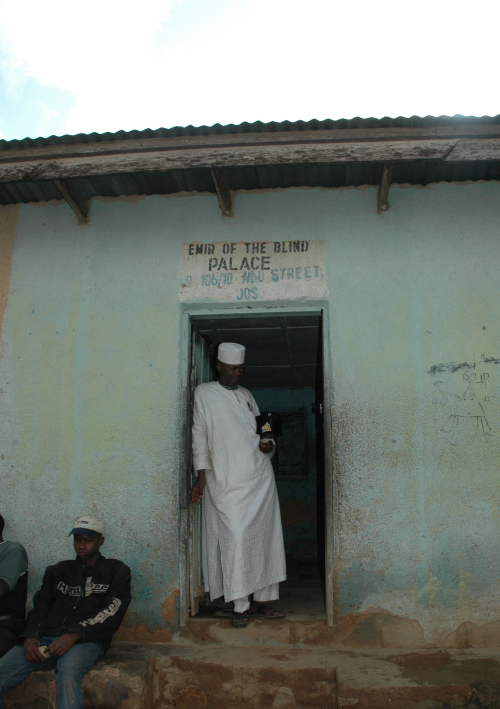
When you think about it, missions is about receiving other people’s smell. In my post entitled “Leprosy” I shared about my visit to Blind Town in Jos, Nigeria. One of the most memorable things about that visit was the overpowering smell produced by impoverished human beings living in the dark shadows of filth. Incarnational living is about embracing those people, holding them close, and allowing their odor to seep into your skin and into the fabric of your heart.

I asked my friends from Benin to quote John 3:16 for me. John 3:16 in the Fon language begins, “For God received our smell…” Imagine that. In spite of the foul stench produced by our sin and rebellion, God received our smell. The God of the universe sent His only Son to walk among us, die for our sins, wash away the smell, and make us “a fragrance of Christ to God among those who are being saved and among those who are perishing.” (2 Cor. 2:15). I am grateful that God receives our smell. We must do no less.

Posted by: Omar C. Garcia | September 12, 2008

Night of Fear and Faith

A Page From My Journal | Bangladesh • November 11, 2001


This year marks the seventh anniversary of 9/11. I was scheduled to travel to Bangladesh on September 16, 2001 but had to reschedule my trip to November because of canceled flights. This is a portion of what I wrote in my journal on November 11 of that year.


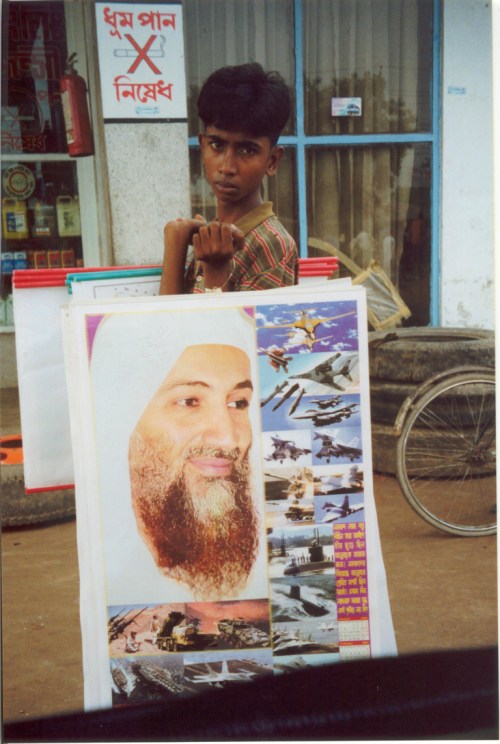
My friend Todd and I are in a small village named after a Hindu leader who once lived in this now predominantly Muslim area in northern Bangladesh. We arrived to find the village saturated with propaganda praising Osama bin Laden and his lieutenants for their attack on America. One young boy in the crowd stared at us from behind a full-color poster of the bearded bin Laden. And, some heckler mustered his best Bangla-flavored English and shouted, “American, Go Home.” Our bicycle rickshaw-walla (driver) strained every muscle as he peddled against a current of pedestrians, buses and trucks belching black puffs of smoke, his competitors, and the unsettling tension we felt so far from our familiar shore.


Bib Laden


We have come to this distant and difficult place to search for a man of peace — an individual who will welcome us into his home, listen to our message, and perhaps open a door of opportunity for us to share the good news of Jesus Christ with a larger audience. We were fortunate enough to meet a young man named Sadiq who is very interested in discussing Islam and Christianity. But, because he lives in a small home with no room for guests, he directed us to a fifty-cent a night room just down the road and invited us to spend the following day with him. Our initial conversation with Sadiq impressed us. He is an intelligent young man with a Berean kind of interest (Acts 17:11) in what we have to share.


Our new friend escorted us to our less-than-no-star accommodations. The walls of our little room are painted with brushstrokes of mildew, the holes in the mosquito nets are not too big, and we have an indoor squatty-potty and one rust-encrusted faucet with a miserly attitude. But, we are thankful for a place to sleep and the promise of making new friends. Todd and I settled in for the night, resting our weary bodies on our respective bunks and on sheets that are obviously estranged from the local laundry woman.


What we had hoped would be a good night of rest was cut short. At about 4:00 AM I peered through sleepy eyes at a figure moving nervously in the dark. It was Todd. He was fully dressed and pacing back and forth between our beds. “Are you ok?” I mumbled. “No,” Todd replied. “I am more frightened than I’ve ever been.” And then he told me that for the last hour he had heard suspicious sounds at the door and at the windows. And then it happened — someone banging at our windows and someone banging at our door, a quiet pause, and then more. Each strike released a wave of intimidation and unleashed a flurry of panicked thoughts: “Who is doing that and why? Nobody knows where we are. How can we escape and where would we run? We’re trapped.” The banging continued — on and then off and then on again.


And then, we took a cue from the book of Acts and started to pray in our boarding room turned prison cell. Each of us poured out our fears and anxieties at the throne of Him who offers mercy and gives grace to help in time of need (Hebrews 4:16). I thought of appropriate passages of Scripture and quoted Psalms 3 and 4. When I spoke the final verse, the cacophony of banging started again. Todd immediately asked to hear the Psalms again. This time I prayed these Psalms, turning David’s words into a prayer for our safety. Somewhat calmer, we started to sing “You Are My All in All” and other songs. We raised our voices louder with each round of banging so that even our intimidators could hear our slightly out of tune but earnest vocals! We continued to do this until the first rays of dawn appeared like the cavalry thundering across the sky to our rescue.


As the soothing light began to slowly seep into the room through dirty window panes and from beneath the door, Todd and I reflected on the fact that we are in a place and in a position where we can only depend on God. No props, no phone, no car, no one to turn to for protection but God alone. His presence sustained us through the night. And then, Todd reached into his backpack to pull out a daily Scripture verse written and given to him by our friend Kevin. The verse for today — “In God I have put my trust, I shall not be afraid. What can man do to me?” (Psalm 56:11).

Posted by: Omar C. Garcia | September 9, 2008

The Savages in America

A Page From My Journal
Tanzania • August 6, 2008

   We left Mbeya early this morning, packed like sardines into Land Rovers bulging with supplies for our stay in the African bush. This is a “bring it with you or do without” kind of trip. We lashed our stuff to the top of our vehicles and wedged it into any available space inside. Our bumpy off-road trek ended at the foot of a hill where people from the Nyiha tribe welcomed us with enthusiastic waves and joyous shouts. Within minutes, local women were balancing our heavy supplies on their heads and climbing effortlessly up the hill.

   Our first order of business was to set up our base camp. Our rocky perch gives us a panoramic view of the mud-plastered, thatch-roofed huts in the surrounding valley where people from the Nyiha and Ndali tribes live. We cleared the area of rocks, pitched our tents, and moved into the neighborhood. Locals marched to the top of the hill like an army of ants, curious about the activity and eager to meet the mzungus (white people) in the blue tent village.

    Quickly eating our lunch of peanut butter and jelly slathered on thick slices of egg bread, we divided up into teams with believers from the Safwa tribe. These Swahili-speakers are here to interpret for us as we introduce the Nyiha to the story of God’s love through chronological Bible storying. Anxious to bring light to the people of the Dark Continent, we headed downhill toward all compass points. This is the idyllic “ends of the earth” adventure — trekking down dusty trails to huts in remote African valleys.

   In the heat of the day, my team arrived at a tiny hut in the middle of a brown field covered with the dandruff of the recent cane and maize harvest. Children stared at us with curious eyes while a hen and her chicks clucked and peeped their way across the barren ground.  The family invited us to sit with them in the dirt outside their hut. While the hot afternoon sun painted our shadows on the dusty canvas, we introduced ourselves to our humble hosts. And then, the unexpected! Upon hearing why we had traveled so far, our hosts exchanged relieved expressions and said, “Karibu” — you are welcome. “We are among the few believers here and have been praying for the mzungus because we were not certain they had heard this wonderful story of Jesus. We are happy to know that you too have heard this message.” How humbling to be reminded that God cares for the nations and that believers on the Dark Continent are praying for the savages in America!

Posted by: Omar C. Garcia | September 9, 2008

Leprosy

A Page From My Journal | Nigeria | July 9, 2008

Today my world changed as I visited Blind Town in Jos, Nigeria. As its name suggests, this little community is home to the blind, or at least to the poorest of the blind. But, it is also home to those who have leprosy.


This little community is perched on rocky hills that descend to the litter-choked banks of a murky river flowing below. The streets are narrow and uneven, making walking a challenge for those with sight and an obstacle course for those without. The walls hemming in the streets are stained with green algae that fades into black as it creeps upward through the shadows. Little streams fed by human waste flow into each other as they wind down paths of least resistance to add their toxins to the filthy river below. The overpowering odors of human waste, rotting litter, and cooking fires hang heavy in the air.

This is life at the bottom — life lived amidst the shards of something that only hints at kinship to human dignity.

Today my world changed for the better as I met and touched a man with leprosy. To call him a leper somehow seems wrong. I feel as though using that awful designation will somehow make me an accomplice with the disease and consequently shave away one more thin slice of his remaining dignity.

He is a man — a man whose once strong hands are now fingerless and whose feet have eroded to stubs. He is a man whose misshapen face betrays the presence of something he cannot control and that mercilessly beats him against the reefs of human mortality. Leprosy has already exacted a cruel toll on his dignity, robbing him of his appearance and the ability to care for himself. I embraced him and prayed for him because today he has a fever, just one more straw adding to the weight he struggles under every day.

Today I touched a man with leprosy and, to my surprise, I was not afraid.

Perhaps fear lost its grip when I saw the man’s very human eyes looking into my own. It’s interesting how a person’s eyes can speak. Looking into his eyes I wondered when was the last time he had felt a human embrace.

Since wealth cannot restore what leprosy takes, I imagine that a human touch becomes the coveted currency of those conscripted into the unenviable ranks of the untouchables. Of course, I thought of Jesus who tenderly touched people with leprosy. I understand that a little better now — the significance of a human touch.

Yes, I touched a man with leprosy. But I think that what really happened today is that a man with leprosy touched me.

Posted by: Omar C. Garcia | September 9, 2008

Among the Least of These

A Page From My Journal | Mongolia | June 18, 2008

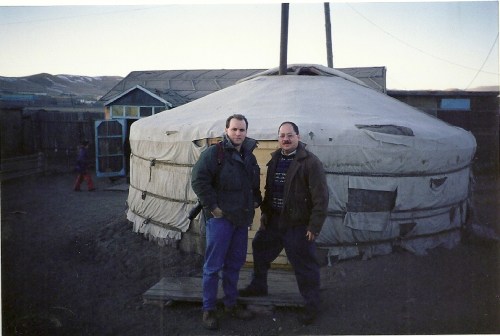
As this day comes to a close, I am seated outside facing west, watching the sun go down behind the distant purple steppes. The last rays of the sun are illuminating the white-sheathed gers dotting the valley west of the Haraa River. Night is preparing to make its grand entrance. The stars are awaiting their cue. The grass and wildflowers are dancing to the rhythm of a gentle northern breeze as a flock of birds fly against its unseen current. This is Mongolia, the ancient land of Ghengis Khan, whose hoards once thundered across these steppes, sowing fear and reaping conquest.

Once again, we have returned to this vast land where horses almost outnumber people, flocks of sheep and goats graze across fenceless ranges, and camels lazily lumber near the Gobi. We have come to make connections with people whose  souls were raped by the atheism of Communist philosophy, whose hearts are searching for meaning in ancient Buddhist ways, and who minds are caught between a proud past and an encroaching future. With only 2.5 million people scattered across this vast country, reaching Mongolia with the gospel of Jesus Christ is not an unrealistic goal.

I am proud of our team. They have compassionately demonstrated the love of Jesus to children with dirty faces, to the elderly who have outlived their families and are facing final days alone, to single mothers with no place to call home, to nomads with matted hair and weather-worn faces, to those whose health is failing, to those bullied by despair and who feed on the table scraps of hope, and to those who have never entertained significance or befriended worth.

Jesus cared about people like this. He cared about the least of these — a woman at a well, a tax-collector in a tree, an adulteress dragged through the streets, a grieving mother at a funeral, hungry crowds on a hillside, lepers in the shadows, and others living on the edge of dignity. We are perhaps most like Him when we love the least of these as He did.

Many in Mongolia are turning to our compassionate Savior because He has visited them here on the endless steppes. He has kissed dirty cheeks, combed matted hair, delivered food to the hungry, built shelters for the homeless, given new sight to those with dim vision, and brought laughter and joy to children rescued from the sewers that carry the refuse of living. He has visited Mongolia through the people of Kingsland, through those who have made room in their hearts for the least of these.

Posted by: Omar C. Garcia | September 8, 2008

Domine Ivimus

Domine Ivimus - two Latin words written on a stone tablet by some unknown individual who made a pilgrimage to Jerusalem in the Fourth Century.

Archaeologists discovered the tablet bearing this message that somehow survived the ravages of time. Carefully written beneath a crude outline of an ancient ship, the words commemorate the commitment of a Christ-follower. The translation: “Lord, we went.” What a message! These simple words inspire and challenge me to go beyond.


I cannot help but wonder about the person who wrote the message on the stone tablet.

What challenges did this individual face? What fears had to be overcome? What sacrifices were made in order to book passage on the ship so crudely etched into the stone tablet? What did this pilgrim feel at the first sight of Jerusalem? In what ways was this unknown traveler changed? What happened when he or she returned home? What stories captured the imagination of the children who heard them and were consequently inspired to go beyond?

Those who go beyond today face many of the same challenges as the ancient pilgrim. But because they go, they also return home somehow changed by their experiences. God uses those who go beyond to make a difference but also makes them different.

St. Augustine said, “The world is a book. He who does not travel reads only a single page.” Those who go beyond read another page, broaden their vocabulary, become better informed, and see the world through new eyes. You don’t have to go far, you just have to go somewhere … perhaps across the room, across the hall, across the street, or across the globe.

Where will you go to make a difference? Go beyond for God and His purposes and write the words Domine Ivimus on the tablet of your heart.

Posted by: Omar C. Garcia | September 8, 2008

Move Toward the Edge

Missions is about movement — movement from the center to the edge, from comfort to inconvenience, and from safety to risk.

Imagine a new and different map of the world, one with a series of concentric circles with peoples and nations organized according to their access to the gospel. On such a map you and I would occupy the gospel-saturated center.

Peoples with less access to the gospel would occupy the concentric circles radiating away from the center. On the very edge of that map you would find the Jebala people of North Africa, the Bungu and Sukuma tribes of Tanzania, Sufi Muslims of Bangladesh, the Mongols of Outer Mongolia, the Kurds of northern Iraq, Muslims in Kashmir, the Kui people of India, and even the unborn in Uganda. These are among the world’s least reached people groups we have adopted and to whom we are committed to taking the gospel.

Our Missions Ministry is committed to moving from the center to the edge — from the comforts of our own community to the inconveniences of faraway places.

We are committed to going beyond the geographical and cultural boundaries that often keep people apart.

We are committed to taking the gospel to those who are kept in darkness by hostile cultures and governments.

We are committed to strategic partnerships with others who seek to reach and rescue those living in the outermost circles.

We are committed to bold and risky initiatives that will mean the difference between life and death for those living on the ragged edge.

Movement toward the edge, however, will not happen unless we truly love God and love people. That’s what we’re about at Kingsland. We go beyond because we love God and love people.

Thanks for your faithful support of our missions ministry. Let’s continue to move toward the ragged edge in anticipation of the day the whole earth will be filled with the knowledge of God as the waters cover the sea.

« Newer Posts - Older Posts »

Categories