Posted by: Omar C. Garcia | October 24, 2008

Sometimes, I Like It

A Page from My Journal
Kurdistan • October 24, 2008

   “It’s always hard,” he said, as he looked at me with intense, piercing eyes set in a face chiseled by hardships. “But sometimes, I like it.” I choked down his words – difficult words prepared on the stovetop of persecution and served to me across the table of our new friendship. These were the words of a 48 year-old pastor who had already endured two imprisonments this year. “Have you been imprisoned?” he asked me, as if it were a normal part of the Christian experience. “No,” I softly replied. “Sometimes, I like it,” he continued, “because my flesh becomes very small and my trust in God grows very big.” Those are words spiced with the kind of insight that is found only in the pantry of dark, dangerous, and terrible places.

   Later in the afternoon, we drove past the place of his imprisonment. He pointed to his cell window. I sat quietly. His wife recalled, “I cried when they took him away and imprisoned him on false charges. I told him that he was like Jesus who was numbered with the transgressors” (Luke 22:37). In prison he found a new congregation among transgressors, men with hearts buried deep beneath the debris of their sinful choices. He tossed aside the encumbering manacles of self-pity and got to work. He determined to allow God to use him in this terrible place.

   The only Bible he carried with him was the one written on the pages of his heart. These memorized passages nourished and sustained him from day to day. Soon, others sought him out for counsel. He shared the gospel with one man who suddenly clutched his heart and asked him to stop. “What are you doing to me?” he shouted. “Something is happening inside, I can feel it.” As it turned out, the man was having a heart-attack — God’s convicting words were attacking and breaking through the barriers surrounding his sinful heart. He waved the white flag of surrender and yielded to Jesus as Lord and Savior. This prisoner set free then raised his hands and shouted this praise: “God brought me to this terrible place so that I could hear this wonderful message.”

   I could not help but think about all of the things we think are hard or uncomfortable and inconvenient. Honestly, what must God think of us when we are so unwilling to sit patiently under any blows from His divine hammer and chisel? What can He do through those who complain every time they find themselves temporarily imprisoned by life’s difficulties? Don’t live a bland and tasteless life. Allow God to use the seasoning of hardships to enrich your relationship with Him. The next time you find yourself in a place where your flesh must grow small, learn to like it so that your trust in God can grow big.

Posted by: Omar C. Garcia | October 23, 2008

A Wasted Life

A Page from My Journal | Kurdistan | October 21, 2008

Heather Mercer

As we sat around the dinner table this evening, we waded deeper and deeper into conversation about service. Heather Mercer shared the following personal story with us that caused us to consider how others sometimes perceive those who serve in terrible places.

While home on a brief furlough, Heather’s mom took her to the local beauty salon for some much-deserved pampering – the kind you can’t really get in the obscure places Heather calls home. Accustomed to the “Oh, you’re thaaat Heather Mercer” kind of attention, it was no big deal when her presence in the salon turned the tide of conversation. Each stylist related highlights of Heather’s story to their respective captive audiences of one. They talked about her arrest and imprisonment by the Taliban, her current work among the Kurds, and more.

Then, something unexpected happened. While Heather was savoring a little slice of pampering, a stranger walked across the salon and stopped in front of her. The woman planted her hands on her hips, looked directly at Heather, and bluntly said, “So, you’re the nutty one who is wasting her life among those people in Iraq.” With her verbal dribble still splattered across Heather’s shocked expression, the woman then turned and walked away.

The world does not understand the value of a wasted life, nor does it understand that in the kingdom we always descend into greatness. We always lose to gain or to turn a popular phrase: “No waste. No gain.” Jim Elliot once said, “He is no fool who gives what he cannot keep to gain what he cannot lose.” Jim lost his life at the end of a spear. A wasted life? Some might think so, but not the One whose judgment matters more than that of people like the woman in the hair salon.

The world does not understand the value of a wasted life. That kind of thinking runs counter to the cultural currents that usher people into the comfortable pews of selfish living. These devoted disciples can recite chapter and verse of the Gospel According to Madison Avenue. And, when the offering plate is passed, they are the most cheerful of givers. They often leave with evangelistic zeal and never miss an opportunity to bless themselves. Jeremiah the prophet understood what really makes a life worthless. He would have shouted the truth on Madison Avenue, “You have followed worthless idols and become worthless yourselves” (Jeremiah 2:5).

Many in Jesus’ day failed to grasp the significance of waste – of giving all to Jesus. While visiting in the home of a man known as Simon the Leper in Bethany, a woman with a very expensive jar of perfume approached Jesus. Then, something unexpected happened. “She broke the jar and poured the perfume on His head” (Mark 14:3). That shocking act of devotion provoked this review from observers in the room: “Why this waste of perfume?” The only thing sadder than those words is coming to terms with all of the jars of unused perfume many of us cling to. What will it take for us to break the jar and release the sweet fragrance of waste for the One who has given us everything?

Let’s determine to look for Jesus in the distressing disguise of those in need. Let’s look for him among the poor, the ragged, the hungry, and the forgotten. And then, when we find Him, let’s break a jar of perfume and release the sweet fragrance of selfless service. And never forget that the world would be a better place if more of us chose to waste our lives. So, go waste your life!

• • • • •

PS | Thanks for your continued prayers for our team. We welcomed one of our Kurdish translators into the family of God yesterday!

Posted by: Omar C. Garcia | October 20, 2008

A Terrible Place

A Page from My Journal
En Route to KurdistanOctober 19, 2008
Posted October 20 from Amman, Jordan

   I heard the same words twice today, and they have been steeping in my heart for hours. For some reason, I cannot stop thinking about them and their implications. The first time I heard them was from a ticket agent at Bush Intercontinental Airport. When the gentleman assisting us was having a little trouble getting his computer to print out our boarding passes from Amman to Erbil, one of his colleagues approached to help. “Where are they going, “she asked. “Erbil,” replied our agent. “It’s in Iraq.” The word Iraq instantly collided with her face and disfigured her expression. “Oh my,” she whispered in a low, somber tone. “That’s a terrible place. I would never go there.” I just stood there and discreetly brushed off her words like annoying flakes of verbal dandruff.

   I heard the same words a second time a few hours later. Stuffing our backpacks into overhead compartments for our flight from Chicago to Amman, one of the flight attendants asked a team member what we would be doing in Jordan. “Oh, that’s not our final destination. We’re en route to Erbil.” Hearing this, the flight attendant shook his head and said, “Iraq is a terrible place, and dangerous. I used to live there and will never return.” This time I could not ignore these same words. It’s as if each letter had been sprayed and scrawled across my mind like unwelcome graffiti.

   Hours from now we’ll meet Heather Mercer in a terrible place. She knows about terrible places. In the weeks prior to the terrorist attacks of September 11, Heather and her co-worker Dayna Curry were arrested and imprisoned by Taliban forces in Afghanistan. In their book, Prisoners of Hope, Heather and Dayna said, “We wanted to go to Afghanistan because we knew few others were willing to do so” (p. 41). These young women willingly went to a terrible place and ended up in a place more terrible than they could have imagined. But, God used them in that terrible place. “Even while we were in prison,” they write, “Taliban officials frequently asked us questions about our faith. We honestly talked more about Jesus in Afghanistan than we ever did in America” (p. 42).

   The Apostle Paul found himself in more than a few terrible places, including prison, as he worked to advance the work of the kingdom. But, God used him in those terrible places. He reminded the Philippians of that fact when he wrote, “Now I want you to know, brothers, that what has happened to me has really served to advance the gospel. As a result, it has become clear throughout the whole palace guard and to everyone else that I am in chains for Christ. Because of my chains, most of the brothers in the Lord have been encouraged to speak the word of God more courageously and fearlessly” (Philippians 1:12-14).

   God does some of His best work in terrible places. But, in order to do so, He needs His people to go to terrible places, and even to dangerous places. And, if God can advance His purposes in terrible places, imagine what He might do through us in the places where most of us live, places not so terrible and not so dangerous. Let’s allow Him to use us wherever we find ourselves. It would be terrible to do anything less than that.

Posted by: Omar C. Garcia | October 18, 2008

Go Remote

   Several years ago I read a story by Linda Ellerbee in which she lamented the loss of a friend. The disappearance happened in the summer they had agreed to set a new record together — to see how high they could swing on the backyard swing-set. Everyday they practiced, their little bare feet pumping back and then quickly swooping forward and up toward the sky to increase momentum, higher and higher. This would be the summer. And then, tragedy struck. Linda’s friend disappeared, never to be seen again for the rest of the summer.

   Ellerbee said that she witnessed the kidnapping. She saw it all happen and knew the exact location where her friend was being held for ransom. The crime occurred early that summer when her friend’s Dad brought home a television (in the days when no one had televisions). This new nanny kept her best friend tethered inside the house for the entire summer. From that day on, Linda went to the swing set alone.

   Years after Ellerbee’s childhood friend was kidnapped, British long distance runner William Lindesay determined to set his own record — to be the first foreigner to run the entire distance of the Great Wall of China. Wow. I’ve visited the Great Wall eleven times and each time its magnificence and magnitude still takes my breath away. In 1987, Lindesay completed this remarkable feat of strength and endurance. Since then, he has become a key advocate for the conservation of the Great Wall and its environs.

   Lindesay recorded his amazing adventure in his book, Alone on the Great Wall. In the opening paragraph of the book he wrote these sobering words: “My experience is that unless you make a commitment opportunities pass by. Life seemed full of people who talked about achievement yet never did anything more adventurous than watch television.” Lindesay and Ellerbee both understood the bewitching power of television. It can hypnotize us into thinking that watching is the same as doing. It can gently lull us into loosening our grip on our goals and putting off the pursuit of the great adventures that await us on the outside. Its currents can erode our lives away one-half hour segment at a time.

   Did you notice what happened when Hurricane Ike rudely reached into our comfortable suburban homes and unplugged our televisions with his windy hand? People emerged zombie-like, dazed and confused, not knowing what to do with their time. And then, they started conversing with one another and lending a helping hand — until the kidnapper was awakened from slumber and ordered everyone back inside.

   Don’t wait for another hurricane to release you from bondage. Take charge. Put down the remote and go remote. Great adventures await you. Go join a friend on a swing set and swing for the sky.

• • • • •

PS | I am headed to Kurdistan in northern Iraq on Sunday. I am not sure I will have internet access where I am going. If I do, I’ll be sure to post from Iraq, so check back often.

Posted by: Omar C. Garcia | October 16, 2008

Jacob’s List

   When Joseph’s brothers allowed jealousy to bully them into throwing him into a pit and later selling him to a caravan of Ishmaelites (Gen. 37), they never expected that their little brother would end up in a palace. But, that’s what happened. God employed the services of a series of seemingly unfortunate events to guide Joseph to a position of great authority in Pharaoh’s court (Gen. 41). When a famine drove Jacob to send his sons to Egypt to purchase grain (Gen. 42), he never expected that this trip to the grocery store would eventually reunite him with his son Joseph (Gen. 46). But, that’s what happened.

   One of my favorite parts of this story is when Jacob reluctantly agreed to allow his sons to take Benjamin with them to Egypt in order to purchase food and to be reunited with their brother Simeon who was being held hostage there. Jacob instructed his sons to pack some things in their bags “to carry down to the man [Joseph] as a present” (Gen. 43:11). Jacob told his sons to carry the best products of the land with them, including “a little balm and a little honey.” I’m so glad that the Bible includes those kinds of details — things like packing lists! It’s easy for us to rush through or to skip the lists when we read the Bible. Somehow they don’t seem as important to us as other things. But, they are.

   When I read Jacob’s packing list I had to pause to consider it. A little balm and a little honey? How brilliant. Among all of the other stuff we carry with us throughout the day, we should never leave home without a little balm and a little honey. Think about it.

   Every day you and I encounter people whose hearts are bruised, whose emotions are raw, whose shoulders ache under a load of care, and whose steps are faltering from exhaustion. Those are the times we need a little balm. As Christ-followers we must be prepared to offer a prayer, to shed some tears, to listen to a story, to help carry a burden, and to walk beside weary travelers — a little balm.

   Every day we encounter individuals who wear lifeless expressions, whose heads hang low, who are estranged from laughter and divorced from joy. Those are the times we need a little honey. As Christ-followers we must be prepared to dispense the sweet aroma of encouraging words, the life-giving warmth of a human embrace, and the affirming expression of a simple smile — a little honey.

   So, when you get up in the morning and get all of your stuff together for the day, don’t forget to pack a little balm and a little honey — and be sure to dispense it generously.

Posted by: Omar C. Garcia | October 14, 2008

Flyleaf Prayers

I started reading Malcolm Muggeridge’s book entitled Something Beautiful for God this week. In this account of Mother Teresa’s life of compassion and faith, Muggeridge recorded something that serves as a follow-up to my post entitled, “A Legacy of Love Notes” (October 12, 2008). Muggeridge, a professed agnostic for most of his life before becoming a Christian, noted that he wrote the following words on the flyleaf of a paperback edition of St Augustine’s Confessions. The note was dated 7 April 1968 and written in Salem, Oregon.

Oh God, stay with me. Let no word cross my lips that is not your word, no thought enter my mind that is not your thought, no deed ever be done or entertained by me that is not your deed.

On the flyleaf of a devotional manual that Mother Teresa gave to Muggeridge, she wrote the following prayer. This manual, Muggeridge wrote, was a “very precious possession.”

Make us worthy, Lord, to serve our fellow men throughout the world who live and die in poverty and hunger.
Give them through our hands this day their daily bread, and by our understanding love, peace and joy.

Recording prayers on those blank pages generously provided by publishers is just one more way in which we can bless future generations. Whether our books remain on the shelf, end up in cardboard boxes in the attic, or find a new home after we die, imagine what it may mean to a loved one or a stranger to find a prayer recorded on the flyleaf of one of these volumes. We are accustomed to speaking our prayers or silently offering them to God. But perhaps we should consider recording them … or at least a few of them.

As I read Muggeridge’s prayer I was convicted to make it my own. As I read Mother Teresa’s prayer I was convicted by the beauty and simplicity of her life and by her determination to care for the least of these. How might a simple prayer, written by our own hand on the flyleaf of a book, inspire or influence another?

Posted by: Omar C. Garcia | October 12, 2008

A Legacy of Love Notes

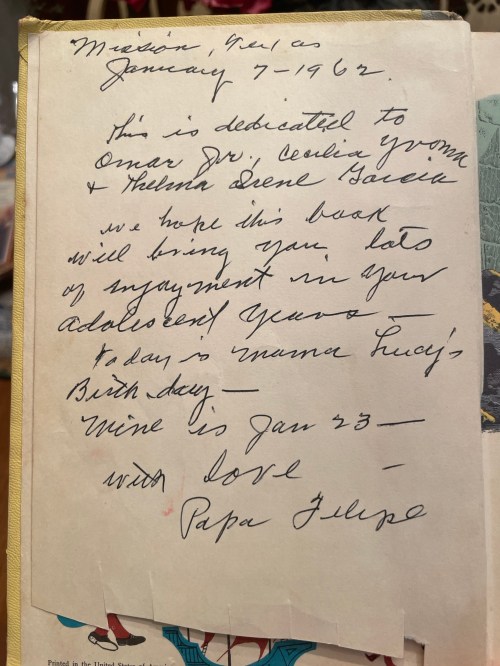
Each surviving book bears the marks of repeated use — broken spines, worn and dog-eared pages, random streaks of crayons, and pages smudged by the hands of young readers. I remember when these books were in pristine condition, personally delivered by a grandfather who loved to read and who understood how to harness childhood curiosity.

Books — lots of them, bulging with stories that begged us to read at a time when television was beginning to bewitch children. Books that introduced me to wonderful characters like Androcles and the Lion, Alice in Wonderland, Gulliver, and others who lived in worlds beyond my own.


My grandfather, perhaps unintentionally, gave us another gift — one that means more to me now than when I was a child. In the flyleaf of each book he wrote love notes to his grandchildren. Instead of letting the blank real estate at the front of each book go to waste, he used his Sheaffer fountain pen to give the words in his heart a home on the page.

I don’t know if he ever thought about what his words would mean to his grandchildren after his death, but they continue to bless. It’s interesting how ink on a page may fade through the years but how words never do.

My grandfather also wrote notes on the pages of other books in his personal library. He wrote notes about notable moments in our family history, about current events, and about other daily stuff. These brief handwritten snapshots captured moments in time and mean as much to me now as all of the old photographs in family albums. His words are weighted with encouragement, pregnant with hope, and still fertile with inspiration.

Years ago I started to do the same thing — to write love notes and to capture moments about our family history on the blank pages of the books I own. I don’t know that these little ramblings mean much to my family now, but perhaps they’ll be a blessing to read after I die.

I have about 1,500 books in my personal library, so I still have lots of writing to do. I hope that you’ll look at the flyleaf of each book you own as a canvas on which to sketch something that will encourage and inspire your loved ones, both now and after you die. Never underestimate the lasting power of a written word. Leave a legacy of love notes.

Posted by: Omar C. Garcia | October 10, 2008

The Distressing Disguise

   They just needed a place to freshen up — a little water to wash away the grime and neutralize the odors that hover around those who live on the streets. At 17 years-old, these young men are prodigies in the school of hard knocks. Each of them carries a few fragile scraps of happy childhood moments. The rest of their childhood was lost in too many places to count, broken off bit by bit by along the way by repeated blows of neglect. Their expressions bear the disfiguring scars of loneliness, but their hearts still beat in anticipation of being accepted. They walked onto our campus this week looking for a place to clean up.

   Doyle was the first to meet and to speak with these young men with matted hair, missing teeth, and all of their possessions stuffed into worn backpacks slung over tired shoulders. He listened compassionately as they spilled their stories and felt their sad words splash onto his heart. Doyle talked to them about Jesus and His unconditional love and even gave them a copy of the Bible to add to their meager inventory of possessions. He showed them where they could shower and change clothes and then invited them to join us for lunch. I am so glad he did.

   The young wanderers were grateful for a hot lunch. But, I noticed that each of them only ate half of their food and then put the rest in a to-go box. I’ve seen street kids in Mongolia do the same thing. When you are not certain where your next meal is coming from, you learn to ration your eating. We learned more about them as we sat around the table and made plans to offer some immediate assistance. Patrick helped them make a connection for pursuing a GED. We asked Jon to take them to Wal-Mart to purchase shoes and a bicycle. But most of all, we allowed them to soak their tired and wounded souls in unconditional acceptance. These guys just needed a little bit of honey and a little bit of balm.

   Several years ago my own son made some choices that led him down a nightmarish path, choices that eclipsed the light of hope in our home and hearts. Our fears were soaked with tears as we kept him tethered to life by our prayers. When we lost sight of him in the darkness I fasted for forty-two days and would have given my life to rescue him. Slowly, he emerged from the toxic fog of his destructive behavior and came to his senses, like the prodigal son of another father. So, whenever I look into the faces of kids who have lost their way, I see the face of my own son and am compelled to act in love.

   It is easy to look at kids like these or at the guys holding cardboard signs on street corners and to quickly pass judgment and pass them by. I can’t do that anymore. I can’t do it because I see the face of my son in each one and shudder at where his choices could have led him. I may not be able to offer much, but I can offer something. And, anything I offer may at least be a drop of hope on the barren landscapes of their lives. But, imagine what could happen if each of us offered a single drop of hope. It would soon start to rain, and rain can make a difference in a desert.

   Mother Teresa was compelled to help others because she loved Jesus. She told her nuns that as they walked through the slums of Calcutta they should look for Jesus “in the distressing disguise of the poor” (Created for Greater Things, page 11). Mother Teresa reminds us that when we look at the least of these we should see the face of God’s Son in each one, and then do what Jesus would do. So, determine that you will look for the face of Jesus in the distressing disguise of 17 year-old boys and homeless guys on street corners and single moms in need and widows who are lonely. And then be Jesus with skin on and love them as He would.

• • • • •

PS | God is faithful. Never forget that. I’ll be kayaking with my son on the San Marcos River on Friday … in the warm light of day.

Posted by: Omar C. Garcia | October 7, 2008

Hold the Ropes

The dramatic conversion of the Apostle Paul is recorded in Acts 9. In brief, Paul was a devout Jew who hated the followers of Christ. He secured permission from the high priest to arrest and to persecute Christians in Damascus. On the road to Damascus, Paul had an encounter with Jesus that changed the course of his life.

After his salvation, Paul began to preach the gospel in Damascus, the city where he intended to persecute the followers of Jesus. Those who heard Paul were astonished at his powerful and effective speaking. As a result the Jews became very upset and made plans to kill him.

We don’t know how, but the plot to murder Paul became known to him. Those seeking to kill Paul enlisted the help of the governor, who kept guards at the city gates in hope of catching him (2 Cor. 11:32-33). Paul was trapped in the city of Damascus with no way of escape.


Paul’s disciples, however, came up with a clever plan to help him escape. They took Paul at night, put him in a basket, secured the basket with ropes and lowered him to safety through a window. As a result, Paul was able to escape and continue his work of spreading the gospel throughout Asia Minor and beyond.

Paul was able to escape because there were people willing to hold the ropes for him.

Those who held the ropes for Paul were amazing individuals. We don’t have much information about them but can conjecture that they were not selfish because they were willing to risk their lives to help Paul. Nor are they named. They got caught in the spotlight of Scripture for one fleeting moment but their names were not recorded. And, they received no earthly honor or recognition for helping Paul.

We do know that they recognized the need to cooperate because the task could not be completed alone. They also coordinated their efforts because working in harmony was the only way to get the job done. And, they combined their strength because the task could not be done in the strength of one person.

It’s easy to overlook the people in the background who render valuable service for the kingdom. I have great admiration for rope holders. The work of the kingdom advances because of the faithful service of those who are willing to hold the ropes.

So, hold the ropes and help advance the purposes of God on the planet. Get your hands dirty, bruised, bloodied, calloused, and scarred. Don’t show up in heaven with a clean uniform and smooth hands. That would be the ultimate embarrassment.

Posted by: Omar C. Garcia | October 5, 2008

Are You Bilingual?

   Earlier this week, I was again reminded of the lasting impact of an act of kindness. Tired and in bed, the sound of my cell phone ringing startled me awake. I fumbled for my phone and took a quick glance at the Caller ID before answering. It was an overseas number — one that I did not recognize. I cleared my throat and mustered my best post-sleep hello. “Hello,” replied the caller. To my surprise, it was a Muslim friend from Pakistan. “Today is Eid,” he said, “and our village was remembering when you and Mr. Lee were with us on Eid in 2005.”

   2005 was a banner year for natural disasters. A tsunami in South Asia rushed in from the sea, swallowed up thousands of lives, and retreated with its human plunder. Hurricane Katrina busted down the door of weak levees and held Louisiana hostage. Hurricane Rita’s arrival triggered the unprecedented evacuation of our own city. And the earthquake in Pakistan simultaneously ended the lives of tens of thousands of people in a matter of minutes. In the span of just a few months, these disasters had rudely ushered thousands of souls into eternity.

   My friend Lee Pullin and I traveled to Pakistan to assist with earthquake relief efforts. With no agenda other than to allow God to guide us, Lee and I ended up in a remote village in the mountains of Pakistan’s Northwest Frontier District. The entire village had been destroyed by the earthquake. Throughout the area, many bodies had not yet been recovered. “You will smell death,” said our translator. And, we did.

   After an assessment of the damage and an inquiry into available supplies, we learned that there was no more canvas and no more tents available for the displaced. So, we improvised. We purchased empty rice and flour sacks, filled them with dirt, stacked them into walls that could survive the frequent aftershocks, and then covered their span with sheets of tin. Our model home won rave reviews. With the harsh winter coming, the people of the village embraced this temporary but life-saving solution. So, we purchased enough supplies for villagers to build their own shelters.

   The night of Eid in 2005, Lee and I sat around the campfire with our new bearded Muslim friends. In the course of the conversation, one of the men talked about how much he admired Saddam Hussein. I replied that although Lee and I had seen much in the area, we had not seen Saddam. “And,” I continued, “if he were still in power I doubt he would have sent you any aid. But, we are here — two Christians from America who love God and love people.” Our host later told us that he was struggling to understand why the only people who had come to his village were two Christian men and not any of his own Muslim cousins. He said that our unconditional kindness had caused him to think about and to see Christians in a new light.

   Kindness is a language that anyone can speak and that most people understand. I just finished reading my fourth book on Mother Teresa’s life. The author observed, “She had to speak only one language to be understood by Asians, Africans, Europeans, and Americans. Her life of service spoke the international language of love” (Created for Greater Things, page 103). When you think about it, every Christian ought to be bi-lingual. So, learn the language of love and kindness and look for every opportunity to speak it. It will help others to see Jesus and His followers in a new light.

« Newer Posts - Older Posts »

Categories