Posted by: Omar C. Garcia | March 15, 2009

Galilee | Day 3 Morn

The Unimaginable | We drove to Mount Gilboa on the morning of March 13 for our first hike of the day. Mount Gilboa is located on the southeastern side of the fertile Jezreel Valley. The hike was not difficult. However, the history of this particular place is difficult. It was here that Saul’s army camped in anticipation of doing battle with the Philistines. The text tells us, “When Saul saw the Philistine army, he was afraid; terror filled his heart” (1 Sam 28:5). Saul consequently consulted a medium that lived in Endor and learned that he and his sons would not survive the battle. Saul was critically wounded in the battle (2 Samuel 31:3) and committed suicide rather than falling into enemy hands (2 Samuel 31:4). When David, Israel’s new king, heard this news, he cursed the mountain: “O mountains of Gilboa, may you have neither dew nor rain, nor fields that yield offerings” (2 Sam 1:21).

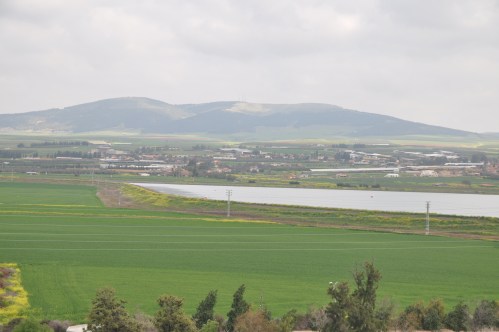
Endor as seen from Mt. Gilboa

Caution | As in the case of his earlier battle against the Amalekites (1 Sam. 15), Saul had a problem trusting and obeying God. He was too impatient to wait on God and chose to do things his own way. When we fail to trust and wait on God we are prone to do the unimaginable to deal with life’s difficulties. Saul went to a witch to get advice! Be careful where you turn for help when you find yourself on your own Mount Gilboa.

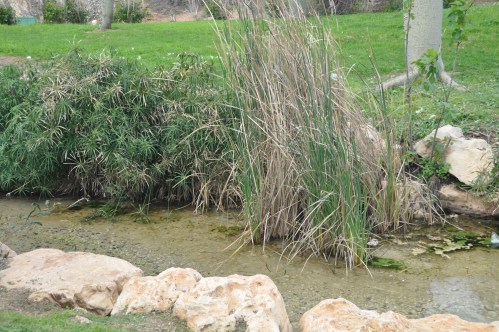
The Unexplainable | From Mount Gilboa we walked the short distance to En Harod, also known as Gideon’s Fountain. This is the place where Gideon’s hastily-assembled volunteer army of 32,000 was camped while waiting to do battle with the Midianite coalition of more than 135,000 (Judges 7). It was there that God told Gideon, “You have too many men for Me to deliver Midian into their hands” (Judges 7:2). So, God reduced Gideon’s army to only 300 men. The first to be released from service were twenty-two thousand fearful men. God then instructed Gideon to take the remainder of his men “to the water” to further reduce the size of his army. “There the Lord told him, ‘Separate those who lap the water with their tongues like a dog from those who kneel down to drink’” (Judges 7:5). God used this test to reduce Gideon’s army to 300 men. And, with only 300 men God gave Gideon an unexplainable victory over an army of more than 135,000 men. We should always keep in mind that “Nothing can hinder the Lord from saving, whether by many or by few” (1 Sam. 14:6).

En Harod | Gideon’s Fountain

Encouragement | The men who drank water did not know they were being tested. And, the Scripture does not tell us the significance of the test of drinking water. Some have conjectured that those who knelt to drink and brought the water to their mouths were more alert and kept their eyes on Gideon and their surroundings. The important thing to keep in mind is that this was a simple way to reduce the size of Gideon’s army without raising suspicion. On a practical note, this occasion reminds us to always be alert because we may not know when we are being tested. I once heard that we should make every occasion a great occasion because we can never tell when somebody may be taking our measure for a larger place.

Posted by: Omar C. Garcia | March 13, 2009

Galilee | Day 2

We spent March 12 visiting locations north and east of the Sea of Galilee. You can’t walk among these ruins without thinking deeply about the people who lived in these places. Their choices impacted generations. We can learn good lessons even from the worst examples set by these ancient peoples. Here is a quick overview of the places we visited today.

Extreme Devotion | This morning we hiked to the ruins of Gamla located on a steep mountainside east of the Sea of Galilee. The homes in Gamla were built on top of one another in stair-step fashion with the roof of one house serving as the front yard of the house above. We visited one of the oldest synagogues ever found there, a place where Jesus very likely visited as He “went throughout Galilee, teaching in their synagogues” (Matt. 4:23).

Hiking to Gamla

Gamla is best known as the birthplace of the Zealot movement, founded by a man named Judas of Gamla. The Zealots were a group of fiercely independent Jews who opposed Roman rule and taxation and sought to overthrow Rome. Rome sent an army to crush this movement when the Jewish Revolts began around AD 66. The arrival of the army created mass panic and, rather than surrender to the Romans, more than five thousand people jumped to their deaths off Gamla’s northern cliff. Thus, Gamla is often called the Masada of the north.

Reflections | As I think about the Zealots and the price they were willing to pay for what they believed, I have to ask myself what I would have done had I been in Gamla. Would I have taken my family to the edge of the cliff and led us all to jump to our deaths for what we believed? It’s easy to say yes but harder to follow-through. On the night before the crucifixion, Peter said to Jesus, “Lord, I am ready to go with you both to prison and to death” (Luke 22:3). However, Peter denied Jesus three times that night. I don’t know that I will ever die for Christ, but I should certainly be willing to live for Him.

Extreme Depravity | From Gamla we traveled to the upper Jordan Valley to Caesarea Philippi, a pagan city built by Herod Phillip, a son of Herod the Great. Caesarea Philippi was a religious center where people worshiped the Canaanite god Baal. Later, a shrine there was dedicated to the Greek half-man and half-goat god Pan. Worshipers expressed their devotion to Baal and later to Pan without moral restraint.

Gates of Hades

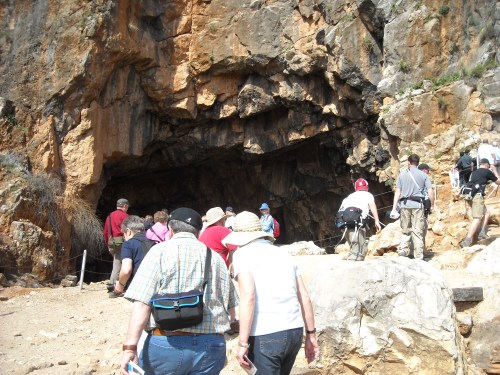
Perhaps one of the most interesting things about Caesarea Philippi is the cave that is located there. At the time of Jesus, pagans believed that caves were a door to the underworld — or the gates of Hades. And, the people who lived here also carved niches in the rock cliff and placed their pagan gods there. This rock wall was called the Rock of the Gods. Jesus took His disciples to Caesarea Philippi, a place that represented the worst evils of the day. It was there that Peter acknowledged Jesus as the Messiah (Mat. 16:13-16). In this context Jesus said to His disciples, “…on this rock I will build my church, and the gates of Hades will not overcome it” (Matt. 16:18).

Reflections | Jesus challenged the disciples to deny themselves and follow Him. He issued this challenge at Caesarea Philippi, a place where people denied themselves nothing (Matt. 16:24). Our culture is not much different from that of Caesarea Philippi. Do we have the courage to follow Him in the midst of our pagan society? We will not change the world unless we do.

Extreme Departure | Not far from Caesarea Philippi is Dan, the city regarded as the northern border of Israel (2 Sam. 3:10). We hiked through a beautiful wooded trail to the ruins of Dan. The tribe of Dan was originally given an allotment in the Shephelah where Samson, a Danite judge, fought the Philistines. However, the people lost their resolve to deal with the Philistine threat so they left the land of their inheritance and moved to the northern part of the country.

The saddest thing about Dan is their step-by-step departure from God. King Jeroboam built a high place there and provided the people with two golden calves (1 Kings 12:28). Instead of worshiping God, the people began to worship idols, which invited trouble for Jeroboam (1 Kings 14:9-10). Later King Ahab encouraged the people to worship other gods. During Ahab’s time Dan became a regional center for Baal worship. King Ahab and later King Manasseh sacrificed their own children to Baal. Eventually, God allowed the Assyrians to invade the Northern Kingdom and it ceased to exist.

Reflections | I learned about cumulative error while helping a friend build a sidewalk. Compromising a fraction of an inch on the front end will eventually lead to a big difference in the width of the sidewalk at the other end. It is easy to move away from God one inch at a time as we make bad choices and compromises even in little things. We must align our lives to God’s Word and refuse to make compromises in the midst of our pagan culture.

Posted by: Omar C. Garcia | March 12, 2009

Galilee | Day 1

The best thing about being in Israel, other than sharing the experience with friends, is learning about the geographical context of the events of the Bible. We spent March 11 visiting sites located around the Sea of Galilee. I must confess that it is hard to wrap my mind around actually being in the places I have read about for so many years — and realizing that I am walking in places where Jesus walked. We will be in Galilee for a few days, so I will give a brief overview of the places we visit and the lessons I glean along the way.

The Place of Prayer | This morning we went to Mt. Arbel, a prominent mountain ridge that rises one-thousand feet above the Sea of Galilee’s western shore. We hiked along a narrow trail that steadily winds its way up to the top of the mountain. The hike was challenging but reaching the summit made it worth the effort. From the top of the mountain we had a beautiful panoramic view of the Sea of Galilee and the cities located along its shores.

Rabbis called Mt. Arbel the prayer mountain. It is, most likely, the place where Jesus often withdrew to pray (read Matt. 14:23; Mark 1:35; Luke 5:15-16). I can understand why. It is a lonely place free of distractions, but it is also a place of perspective. From the summit you can see Capernaum, Chorazin, and Bethsaida (where Orthodox Jews lived). And you can look in the direction of Gamla (the home of the Zealots), the Decapolis (where the pagans lived), and Tiberias (home of the Hellenistic Jews).

Reflections | Climbing Mt. Arbel was hard. How much effort do I put into prayer and to praying in places free of distraction? And, how much perspective do I have when I pray? Am I aware of the needs of those around me?

Pastor Brian Haynes Teaching at Tabha

The Place of Calling | From Mt. Arbel we traveled the short distance to Tabgha, a small area located on the northwestern shore of the Sea of Galilee. Tabgha means “seven springs” and it is believed that the warm water from these springs attracted schools of fish, making this area an ideal place to fish. It is very likely that Jesus called Peter, Andrew, James, and John to follow Him at Tabgha. “’Come, follow me,’ Jesus said, ‘and I will make you fishers of men’” (Mathew 4:19). Jesus used the figure of their old work to tell them what their new work would be. Each of these men willingly left behind everything familiar to them in order to follow Jesus. The key point in this verse is that Jesus cannot make us into anything if we will not follow Him.

Reflections | Am I willing to follow Jesus even if it means leaving behind the things that are familiar, comfortable, and manageable? Following Jesus can be hard. Refusing to follow Him can be harder. The only way to become what He intends for me to be is to follow Him.

The Place of Teaching | We walked to the mountainside near Tabgha where Jesus taught the crowds the Beatitudes, one of Jesus’ most popular teachings (Matt. 5:1-12). The mountain was blanketed with beautiful yellow wildflowers with random blue, red, and purple flowers competing for attention. We took a moment to read and discuss the Beatitudes while imagining what it must have been like as the people from the surrounding villages listened to Jesus’ refreshing and practical instruction.

Reflections | Jesus taught the people of His day through the use of simple and memorable lessons. He often told stories they could relate to and never used words they could not understand. He talked to crowds and to individuals and took the time to listen to them. Jesus’ example challenges me to walk slowly among people and to listen and speak to them as He would.

The Place of Family| I enjoyed our walk through the ruins of Chorazin where we looked at a typical Jewish home. Generations of Jewish families lived in clusters of buildings called insulas. These buildings were built around a central courtyard. As sons married, they added another room to the family insula. However, a son could not bring his bride home until his father approved that the new addition was complete. Jesus used the image of the insula in John 14:2, “In my Father’s house are many rooms … I am going there to prepare a place for you.” And then one day, when the Father says all is ready (see Matt. 24:36), Jesus “will come back and take you to be with me that you also may be where I am” (John 14:3).

Reflections | Jesus is preparing new rooms, not mansions, for His followers in the insula of heaven. I must live daily in community with the household of faith and eagerly watch for His return.
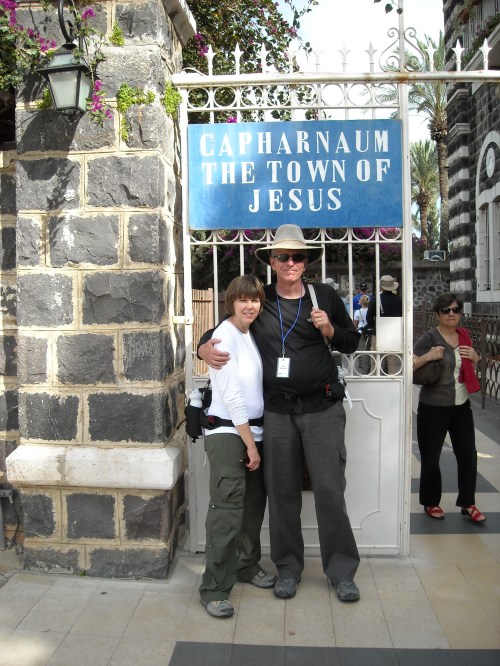
Westervelts at Capernaum

The Place of Jesus | We visited Capernaum this afternoon, the place Jesus chose as His base of operations when He began His ministry. Capernaum was known as Jesus’ home (Matt. 9:1 and Mark 2:1). We walked through the local synagogue where Jesus taught. This synagogue had a large school, suggesting that the people placed a high value on education. However, the saddest note about Capernaum is that the people there did not accept Jesus’ messianic role. Jesus therefore said to the people of Capernaum, “…If the miracles that were performed in you had been performed in Sodom, it would have remained to this day. But I tell you that it will be more bearable for Sodom on the day of judgment than for you”  (Matt. 11:23-24).

Reflections | Like the people of Capernaum, many people today miss Jesus. Despite the availability of resources and access to those who can help them understand, they fail to embrace who He is and why He came. We must work to make certain that the people in our own homes and hometowns know Jesus.

The Place of Healing| We concluded our day at Bethsaida. Mark recorded an account of a miracle that Jesus performed in two stages at Bethsaida (Mark 8:22-26). A blind man was brought to Jesus. Jesus took the man aside, spit on his eyes and laid hands on him, and then asked him if he could see anything. The man replied that he could see men, but they looked like trees walking about — an indication that his sight was blurry. Jesus laid His hands on the man’s eyes a second time and, as a result, the man could see everything clearly.

Reflections | Jesus could have healed the blind man with one touch. Instead, He chose to touch the man a second time. I’m glad He performed this particular miracle in two stages because it serves to remind me that insight often comes slowly. I want for Jesus to touch my eyes again so that I might see others clearly and with greater insight.
Posted by: Omar C. Garcia | March 11, 2009

The Negev

We spent March 10 hiking and climbing in the Negev, which means “dry land.” Located in the southernmost part of the country, the Negev served as the buffer between ancient Israel, Egypt, Edom, and the trade routes of the desert. Although I am a bit tired and a day behind on my posts, I wanted to write a quick word on what we saw and the prayer that God impressed upon me at each site.

The Sea | We started our day early in the morning on the shores of the Dead Sea, the lowest spot on the planet. The Dead Sea lies almost 1,300 feet below sea level in the Jordan Rift Valley between the Wilderness of Judah to the west and the mountains of Moab to the east. Nothing lives in the Dead Sea – no fish or seaweed or plants of any kind. That’s why it’s called the Dead Sea. Water flows in but it does not flow out. When ancient travelers came across the barren mountains of the wilderness of Judah and saw the water here, everything appeared normal and inviting. Imagine their disappointment when they discovered that this water would never quench their thirst.

My Prayer | Lord, it’s easy to become like the Dead Sea if all we do is to attend church but never be the church. Please help me to intentionally allow the truths I take in to flow out and refresh others by doing what you ask me to do.

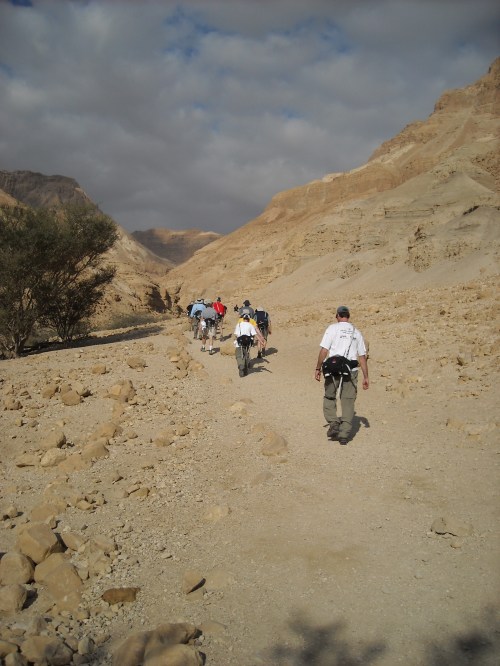
Hiking into En Gedi

The Spring | From the shores of the Dead Sea we made our way to En Gedi, a major oasis along the western side of the Dead Sea. This is the place where David hid when he was fleeing from Saul (1 Samuel 23:29). We hiked through the Crags of the Wild Goats where Saul took three thousand men to look for David and his men (1 Samuel 24:1-2). At the end of our hike between steep canyon walls we stopped at a hidden waterfall flowing from the rocks. Unlike the water in the Dead Sea, this was living water – cold and refreshing. This water does not disappoint. The desert is a metaphor for how and where we meet God. In the desert water is life and in the Bible water is one of the central pictures of God (Psalm 42:1 and 63:1).

My Prayer | Lord, I don’t want to go through life taking little sips of living water — I want to dive in and to be completely immersed. I want to always thirst for you like a traveler in a dry and weary land where there is no water. Let me be content with nothing less than giving all of me to all of you.

The Mountain | Not far from En Gedi is the imposing mountain fortress known as Masada. Rising 1500 feet above the level of the Dead Sea, we hiked up the Snake Trail to the top of Masada. When Jerusalem fell to the Romans in AD 70, 960 people followed the Jewish patriot named Eliezer Ben Yair to this rock plateau fortified by Herod the Great. The Roman army pursued and besieged them for two years. Rather than surrender to the Romans when the end was near, all but five people took their own lives. Consequently, Masada has become to Israel what the Alamo is to Texas. “Masada will never fall again,” is the firm resolve of the Jewish people.

On an “it’s a small world note,” while hiking down the mountain I met a mother and daughter from Chile. We talked about travel with a purpose as we made our way down the Snake Trail. When I mentioned that I had recently volunteered at Mother Teresa’s homes in Kolkata, the daughter told me that she had also volunteered there last summer. This is just one more testimony of Mother Teresa’s powerful legacy. Twelve years after her death, Mother Teresa continues to inspire people from all over the world to serve the poorest of the poor.

My Prayer | Lord, you are my rock, my fortress, and my deliverer. Help me to seek refuge in you alone. Thank you that when the enemy attacks and besieges me, I can look to you as my shield and the horn of my salvation.

The Caves | Qumran is located just west of the northwestern edge of the Dead Sea. It’s the place where a young Bedouin shepherd boy discovered the Dead Sea scrolls in a cave in 1947. And, it’s also the place where the Jewish sect called the Essenes lived. The Essenes set themselves geographically apart so that they could pursue complete devotion to God. They also were responsible for the copying and studying of Scripture. We visited the place where these devoted followers of God preserved and copied the Scriptures and then hiked into the surrounding mountains to look at the caves where they hid their manuscripts when the Roman army threatened their existence in AD 70.

Brian offered our weary team an optional hike to the top of one of the mountains between the Judean wilderness and the Dead Sea. Along with others, I took him up on the offer. It was a grueling climb. When we reached the top, Brian challenged us to recommit ourselves to be people of the text. Each of us pledged our commitment by writing out our intention on a rock and then placing it on a pile of similar rocks left by earlier visitors. This alone made the long climb worthwhile. I also took this opportunity to write a birthday greeting to Niki, my oldest daughter. I placed both of our rocks side by side on the mountain. I am not a perfect parent and Niki is not a perfect kid, but we have both learned to trust the text – God’s precious Word – to guide us. I am thankful that she loves Jesus and the text.

My Prayer | Lord, thank you for the Essene community and their diligent and careful work to preserve your Word. Like the Essenes, may I always be consumed with longing for your Word at all times. Help me to honor my commitment to be a person of the text. And thank you for blessing our family with Niki, a daughter who loves you and the text.

dads-rocknikis-rock

Posted by: Omar C. Garcia | March 9, 2009

The Shephelah

Wow! What a day. It’s hard to explain, but being here has helped a lifetime of Bible study to come alive for me. We spent most of today hiking in the Shephelah and then made our way to the Dead Sea, the lowest spot on the face of the earth. Shephelah is a Hebrew word that means “lowlands” or “foothills.” It is the area that separates the coastal plains to the west and the Mountains of Judea to the east. Perhaps the best-known thing that happened in the Shephelah was the battle between a young shepherd boy named David and a Philistine giant named Goliath. Here are a few of the things I thought about as we stood atop Azekah and surveyed the Valley of Elah where this famous battle was fought.

Overlooking the Valley of Elah

S = Strategic | The Shephelah was a strategic region that separated the pagan Philistines, who lived along the coastal plains, from the Israelites, who lived in the Mountains of Judea. This is the area where worldviews collided in the days of Samson (Judges 13-16), Saul (1 Samuel 17), and others. The Shephelah was the piece of real estate where two cultures met – God’s people and the pagan Philistines. Whoever controlled this region shaped the culture of this part of the world. When you think about it, there is a Shephelah in each of our lives. And, whoever wins the battles fought there shapes our lives.

H = Helpless | The Shephelah is a place where we often feel helpless. The challenges are great and there seems to always be a giant to contend with. Goliath had defiantly taunted the Israelite army for forty days (1 Sam. 17:16). Forty is a number that represents testing in the Bible. Goliath’s psychological warfare was so effective that nobody wanted to face him. His imposing presence weakened the resolve of the Israelites and sent them scurrying for cover (1 Sam. 17:24). Who or what weakens your resolve, frightens you, and makes you feel helpless in your Shephelah?

E = Expectations | The Shephelah is a place where we can expect opposition, not just from the enemy, but from family and friends as well. Eliab, David’s oldest brother and a soldier in King Saul’s army, was angry with David for leaving the family’s few sheep to “come down only to watch the battle.” He called his little brother “conceited” (1 Sam. 17:28). Those who do not understand us may raise demoralizing objections and insults. However, like David, we must not lose heart.

P = Perspective | The Shephelah is a place where we can easily lose perspective. For forty days the Israelites had been saying, “Do you see how this man keeps coming out? He comes out to defy Israel. …” (1 Sam. 17:25). Saul’s army referred to Goliath as “this man.” However, David referred to Goliath as “…this Philistine … this disgrace … this uncircumcised Philistine …” (1 Sam. 17:26). David’s perspective was entirely different. He saw the nine-foot-plus sized giant as an enemy that should be cut down to size. Ask God to help you keep things in proper perspective in your Shephelah. Don’t allow the giants to frighten you away. While the giants you face may be bigger than you, God is bigger than the giants.

H = Hero | The Shephelah is the place where heroes are made. Goliath was the Philistine’s champion but David became the Israelite’s hero. Had he returned home because of his oldest brother’s objections, this story might have had a different ending. What battles do you need to win in your Shephelah? How will the outcome of those battles change if you refuse to fight? Ask God to give you the courage to heroically face your giants and win the battle.

E = Equip | The Shephelah is a place where you must decide how you will fight. Saul tried to dress David in his armor (1 Sam. 17:38-39), which would have exposed David to greater danger because Saul’s armor did not fit him. David preferred to fight using only his sling and “five smooth stones” (1 Sam. 17:40). David intentionally “chose” the stones because something very great was at stake. This morning, we hiked to the stream where David had selected his stones and then selected our own stones. Looking out across the valley I tried to envision what David might have seen. I don’t know what battles you face in your Shephelah, but make sure you have the proper equipment.

L = Language | The Shephelah is a place where positions and intentions are defined. Goliath used language to define his position (1 Sam. 17:8-10) as well as his intentions (1 Sam. 17:43-44). He cursed David and threatened to feed his remains to the birds and beasts. David also used language to define his position and intentions (1 Sam. 17:46). Both Goliath and David knew what was at stake. What is at stake in your Shephelah? What will happen if you choose to act or to walk away and how will your decision impact you and the next generation?

A = Action | The Shephelah is a place of action. You cannot remain passive in the Shephelah and hope that things will get better. You have to take a stand and make a move. As Goliath moved to attack David, the young shepherd boy “ran quickly to the battle line to meet him” (1 Sam. 17:50). David trusted in God but was also prepared. I once heard someone say that success happens when preparation meets opportunity. Are you ready for action? Be prepared to take your stand and make your move in defense of what is worth fighting for in your Shephelah.

H = Honor | David’s actions honored God and inspired the troops. David revealed his motivation for facing Goliath. He wanted the whole world to “know that there is a God in Israel” (1 Sam. 17:46). David was not interested in making his own name famous. He was interested in God’s honor, in making God’s name famous. And, his actions inspired Saul’s demoralized troops. These once fearful soldiers “surged forward with a shout and pursued the Philistines” (1 Sam. 17:52). Just imagine what God might do through you if you will face the giants in your Shephelah.

We ended our day by floating in the Dead Sea. As my tired body bobbed effortlessly in the water, I could not help but think about shepherd boys and giants, mountains and valleys, and the difference one smooth stone in the hands of a determined individual can make. What’s going on in your Shephelah and what are you willing to do about it?

Posted by: Omar C. Garcia | March 8, 2009

Follow the Rabbi

At 3:30 PM today, I smiled as Continental flight 90 gently bounced onto the tarmac at Ben Gurion International Airport in Tel Aviv. Although I am privileged to lead short-term volunteers on missions initiatives all over the world, I have never made the time to visit the Holy Land. Today, all of that changed. I actually get to be a participant instead of a leader. I get to follow the rabbi. Brian Haynes, Kingsland’s Associate Pastor, is leading our team of thirty on a study tour of the Holy Land in a rabbinical style. We will follow him, on foot, over the next several days as he leads us to ancient sites in order to teach us relevant truths.

Once we secured our luggage we boarded our bus and made our way toward Gezer, a major Canaanite city located on the edge of the foothills of Judah near the Shephelah. The Shephelah is the area between the coastal plains and the Mountains of Judea. I’ll write more about the Shephelah tomorrow.

The ancient city of Gezer was an important city that was strategically located at the junction of the Via Maris and the road leading to Jerusalem. We hiked a couple of miles across ancient ruins to what is left of the city gates. Brian stood on the ruins of the gates built by Solomon as he told us the story of Gezer. When Solomon disobeyed God and took for himself foreign wives, he married a daughter of pharaoh. His Egyptian father-in-law captured Gezer from the Canaanites and gave it to Solomon as a wedding gift. Gradually, Solomon’s wives turned his heart from God (1 Kings 11:1-6). Gezer, Solomon’s wedding gift, stands as mute testimony to his gradual departure from God.

Pastor Brian Haynes near Gezer

A short walk from Gezer we stopped at a row of standing stones believed to have been one of the high places, an ancient Canaanite sacrificial site. Nobody really knows for certain the story of these stones that have defiantly survived the centuries. Standing on what was likely a Canaanite sacrificial altar, Brian led us through a study of standing stones in the Scriptures, such as the stones Joshua had placed to commemorate the crossing of the Jordan (see Joshua 4:1-9). We examined several passages and concluded with 1 Peter 2:5, “you also, like living stones, are being built into a spiritual house to be a holy priesthood, offering spiritual sacrifices acceptable to God through Jesus Christ.” We stood as living stones looking at the row of dead stones someone had planted in the rocky ground near Gezer centuries ago.

Brian pointed out that all of the standing stones in Scripture have a story. “But, these dead Canaanite stones do not have a story,” he continued. “We are to be living stones,” Brian said, as the last rays of the sun disappeared below the horizon. Living stones have a story. However, we are most like the dead stones near Gezer when people do not know our story. We paused to pray that we would take seriously our responsibility to remain faithful to God, obey His Word, and tell others our story of how He made us into living stones. We hiked out of Gezer in the dark, following the rabbi and watching out for each other, more determined to tell the world our story. The adventure continues at 6:30 AM tomorrow.

Posted by: Omar C. Garcia | March 7, 2009

Deuteronomy 4:14-43

• Encouragement and Warning | Deuteronomy 4:14-40

4:14-20 | Moses reminded the people of the importance of obeying God’s Word (4:14) and warned them against making and worshiping idols (4:15-18) and/or worshiping celestial bodies/nature (4:19). They were to be completely devoted to the Lord. Verse 19b suggests that while other peoples looked to the heavens for evidence of a greater being, their relation to God was based on His deliverance of them from “the iron furnace, from Egypt, to be a people for His own possession, as today” (4:20).

4:21-24 | After reminding them that he would not be permitted to enter the Promised Land (4:21-22), Moses again warned the people to be careful lest they violate the contractual agreement made with God at Horeb by making and worshiping idols (4:23), a particularly loathsome thing to God (4:24).

4:25-31 | Moses prophetically spelled out the consequences of forsaking God for the worship of idols (4:25-26). E. Stanley Jones said, “Anything less than God will let you down.” Interestingly, Moses declared that the punishment would fit the crime — idol worshipers would be carried into exile where they would have their fill of idolatry (4:27-28). Yet, even in exile, God would continue to mercifully give the people the opportunity to repent (4:29-31).

God alone is worthy of our worship. | Moses’ message included stern warnings against involvement in idolatry, a particularly loathsome thing in God’s sight. One cannot read Moses’ prophetic account of the consequences of embracing idolatry without thinking of the fall of both the Northern Kingdom of Israel and the Southern Kingdom of Judah. God alone is worthy of our deepest devotion and our highest praise. He alone is worthy of our worship.

4:32-40 | These verses are the conclusion of Moses’ first message to the people. Moses challenged the people to compare their unique history to that of other nations (4:32-34). Verses 32-34 form an answer to the question asked in verse 7, “For what great nation is there that has a god so near to it as the Lord our God whenever we call on Him?” They were privileged to witness great wonders (4:33-34, 36) to the end that they “might know that the Lord, He is God; there is no other besides Him” (4:35). Verses 37-38 form the basis for the exhortation to faithfully follow the Lord (4:39). The phrase “that it may go well with you” (4:40) occurs eight times in Deuteronomy and emphasizes the motive for obedience. Their life, well-being, and security in the Promised Land were directly dependant on their loyalty to God (4:40).

• Cities of Refuge | Deuteronomy 4:41-43

4:41-43 | Read Numbers 35:9-15 for background information. These verses briefly address the provision made for refuge for those who unintentionally kill another. The cities of refuge were established to insure that such individuals would find asylum until they could stand trial (Numbers 35:12 and Joshua 20:9). The cities of Bezer, Ramoth, and Golan were located east of the Jordan. Joshua later established Kedesh, Shechem, and Kiriath-arba (Joshua 20:7) as cities of refuge on the west side of the Jordan (Joshua 20).

Posted by: Omar C. Garcia | March 6, 2009

Clean Stories

Reports of our Caring for Katy Day continue to come in via e-mail. The One Spirit Adult Bible Fellowship stationed themselves at Laundromats in Katy. They paid for the laundry costs for everyone who walked in to do their laundry and also provided soap and dryer sheets for these patrons. Here is what they experienced as they cared for Katy on Sunday, March 1, 2009.

Tabitha Williams | Served with the group at the Laundromat at Franz and Avenue D. Tabitha reported…

The one thing that touched me was this lady and her husband who walked in. They were bringing laundry that you pay by the pound to have washed. She brought in several piles to the guy and he weighed it. I happened to be standing there and I asked the guy to tell me how much it cost because I decided we’d pay for it. She heard me and was so grateful. She said, “Thank You Jesus.” It was really cool.

She said that she was there because she has been taking care of her mother who is blind and has diabetes. She comes in once a month to bring all her laundry. She asked me what church we went to that was doing this and I told her Kingsland Baptist Church and told her where it was. She had heard of it said she would take an offering or something to the church and she wrote my name down. However, I felt lead to do this — all I told her was to just go bless someone else sometime when she got the chance. She said she would most definitely do that.

She and her husband thanked us very much as they left. I just thought that was really neat because by us being there today, we had such an impact on her and then that will impact her mother and most likely someone else. God is so cool how He works! The other thing I thought that was cool was how people would come up to us and give us their quarters that they were going to use. So we were able to bless others with it.

Luty Luna | Served with the group at the Laundromat at Pin Oak. Luty reported…

It was a great joy for me to see the happiness on their faces for the help that we provided. It was very hard to listen to their stories and hardships that they are facing here in a foreign country just to provide for their families. What matters most was that they were open to listen to God’s Word. We had planted the seed. God will do the rest.

Terri Sukey | Served with the group at the Laundromat at Fry and Franz. Terri reported…

The manager at the Fry Road Washateria was so touched and grateful for our volunteers. He suggested that we branch out to an additional location in Katy on Franz at Avenue D, which we did, where the people were “even more needy” than his customers. The customers at the Washateria were reluctant when we initially approached them. Once they understood our intentions the reluctances turned to appreciation. The looks on their faces when they realized what we were doing was one of amazement and joy. Some had tears in their eyes. One family of 5 gave hugs to all of the volunteers and thanked everyone as they left.

Food is a great barrier breaker. We passed out drinks, donuts and kolaches. We had candy bags with Bible verses that we passed out to the kids. These small gestures provided an opportunity for many conversations.

The energy and enthusiasm generated in our group was evident when we teamed up for lunch. The excitement was intoxicating. I believe that God is working in the hearts and lives of our group. I praise God for weaving His love throughout our group and bringing together a wonderful family of friends.

• • • • •

Note | Read more about our second annual Caring for Katy initiative.

Posted by: Omar C. Garcia | March 6, 2009

Deuteronomy 4:1-13

• Encouragement and Warning | Deuteronomy 4:1-13

4:1-4 | The fourth chapter begins with a “therefore” kind of transition. Because of the goodness of God on behalf of His people (reviewed in chapters 1-3), Moses challenged them to respond with gratitude, devotion, and obedience to God (4:1). Their success in the Promised Land would be directly linked to their obedience to God’s Word. Moses warned the people to not add or take away from God’s Word (4:2). He recalled an incident recorded in Numbers 25:1-5 in which many people were led astray and committed acts contrary to God’s Word (4:3-4). These individuals suffered swift judgment, which served as a warning to any others brazen enough to commit similar transgressions in violation of God’s commandments.

God’s instructions cannot be ignored with impunity. | Moses made clear to the people the importance of obeying the commandments of God. He also spelled out the dangers of disobeying God’s Word. He emphasized that it is not possible to ignore God’s instructions and be exempted from punishment or penalty. Proverbs 13:13 reminds us, “Whoever despises the Word [of God] brings destruction upon himself, but he who (reverently) fears and respects the commandment [of God] shall be rewarded” (Amplified Bible).

4:5-13 | Moses exhorted the people to obey God’s Word (4:6). Their obedience to God’s word would make them distinctive in the eyes of other nations (4:7) not favored with the possession of such righteous statutes and ordinances (4:8). Moses also exhorted the people to “give heed … lest you forget” the mighty acts of God on their behalf and to share the accounts of those acts with their sons and grandsons (4:9). Deuteronomy repeatedly stresses the responsibility of parents to teach their children the great truths of God’s Word, works, ways, and deeds. Moses also recounted the awesome events surrounding the giving of God’s law (4:10-12) and the establishment of the covenant (4:13). He exhorted the people to remember those events (4:10) to the end that they would obey God’s commandments and worship Him alone.

Parents are the primary faith trainers. | Moses charged parents with the responsibility of teaching God’s Word and recounting the acts of God to their children and to their children’s children. Failure to do so would result in a generation insensible to God and ignorant of His commandments. Parents still have the primary responsibility to instruct their children in God’s Word and in spiritual matters. The task cannot be left solely to the church. Only as parents (and the local church) fulfill their responsibility will youth be equipped to live in a way that pleases God.

Posted by: Omar C. Garcia | March 5, 2009

Deuteronomy 3:18-29

• Encouragement to Possess the Promised Land | Deuteronomy 3:18-29

3:18-22 | These verses recount the specific conditions to be met by the tribes of Gad, Reuben, and Manasseh in order to receive their desired allotment of land east of the Jordan. These tribes were required to assist their fellow Israelites in the conquest west of the Jordan. By so doing they would fulfill their obligation to the Lord and to Israel (Numbers 32:22) and be free to return to their homes east of the Jordan. The tribes agreed to the terms. Read the parallel account in Numbers 32 for more details. Moses also encouraged Joshua, the soon-to-be new leader of the Israelites, to boldly lead the people in the conquest of Canaan (3:21-22).

3:23-29 | Moses earnestly pleaded with God for permission to cross the Jordan (3:23-25), but his request was denied (3:26). God instructed him to go to the top of Mount Pisgah (also called Nebo) to see the land (3:27) and to charge, encourage, and strengthen Joshua with the responsibility of leading the people into the Promised Land.

Obey God. | The book of Deuteronomy admonishes us to be totally obedient to God. The Bible does not hide or mask the stories of its great men who paid the consequences for their disobedience — Adam was driven out of the garden; Moses was not allowed entrance into Canaan; Saul was deprived of his kingdom. If God will hold His chosen leaders accountable for their disobedience, He will hold us accountable as well. We should obey God, regardless of pressure to do otherwise.

« Newer Posts - Older Posts »

Categories