• Obedience Results in a Bountiful Land | Deuteronomy 11:10-17
11:10-17 | Moses informed the people that the land of Canaan was not like the land of Egypt. The agricultural potential of Canaan was far greater than anything they had known in Egypt (11:10-12). He told the people that they could depend on God to send rain from heaven for their crops and cattle (11:14-15) as long as they remained obedient to Him and served Him (11:13). He cautioned them to watch themselves lest they be led spiritually astray and serve and worship other gods (11:16) and thus incur the wrath of God (11:17). God would not tolerate a divided loyalty from His people. Following after other gods would shut the rains from heaven and cause the people to quickly perish from the land (11:17).
• Teach These Words to Your Children | Deuteronomy 11:18-25
11:18-21 | These verses are similar to Deuteronomy 6:6-9. They reemphasize the importance of comprehensively communicating the truths of God’s word to the next generation. Parents cannot effectively communicate the importance and truths of God’s word to the next generation apart from spending personal time with their children. Someone has noted that children spell love “T – i – m – e.” Moses urged parents to communicate with their children in the following ways.
Personally | The communication of God’s word must begin with the communicator. “You shall therefore impress these words of mine on your heart and on your soul … “ (11:18 and see also Deuteronomy 6:6). You cannot teach others what you do not know, nor can you convince others of the importance of what you do not observe.
Privately | “talking of them when you sit in your house” (11:19). Parents should create an atmosphere in the home that fosters open communication, a place where children will ask questions about God.
Publicly | “and when you walk along the road” (11:19). Jesus taught many valuable lessons to His disciples as they walked along the road.
Persistently | “and when you lie down and when you rise up” (11:19). Parents should verbally and non-verbally communicate the importance of loving and obeying God both day and night.
Visually | “and you shall bind them as a sign on your hand … forehead” (1:18), “and you shall write them … “ (11:20). Experts say that our learning is 89 percent visual, 10 percent auditory, and 1 percent through other senses.
We should remind ourselves to remember. | Any person who wants to ‘remember’ can find a way to be reminded. Moses urged the people to employ various means to remember and communicate the importance of God’s word.
11:22-25 | Moses reminded the people that the successful conquest of the land was not dependent on their military superiority but on their careful observance of God’s commandments (11:22-23). If the Israelites were careful to observe God’s commandments, God promised to enlarge their boundaries in the land (11:24 and see also Joshua 1:3) and grant them success in battle (11:25). Isaiah 60:12 emphasizes the importance of nations relying upon God: “For the nation and the kingdom which will not serve you will perish, and the nations will be utterly ruined.”
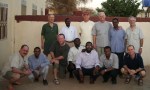
 Our team was tasked with assessing various aspects of the relief work. We will spend the next couple of days debriefing with those who serve here. Hopefully our observations and recommendations will result not only in lives saved, but in helping the beneficiaries of the aid offered by Christian NGOs understand that God loves them. No single individual or NGO can do everything that is necessary to help the displaced peoples living in Darfur. But the combined and cumulative contribution of each is resulting in lives saved. My friends and I will continue to speak for those who have no voice. I am leaving Darfur, but Darfur will never leave me.
 I especially love the children. They are absolutely beautiful. How sad that many children here progressively learn to hate. The soldiers who have been destroying villages, raping young girls, and murdering innocent civilians were all children at one time. Somehow these “once upon a time children turned soldiers” were shaped and influenced by a worldview that does not respect the sanctity of life. It’s hard to understand how people can so totally brutalize others, especially their own people.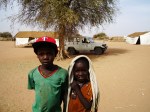
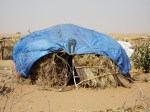 My impression is that Zamzam appeared more desperate than Abu Shouk. I spoke with one man who has been in the camp for almost a year. When his village was attacked by the Janjaweed, he managed to escape with a few of his animals. However, his animals all died along the way as he traveled the long distance from his home to Zamzam. Another young lady told me that she and her mother had been in the camp for three months. These people and tens of thousands of others are now living in houses made of sticks and covered with sheets of plastic donated by NGOs. Somehow, these displaced peoples have managed to build their new community with the barest of essentials.
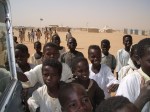 As we drove into the camp, children ran up to meet our vehicle. They were so happy to see us and greeted us with smiles. Our vehicle was quickly surrounded by children who reached out to touch us, to make a connection. I could not help but pray that these children will not be tipped from innocence to hatred by what is happening here. We have already seen enough teenagers with guns in our short time here.
 Abu Shouk is a sobering sight that brought the reality of what is happening in Darfur into sharp focus. It is a vast community of tiny mud-brick homes, straw homes, and occasional blue tarps formed into tents accenting the dusty brown plain outside of Al-Fashir. Not a shade tree in sight. Mothers holding children were lined up at every water well, waiting their turn to fill plastic jugs with the water that keeps them tenuously tethered to life here. The lines at every well were long and snaked out in every direction. This is job number one for mothers and older children. Families have to have a representative at the well at all times. Water and shade is the only ammunition the people have to fight off the strangulating heat.
 After a quick night’s sleep, we awoke early this morning and headed to the airport for our 8:00 AM flight to Darfur. The NGO we are working with was able to book seats aboard a twin-prop United Nations flight to Al-Fashir, the capital city of North Darfur. We quickly ascended to our modest cruising altitude above the barren, brown landscape below. The absence of anything green served as a sobering reminder that the odds are stacked against anything or anyone wanting to stake a claim on life here. I could see the burned-out remains of what once were villages whose inhabitants are either dead or struggling to survive in the displacement camps we will soon visit. As we started our descent, the intimidating landscape below came into sharper focus. We landed with a single bounce and rolled to a stop. No tarmac. When our pilot stepped into the cabin and opened the door, the searing heat of Darfur rushed in to greet us.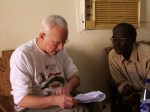
 Every beat of God’s heart is recorded on the pages of Scripture. Listen carefully as you read your Bible and you will hear His divine heartbeat. From the moment Adam and Eve took their first steps away from God, you can hear the beat of God’s missionary heart. Feel the intensity of God’s heartbeat in the Garden as He hints of His plan to redeem His fallen creation (see Gen. 3:15). Sense the pain in His heart when He “saw how great man’s wickedness on the earth had become” (Gen. 6:5-6). Listen to the steady beat as a man named Abram “believed the Lord” (Gen. 15:6) and became the father of a great nation. Feel the strain as God dealt with His stubborn and rebellious people. Listen to the anguished beats of God’s heart as His only Son died for us on a cross. Feel the quickening pulse as God rolled away the stone from the tomb to see His Son emerge the victor over sin and death.
 Go Beyond