Posted by: Omar C. Garcia | April 18, 2009

Deuteronomy 6:16-25

• A Call to Obey God’s Commands | Deuteronomy 6:16-19

6:16 | Moses knew that the people would face many difficult situations in the Promised Land in which they would be tempted to doubt God’s sovereignty and care. He reminded them of the experience of their fathers at Rephidim (Exodus 17:1-7) where there was no water for them to drink. Rather than trusting in God, who had parted the Red Sea (Exodus 14:13-31) and miraculously made bitter waters sweet at Marah (Exodus 15:22-26), the people grumbled against Moses. The attitude of the people is recorded in Psalm 78:17-20 and Psalm 95:8. When they came to a place with no water they quickly forgot the God who had delivered them by parting an entire sea of water. Instead of trusting God, they put the Lord to the test by making their obedience to Him contingent on His meeting their demands. Moses warned the people to not put the Lord to the test as they did at Rephidim. The place near Rephidim where Moses struck the rock was named Massah [test] and Meribah [quarrel] in commemoration of the people’s lack of faith in God.

6:17-19 | Moses again exhorted the people to observe God’s commandments. Their success in the Promised Land was dependant on their obedience to God. They were to “do what is right and good in the sight of the Lord” (6:18) rather than what is expedient in the sight of men. God’s will was to be their standard of conduct.

• Instructions Concerning Children | Deuteronomy 6:20-25

father-and-son16:20-25 | Verse 20 reaffirms the importance of passing the faith on to the next generation. The covenant and commands were not intended for one generation only. They were to be passed on from generation to generation. Moses understood the inquisitive nature of children. He told the parents that the day would come when their children would ask them why they lived as they did (6:20). On that day, parents were to thoroughly explain the story of God’s redemptive activity to their children (6:21-23). Moses offered an outline of the answer parents should give to their children. It is simple enough for a child to understand: First, slavery in Egypt (6:21a). Second, miraculous deliverance out of Egypt “with a mighty hand” (6:21b-22). Third, the journey to the Promised Land (6:23). In addition, parents were to emphasize the practical benefits of obeying God’s commands, “for our good always and for our survival” (6:24), and that obeying God’s commands will result in righteousness (6:25).

We should encourage our children to ask questions about God. | A Persian philosopher gave the following answer when asked concerning how he had acquired so much knowledge: “By not being prevented by shame from asking questions when I am ignorant.” Children are inquisitive by nature. Parents should encourage their children to ask questions about God and be prepared to answer those questions.

Posted by: Omar C. Garcia | April 16, 2009

Taking Chance

When one falls, another brings him home.

Vandertulip

Vandertulip

I met Josiah Vandertulip when I served on staff at Plymouth Park Baptist Church in Irving, Texas. Josiah and several other high school seniors were guests in our home during a student discipleship weekend. I remember talking with him about King Josiah, the brave king who instituted much-needed reforms in Judah. Like his namesake, Josiah was also a brave young man. He joined the military and volunteered to fight in Iraq, hoping that his service might keep some husband or father from having to go to war. On October 14, 2004, his patrol came under enemy fire in Baghdad and 21-year-old Josiah was killed. Several days later I went to the funeral home and stood silently before the open casket holding Josiah’s remains. Tears welled up in my eyes and my throat tightened as I reflected on Josiah’s selfless commitment and personal sacrifice. Josiah’s funeral service was held in the courtyard of the church where he was given full-military honors. And, his name is now inscribed in a monument at Irving’s Veterans Memorial Park along with the names of other Irving residents who gave their lives in service to our country.

Until recently, I had absolutely no idea of the steps the military takes to return the remains of our fallen soldiers to their families. However, that changed last week after I watched Taking Chance, a movie recommended by a friend. In this movie based on actual events, Kevin Bacon portrays Lieutenant Colonel Michael Strobl, USMC, who volunteered to escort the remains of 19-year-old Lance Corporal Chance Phelps to his family in Dubois, Wyoming. Chance was killed by hostile fire in Al Anbar Province, Iraq in April 2004. The film gives a behind-the-scenes and intimate look at how a uniformed escort accompanies a fallen hero home to ensure that the remains are treated with the utmost dignity and respect along the way. This movie touched me deeply. I could not hold back my tears as I watched it.

I don’t know who escorted Josiah’s remains home to his family in Irving, but I have a new understanding of what that journey was like. I hope that you will watch Taking Chance before Memorial Day. This movie will give you a new understanding of and appreciation for the honor shown to those who have lost their lives in the service of our country. To learn more about the movie, please visit Taking Chance online or The Chance Phelps Foundation website to see the movie’s trailer and related video clips.

Posted by: Omar C. Garcia | April 15, 2009

Write Thank You Notes

   I turned 53 years-old on April 7. If I live to be as old as my maternal grandmother I can look forward to another 49 years of life. If I live as long as my paternal grandparents I should be around for another 43 years. This June, I will observe 31 years in full-time ministry. One of the things I enjoy the most about getting older is talking with younger people. I recently met with a young minister from another local church. He asked lots of really good questions about ministry. In the course of our conversation he said, “I know I will experience lots of failures in ministry and in life. But, I want to know how to handle the successes. How can a person remain humble when things are going great?” My reply — “Write lots of thank you notes!”

   Expressing gratitude to others is one of the best ways to stay grounded in life. There is probably no better reminder that our successes are linked to others who assisted, prayed, encouraged, counseled, or cooperated with us. That’s why I make it a point to write personal, hand-written thank you notes every week. Doing so reminds me of how blessed I am and that I am the beneficiary of the gracious love and support of others. If you are not in the habit of writing thank you notes, I encourage you to start this week. Surely you can think of someone to thank or to encourage. Here are a few thoughts about expressing gratitude.

G = Goodness | We all are beneficiaries of the goodness and grace of God. James 1:17 reminds us that God is the giver of “every good and perfect gift.” God has a giving nature, and so should we. He gives good gifts, at the right times, for good purposes. God’s gracious gifts to us should inspire us to give good gifts to others. And, we should be thankful for the good gifts others give to us.

R = Recognition | We should recognize the many ways in which God blesses us daily. I love the old hymn that says, “Count your many blessings, name them one by one, and it will surprise you what the Lord has done.” The next time you feel unappreciated, start a list of all of the ways God has blessed you. Don’t overlook even the smallest act of kindness or that you woke up this morning! Life itself is a gift for which to be thankful.

A = Acknowledgment | We should acknowledge the giver of “every good and perfect gift.” This includes those whom God uses to bless us. Doing so will help us to appreciate all of the ways in which God and others touch our lives daily. Thank you notes are a great way to acknowledge your blessings.

T = Timing | Get in the habit of writing timely thank you notes. A prompt reply communicates a high level of sincerity and appreciation. If someone took the time to bless you, then take the time to thank them. This will affirm and encourage those whom God uses to bless you. Remember that people like being appreciated. And, if you have waited too long to send a note, send it anyway. In this case it would be better to be safe than sorry.

I = Intentional | Be intentional about writing thank you notes. I have one desk drawer where I keep a stockpile of thank you notes for every occasion. This makes it easy for me to write timely notes. Begin by purchasing thank you notes and stamps and keeping them in a handy place.

T = Talk | Psalm 107:2 says, “Let the redeemed of the Lord say so…” One way in which we can express our gratitude is by verbally acknowledging what God and others have done for us. Thank God for His goodness. Tell others what He has done for you. And, speak well of those who have blessed you in a particular way. Gratitude is a good way in which to make God and others famous. However, don’t let talk replace writing — be sure to also acknowledge your gratitude in writing.

U = Understand | Try to imagine what your life would be like without the goodness of God and the kindness of others. Let the kindness of God and others inspire you to express kindness to others in practical ways. Look for opportunities to bless and encourage others every day.

D = Direct | Keep your thank you notes short, sincere, direct, and to the point. Don’t have others write notes for you. This is a do it yourself task. If possible, avoid using e-mail and text messages to express your gratitude because these methods are too impersonal. Instead, take the time to personally write and mail your note.

E = Enjoy | Remain mindful of and thankful for every daily blessing. Recognize and enjoy the many ways in which your life is enriched by the kindness of others. Don’t overlook even the smallest act of kindness. And then, determine to be a blessing to others. Remember that one way to bless others is by writing personal notes. I hope that if you are not in the habit of writing thank you notes you will start this week.

Posted by: Omar C. Garcia | April 13, 2009

Deuteronomy 6:10-15

• A Warning against Disobedience | Deuteronomy 6:10-15

6:10-15 | In anticipation of the blessings they would receive in the Promised Land (6:10-11), Moses warned the people against forgetting the Lord who had delivered them out of Egypt (6:12). Moses knew that those blessings could lead to their downfall (see also Deuteronomy 8:11-14). Notice the repeated use of the phrase “which you did not” in verses 10 and 11. These words reminded the Israelites that God was the source of the blessings they would enjoy in the Promised Land. We often fail to value the things that cost us nothing.

We must beware of the dangers of prosperity. | Moses warned the people to be on guard against the dangers of prosperity. One of the pitfalls of prosperity is forgetting God. Prosperity and abundance can also lead to pride and arrogance (see Deuteronomy 8:17). The blessings of God should humble and inspire us to express gratitude to God.

The “when” of verse 10 (blessing) leads to the “then” of verse 12 (warning). Moses knew that prosperity can intoxicate people and dull their sensitivity and responsiveness to God (as in the case of the prodigal son in Luke 15:11-32). Moses offered three ways for the people to remember God in verse 13. First, they were to “fear only the Lord.” Fear is the attitude that recognizes the holy and majestic character of God. The fear of God should motivate us to holy living (see Genesis 39:9). Second, they were to “worship [serve] Him.” Service was prescribed as a means of remembering God. Those who fear God and are living in close communion with Him will faithfully serve Him. Third, they were to “swear by His name.” Swearing by God’s name was also prescribed as a means of remembering Him. Any oaths taken were to be in the Lord’s name and not in the name of any other god.

Verse 14 is a restatement of the First Commandment: “You shall have no other gods before Me” (5:7). The Israelites would be exposed to many of the gods of the Canaanites in the Promised Land (6:14). They would be tempted to look to those gods for agricultural blessings and success. Moses warned them to have absolutely nothing to do with the gods of the peoples around them. The reason for looking only to God, as well as the consequences of not looking to Him, is given in verse 15. God is a jealous God, interested in protecting what belongs to Him.

Our love for God should be unrivaled, undivided, and unbridled. | Our love for God should be unrivaled. It should be supreme and unequaled. Our love for God should be undivided. It should be a loyal love given in recognition of the awesome character and majesty of God. Our love for God should be unbridled. It should be an unrestrained love expressed from a heart of gratitude.

Posted by: Omar C. Garcia | April 12, 2009

Resurrection Sunday

jesus-body-taken-down-11John 19:31-42 | As evening approached on the day of the crucifixion, Joseph, a secret disciple of Jesus, summoned up courage and went to see Pilate (John 19:38). He asked Pilate, the governor of Judea, for the body of Jesus. After confirming that Jesus was dead, Pilate granted permission for Joseph to have the body (Mark 15:45). Accompanied by Nicodemus (John 19:39), Joseph took the body of Jesus, wrapped it in linen cloth, and placed the body in “his own new tomb that he had cut out of the rock” (Matt. 27:60). Mary Magdalene was among a group of women that followed Joseph and saw the tomb and how the body of Jesus was laid in it (Luke 23:55). Joseph then “rolled a big stone in front of the entrance of the tomb and went away” (Matt. 27:60).

John 20:1-8 | Mary Magdalene was among those who had personally witnessed the crucifixion of Jesus (Matt. 27:55-56). She watched Him die and returned to the site of the tomb early on Sunday morning (see also Luke 24:1). When Mary arrived at the tomb, she “saw that the stone had been removed” (John 20:1). She ran back to Jerusalem and told “Simon Peter” and John, “the other disciple,” that the body of Jesus had been taken out of the tomb (v. 2). The two disciples ran to the tomb to investigate what had happened (John 20:3-4). John glanced into the tomb and saw “the strips of linen lying there” (John 20:5). Peter “went into the tomb” and he too saw the “strips of linen lying there,” like an empty cocoon retaining the shape of Jesus’ body (John 20:6-7). Then John went inside the tomb and realized what had taken place. This was no grave robbery — Jesus was alive (John 20:8)!

    The large stone that sealed the entrance of the tomb was not removed to let Jesus out. The stone was removed to let the world in! Mary Magdalene, John, and Peter were the first to look into the empty tomb. John was the first to understand the meaning of what he saw. He also was the first to believe that Jesus was alive, even before he saw Him. Perhaps he remembered what Jesus had said about His resurrection (see John 2:22; 16:22 and Matt. 26:31-32). The tomb of Jesus remains open and empty to this day. People can visit the empty tomb and consider for themselves its meaning and significance.

John 20:11-15 | “Mary” lingered outside the empty tomb “crying” (John 20:11). She was deeply moved by Jesus’ death. After all, He had dramatically changed the course of her life. Mary had faithfully followed and served Jesus (see Luke 8:2-3). When she went to the tomb on Sunday morning to anoint His body (see Mark 16:1) — a final act of gratitude — her grief intensified when she found the tomb opened and His body missing. The empty tomb seemed to add insult to injury.

   As Mary wept, she “bent over” and looked “into the tomb” (John 20:11) and saw “two angels” who asked why she was crying (John 20:13). Mary responded that someone had removed Jesus’ body and she did not know where to find it. At that point Jesus addressed Mary with the same question the angels had asked: “Why are you weeping?” (John 20:15). Mary did not realize that it was Jesus who had asked her the question. Thinking the gardener had addressed her, Mary assumed he would know where the body of Jesus had been taken (John 20:15). “Tell me where they have taken him,” she asked, “and I will get him” (John 20:15).

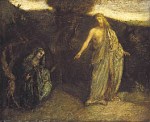
christ-appears-to-mary-by-ap-ryderJohn 20:16-18 | Mary’s profound grief was suddenly swept away by the sound of a single word — “Mary” (John 20:16). She recognized the voice of Jesus, just like a sheep recognizes the voice of its shepherd (see John 10:3,14). At the sound of her name Mary whirled about and saw Jesus standing there (John 20:16). Jesus was alive! Mary cried out “Rabboni” and fell at His feet (see Matt. 28:9) and held tightly to Jesus (John 20:17). Jesus told Mary to report the news of His resurrection and approaching ascension to His “brothers,” or disciples. Mary became the first to deliver the good news about the resurrection. She “went to the disciples” (John 20:18), who were “mourning and weeping” (Mark 16:10), and reported to them that Jesus was alive. Mary’s announcement continues to echo down the corridors of time to our present day. Jesus lives today! We should live with an awareness of His presence and a determination to tell others this good news.

John 20:19-21 | On the morning of the resurrection, Jesus’ followers were hiding behind locked doors (John 20:19). They had been in hiding since the night of His arrest when they had “deserted Him and fled” (Mark 14:50-52). After the crucifixion and burial of Jesus, the disciples continued to cower in “fear” behind securely locked doors (John 20:19). Perhaps they feared the Jews would search for and arrest them as they had Jesus. Maybe they discussed strategies for leaving the city without attracting attention. Perhaps they wondered what they would do without Jesus. These followers of Jesus were, in a sense, entombed and immobilized by their grief, fears, and doubts.

   Sometime during the morning of the resurrection, Mary Magdalene “went to the disciples” (20:18) and told them that she had seen the risen Christ. Unfortunately, the disciples stubbornly refused to believe Mary (Mark 16:11). However, later in the evening “Jesus came and stood among them” (John 20:19). The locked doors did not impede Jesus from entering into the room where they were hiding. His resurrection body had properties that allowed Him to enter the room in spite of the locked doors. The disciples were “startled and frightened, thinking they saw a ghost” (Luke 24:37). Jesus broke the silence and calmed their fears with the words, “Peace be with you!” (John 20:19). Jesus then reassured them He was not a ghost (v. 20) and again said to them “Peace be with you!” (John 20:21).

   As Jesus stood in the midst of His disciples, He commissioned them to be on mission for Him (see also Matt. 28:19-20; Luke 24:44-51; Acts 1:8). “As the Father has sent me,” Jesus said to them, “I am sending you” (John 20:21). His words unlocked the doors that had kept His disciples entombed. They had a very important job to do. Jesus expected His followers to leave the security of their hiding place to carry the message of His victory over sin and death, His power to save, and the invitation to accept His love and grace to all people everywhere. The disciples courageously left the room where they were hiding and faithfully proclaimed the gospel throughout their world.

   Jesus commissions every believer today to function as His representative (see 2 Cor. 5:20). “He has committed to us the message of reconciliation” (2 Cor. 5:19). We are obligated (see Rom. 1:14) to share that message with all people in all places (see Luke 24:47 and Matt. 28:19-20). Every one of the 5.6 billion people on our planet deserves the opportunity to hear and respond to the good news about Jesus Christ. The greatest crime we can commit against others is to withhold the gospel from them. Like the disciples, we have a job to do. So, let’s leave the security and comfort of our hiding places and tell the world that Jesus is alive.

Posted by: Omar C. Garcia | April 10, 2009

Don’t Feed the Bunny

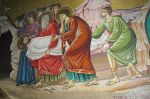
Mosaic in Church of the Holy Sepulchre.

Mosaic in Jerusalem’s Church of the Holy Sepulchre

When I visited the Ming Dynasty tombs in 1998, I was immediately impressed by the beauty of this burial site. Thirteen Ming Dynasty emperors are buried at this site located north of Beijing. As I walked around the beautiful grounds, I thought of those who had invested their lives and spared no expense to preserve the memory of the rulers buried there. And yet, these magnificent and ornate tombs are still occupied. By contrast, Jesus was buried in a tomb carved into the rock in a simple and unpretentious setting. In fact, this tomb was not prepared exclusively for Jesus. No artisan or workman carved it out with the intention of preserving His memory. And yet today, the empty tomb of Jesus is mute testimony to His victory over sin and death. His simple tomb assures us that through faith in the risen Christ, people can have forgiveness of their sins and a new and everlasting life. As we prepare to observe Easter, or Resurrection Sunday, here are some things to keep in mind.

Review | This Easter, take some time to carefully review the story of Christ’s death, burial, and resurrection. Paul wrote, “For I delivered to you as of first importance what I also received, that Christ died for our sins according to the Scriptures, and that He was buried, and that He was raised on the third day according to the Scriptures” (1 Cor. 15:3-4). Paul said that what he had received was rooted in history or “according to the Scriptures.” The death of Christ was foretold in “the Scriptures” (for example, Isaiah 53:5-12). Many men died at the hands of the Romans, but His death was “for our sins.” And, Jesus “was raised” — the perfect tense in Greek indicates that He remains raised from the dead. His resurrection is a past event with results continuing to the present.

Report | This Easter, let’s heed the words the angel spoke to the women who arrived first at the empty tomb: “He is not here, for He has risen, just as He said. Come, see the place where He was lying. And go quickly and tell His disciples that He has risen from the dead…” (Matt. 28:6-7). The world is still waiting to hear this good news. While sharing the gospel in Ukraine, I met an elderly woman who invited me and my translator into her small apartment. I told her that I had traveled from America to share the wonderful news of God’s love with her. She lowered her head and said she had been taught that God is dead. I told her that God is very much alive and interested in her eternal welfare. As I shared the gospel with her she listened attentively to the story of Jesus. I told her of His life, death, and resurrection. “Jesus is alive today,” I said, “and wants to be your Savior and Lord.” With tears in her eyes, the woman humbly bowed her head and placed her faith in the living Christ for salvation.

Rethink | This Easter, take a moment to rethink your spending. Americans spend nearly 1.9 billion dollars annually on Easter candy. According to the National Retail Federation, Americans are expected to spend an average of $116.59 on Easter candy, gifts, food, and decorations this year. That’s a lot of money, especially in these tough economic times. But, even so, that amount is down from an average of $135.03 last year. One Mom sent me an encouraging e-mail this week. “I have decided not to buy Easter outfits,” she wrote, “and instead use the money to go towards adopting a child.” She went on to calculate how much money could be raised in one day to assist families who are trying to adopt children if we all wore last year’s Easter outfits, did away with the candy, and invested the savings in an adoption fund. So, consider eating less, dressing down, and donating the savings to a worthy cause that will actually make a difference in the lives of the less fortunate.

Return | This Easter, many Americans will make their one and only annual pilgrimage to a place of worship. Church pews will be packed with people dressed in their finest. However, the Sunday after Easter the pews will look like they did on the Sunday before Easter. If you are among those who only worship on Easter, listen closely to the Easter message. Consider doing more than sitting in a pew once a year for the One who hung on the cross for you. Heed the admonition of Hebrews 10:25, “not forsaking our own assembling together, as is the habit of some, but encouraging one another, and all the more, as you see the day drawing near.” So, stop sailing alone. Remember that Satan is a pirate looking for a ship without a fleet. Return to the church building after Easter, join a small group, attend worship, and build meaningful relationships with those who can encourage you along your journey.

Reform | This Easter, take inventory of your life. If you are a Christ-follower, does your life reflect that you have a vital and growing relationship with the resurrected Christ? If you were arrested for being a Christian, would there be enough evidence to convict you? Are you holding tightly to anything that is causing your love for God to grow cold? Do you serve others as He would serve them? Does your life reflect your commitment to the kingdom of God? Are you advancing the interests of His kingdom or trying to build your own? Do you need to reform your ways?

Remember that Easter is about the resurrection of Jesus. So, don’t feed the Easter Bunny this year. Instead, make a commitment to focus on the One who gave His all for us. And then determine to give your all for Him. Honor Him with a faithful life — one choice and one day at a time.

Posted by: Omar C. Garcia | April 9, 2009

Psalm 23

Psalm 23 has been called the psalm of psalms and the pearl of the Psalms. It is one of the best-known passages in the Bible. David, who was familiar with the role and responsibility of a shepherd, wrote the psalm.

23:1 The Lord is my shepherd,
I shall not want.
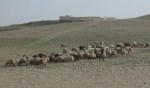
A flock of sheep at Tel Arad, Israel.

A flock of sheep at Tel Arad, Israel.

David confidently acknowledged that the Lord was his shepherd. He had no other shepherd or master. His allegiance was to God alone. Shepherd is an intimate metaphor. A shepherd lives with his flock. He serves as protector, provider, and physician to his flock. The word “want” means “to lack” or “suffer need.” Only the Lord can satisfy our deepest needs. Only the Lord, the Shepherd who is always alert to the needs of His flock, can shepherd the lives of His own so that they can say, “I shall not want.” Phillip Keller, in his book, A Shepherd Looks at Psalm 23, comments: “It is a tragic truth that many people who really have never come under His direction or management claim that ‘The Lord is my shepherd.’ They seem to hope that by merely admitting that He is their Shepherd somehow they will enjoy the benefits of His care and management without paying the price of forfeiting their own fickle and foolish way of life.”

We need the Good Shepherd. | We need the Good Shepherd. We need the wisdom of the Shepherd to guide us, His strength to protect us, His hand to feed us, His presence to assure us, His rod to protect us, and His staff to guide us.

23:2 He makes me lie down in green pastures;
He leads me beside quiet waters.

Sheep are known to be among nature’s most helpless (and stupid) animals. Sheep desperately need the guidance, assistance, provision, and protection of the shepherd. God gives His people rest and resources to sustain them. Phillip Keller comments that it is almost impossible to make sheep lie down until four requirements are met. They must sense a freedom from fear, tension with other sheep, aggravation from flies or parasites, and hunger. Only the Shepherd can see to it that these needs are met. The presence of the Shepherd dispels fear. The Shepherd stops the fighting and rivalry within the flock. The Shepherd administers agents to repel annoying insects and parasites. The Shepherd works to clear land and develop lush pasture for the sheep and knows where water can be obtained. Sheep become restless when they are thirsty and will drink from any polluted hole unless they are led to pure waters.

Look to the Good Shepherd for rest, refreshment, and nourishment. | We all experience pressures and pains. We live busy lives that offer little or no rest and escape from life’s pressures and demands. We have day-timers filled with appointments that leave us with little time for quiet. We have schedules that drain us of the strength to go on. We are surrounded by speed and noise. We cannot survive without rest, refreshment, and nourishment. The Good Shepherd can guide us into the rest we need to survive. Look to the Good Shepherd for rest, refreshment, and nourishment.

23:3 He restores my soul;
He guides me in the paths of righteousness
For His name’s sake.

As the needs of the sheep are satisfied with green pastures and cool waters, so David was refreshed and restored by God’s beneficent provision. The word “restores” may be understood in two senses. First, it may be understood in the sense of retrieving a straying sheep. Second, it may be understood in the sense of renewing and reviving those who have grown weary or stumbled. In addition, God guides His own “in the paths of righteousness,” or along right moral/ethical paths, “for His name’s sake” (the Lord’s reputation as a Shepherd is at stake). Phillip Keller comments, “No other class of livestock requires more careful handling, more detailed direction, than do sheep.” God always guides along right paths, whether we realize it or not.

Phillip Keller comments on a “cast” or “cast down” sheep. A cast sheep is one that has turned over on its back and is unable to get up again by itself. This condition is not uncommon among pregnant sheep. Unless the shepherd keeps diligent watch over his flock, a cast sheep will die or fall victim to predators. The shepherd must “restore” such sheep. He must help the cast sheep to get back on its feet again and regain its equilibrium.

The Good Shepherd can help us get up after we have fallen. | We are all subject to stumbling and falling in life. When we are down we are vulnerable to the deadly attacks of the enemy. When we are down we are vulnerable to attack from despair and despondency. When we are down we often find it difficult to get back up. That’s why we need the Good Shepherd. He knows when we fall. He knows when we are in danger of attack because of our helpless posture. He can help us to get back on our feet and regain our equilibrium.

23:4 Even though I walk through the valley of the shadow of death,
I fear no evil; for Thou art with me;
Thy rod and Thy staff, they comfort me.

Notice that the language changes in verse 4. David now speaks directly to his Shepherd. The Lord guides us through dark valleys of distress and trouble just as through green pastures. His presence with us, through dark valleys where we find ourselves in death’s shadow, helps us to overcome our fear. On these occasions the shepherd serves as our personal escort. David also acknowledged the comfort and protection of God. The shepherd’s rod (a club worn at the belt) was used for beating off animals that threatened the welfare of the sheep. The staff was used to discipline and to gently guide the sheep along the right path. These implements represent protection and provision. We must remember that the Shepherd knows the path better than we do.

Phillip Keller comments that during the summer months, shepherds lead their sheep up the mountains via deep ravines and valleys to alpine meadows. Then, as autumn approaches, he leads them back into the lower elevations via the same gulches and draws. A shepherd chooses this route for several reasons. First, to lead his flock to adequate meadows for grazing. Second, because it is a well-watered route with rivers, streams, springs, and pools along the way. Third, because the richest feed and best forage is found by the way of the valleys.

We do not walk alone. | We never walk alone. The Good Shepherd leads (verse 2), guides (verse 3), and escorts (verse 4) us through life. When we journey through the valleys He walks beside us. He never leaves nor forsakes us (Hebrews 13:5). He knows the right way whether we realize it or not. He will never lead us wrong.

23:5 Thou dost prepare a table before me in the presence of my enemies;
Thou hast anointed my head with oil;
My cup overflows.
23:6 Surely goodness and lovingkindness will follow me all the days of my life,
And I will dwell in the house of the Lord forever.

These verses speak of abundant (overflowing) provision and triumph even in the midst of threatening circumstances. David pictured God as the host and himself as a guest. A host was responsible for the welfare of his guests. An intruder had to first deal with the host before he could deal with the guest. The host also anointed his guests with “oil,” a symbol of great joy and richness. The phrase “my cup overflows” paints a picture of abundance. The word “follow” in verse 6 means to pursue. David was assured — “surely” — that the twin blessings of “goodness and lovingkindness” would pursue him all the days of his life. David acknowledged the gracious provision of God and looked forward to dwelling with Him forever.

Phillip Keller comments that the “table” referred to here was actually the entire high summer range on the “mesa” or high tablelands. Keller also comments on a practice among shepherds of anointing a sheep’s head and nose with oil as an antidote to the flies and parasites that trouble the sheep.

The Good Shepherd is interested in our present as well as our future. | The Good Shepherd is interested in our present estate. He meets our needs with abundant provision. He makes it possible for goodness and lovingkindness to follow us as we journey through life. He blesses us with the assurance of a wonderful future with Him forever.

Posted by: Omar C. Garcia | April 7, 2009

Deuteronomy 6:4-9

• The Shema | Deuteronomy 6:4-9

Deuteronomy 6:4-9 is called the “Shema,” the most important passage of the Old Testament for the Jews. It is the great confession of faith of Judaism. The designation “shema” comes from the Hebrew word “hear” in verse 4. This passage of Scripture is the first that every Jewish child must commit to memory. It is used to open every Jewish service. It is recited twice daily by the faithful in accordance with Jewish rabbinical law. Read also Deuteronomy 11:13-21 and Numbers 15:37-41.

6:4 | This great confession of faith begins with the declaration that God is one. This was important to the Israelites who found themselves between Egypt and Canaan. The Israelites were not unfamiliar with polytheism. The Egyptians acknowledged and worshiped innumerable gods, the names of at least two thousand of which are known. The future of the Israelites would be filled with the temptation to experiment with and incorporate the practices of their pagan neighbors into the worship of God. This confession prohibited both polytheism and syncretism. Thus this was an important confession for a people at the intersection of a past in which they were exposed to polytheism and a future that would tempt them with syncretism.

6:5 | The Israelites were to wholeheartedly love God. They were to love God with all their “heart … soul … [and] might,” terms that indicate the comprehensive kind of love man should have for God.

• They were to love God affectionately, with “all your heart.” The word “all” precludes a half-hearted kind of love. They were to love God entirely, “with all your soul.”

• They were to love God energetically, “with all your might.” In repeating this commandment, Jesus added the word “mind” (see Mark 12:30 and Luke 10:27).

• They were to love God intelligently, “with all your mind.” There is nothing unreasonable about loving God. Our love for God is best demonstrated by our obedience to His commands (see John 14:15 and 1 John 5:3).

Father and son at the Wailing Wall.

Father and son at the Wailing Wall.

6:6-9 | Verse 6 declares that God’s word was to be passed on from generation to generation. Parents were charged with the responsibility of passing the faith on to their children. Note however, the phrase, “these words [that is, the entire law] … shall be on your heart.” Parents cannot teach their children about the love of God if they themselves have not experienced that love. Parents were to instruct their children in a comprehensive way in the course of daily living. What the parents had personally experienced (6:6) they were to communicate through a variety of methods, including verbal communication (6:7), exhibiting (6:8), and writing (6:9). In later times, the Jews interpreted literally the words of verses 8 and 9 and placed the words of the shema in small containers worn on the person (phylacteries) and attached to the doorposts of their homes (mezuzahs).

You cannot give what you do not possess. | Parents cannot impart to the next generation what they themselves do not possess. They cannot teach their children the importance of observing God’s commands if doing so is not a priority in their own hearts. The faith of the parents must be a personal, heartfelt faith. Children know whether or not the things of God are dear to their parents’ hearts.

Youth ministry begins in the home. | Youth ministry begins in the home for three reasons. First, because the Bible declares it. The Bible exhorts parents to teach their children the things of God. Second, because the family demands it. The home provides the proper atmosphere for youth ministry. In the home, youth are under the influence and authority of their parents from day to day. Third, because youth desire it. Youth want guidance from their parents. They want a consistent spiritual example from their parents. Socrates asked, “Fellow citizens, why do you turn and scrape every stone to gather wealth and take so little care of your children to whom one day you must relinquish it all?”

Religious practices can mask a wrong heart. | The Israelites used phylacteries and mezuzahs as outward and visible reminders of the importance of loving and serving God. In time, these outward trappings became more important to them that what they symbolized. In Jesus day, the Pharisees ostentatiously displayed their phylacteries, prayers, fasting, and tithing. It is easy to allow our worship and Bible study attendance, praying, tithing, and other practices to be done without consideration of the condition of our hearts. We must be careful lest good habits become a mask for a wrong heart.

• • • • •

Photo Credit | Doyle Lowry, Jerusalem 2007

Posted by: Omar C. Garcia | April 5, 2009

Deuteronomy 5:16–6:3

• The Ten Commandments (5–10) | Deuteronomy 5:16-21

5:16-21 | These verses contain a restatement of the last six commandments of the Decalogue (see also Exodus 20:1-17) and address man’s responsibility to man.

rembrandt-ten-wordsFifth, the people were to honor their parents (5:16). The first mention of relational responsibility was that of children to parents. Parents had a responsibility to model and teach God’s word to their children. Children have a responsibility to obey and “honor” their parents. The word “honor” means more than just “be nice to your folks.” The word translates a word which literally means “to be heavy or weighty.” The concept of honor probably emerged from the idea of a person having a weight of possessions or great wealth. People with a weight of possessions were thought to have been blessed by God, hence honored. Conversely, the Hebrew word “dishonor” means “to be light, swift, trifling” (see Deut. 27:16).

The Apostle Paul noted that this is the first commandment with a promise (Ephesians 6:2) and listed two benefits of obeying and honoring parents (Ephesians 6:3). The first benefit relates to the quality of life: “that it may go well with you.” I can certainly testify to the fact that things at home went well for me when I obeyed my parents. But as a child I also learned that one minute of disobedience could get me hours of trouble. The second benefit relates to the quantity of life: “that you may enjoy long life on the earth.” This promise does not imply that those who have died young dishonored their parents. The general principle is that children who listen to their parents can avoid the sins and dangers that can easily shorten their lives.

Sixth, murder was prohibited (5:17). The word “murder” refers to taking an innocent life by criminal intent or through negligence (including premeditated murder, murder done in anger, murder done in revenge, and manslaughter through negligence). Life, including that of the unborn, must be respected and treated with reverence. God set specific guidelines regarding who, why, and how life was to be taken in certain instances (see Genesis 9:4-6; Deuteronomy 17:2-7 and 19:12; Romans 13:4).

Seventh, adultery was prohibited (5:18). Marriage was instituted by God. This commandment was designed to guard the sanctity of this human relationship. God expected His people to be faithful in every area of their lives. Read Jesus’ comments on this commandment in Matthew 5:27-28.

Eighth, stealing was prohibited (5:19). Scholars agree that this commandment originally applied to kidnapping of free persons, as in the case of Joseph. The commandment also applies to the protection of property and that which another earns, saves, and owns through honest labor. Read Amos 8:5 and Hosea 12:7 regarding merchants who stole from their customers by making the “bushel smaller” and weighing with “false balances.” We can steal either by taking from others or by withholding from others.

Ninth, bearing false witness against a neighbor was prohibited (5:20). This commandment protected the reputation and character of others. It concerned the giving of truthful testimony concerning another in a court of justice because such testimony had an impact on another’s future (see also Deuteronomy 19:15-21). Proverbs 6:16-19 lists seven things that God hates, three of which relate to the tongue: “a lying tongue … a false witness who utters lies, and one who spreads strife among brothers.” Shakespeare in Othello said: “Who steals my purse steals trash;
but he who filches from me my good name, robs me of that which not enriches him, yet leaves me poor indeed!”

The pen is mightier than the sword, but the tongue is sharper. | When I was a kid I used to watch “Hee Haw,” a popular television show at the time. The show had a segment in which a group of women sang the following words while doing laundry together: “Now we’re not ones to go around spreading gossip, why we’re just really not the gossipy kind, no, you’ll never hear one of us repeating gossip, so you better be sure and listen close the first time.” Gossip is a national past-time. One gossip was heard commenting to another, “There’s something I must tell you before I find out it isn’t true!” The prohibition against bearing false witness against another is broken every time gossip is spread. Someone correctly noted that gossip is the lowest form of communication.

Tenth, covetousness was prohibited (5:21). This commandment forbids both the intention (inner motive) to take for oneself what belongs to another (and what we have no right to possess) and the deed itself. Outward sins and actions begin with inward thoughts and desires. Covetousness is the root of all sins against our neighbor. If we kept this last commandment, we would not break the first nine. This prohibition against covetousness includes another’s spouse, thus emphasizing the sacredness of the marriage relationship

• The People’s Response to the Covenant | Deuteronomy 5:22-23

5:22-33 | These verses contain a review of the circumstances surrounding the giving of the law at Horeb (5:22). The experience was so awesome that the people asked Moses to be their representative and report to them what God desired (5:23-26). The people pledged to obey God (5:27). God was pleased with the request of the people (5:28) and expressed His concern that they follow through on their commitment to obey Him (5:29). God instructed Moses to tell the people to return to their tents (5:30). Moses stayed to receive the “all the commandments and the statutes and the judgments” of God which he was to teach the people that they might prosper in the Promised Land (5:31-33).

• The Purpose of the Commandments | Deuteronomy 6:1-3

6:1-3 | Moses again reminded the people that the commandments of God were given that they might be obeyed (6:1). It is not enough to hear God’s word or to know God’s word, we must obey God’s word (see Luke 11:28 and James 1:22). Hearing God’s word should lead the hearer to “fear the Lord” (6:2). God’s word contains the record of God’s loving search for man. It helps us to understand the character, nature, and will of God and should lead us to reverence and love God. Psalm 119:38 states, “Establish Thy word to Thy servant, as that which produces reverence for Thee.” The fear of God should manifest itself in obedience. The relationship between obedience and blessing is a recurring theme in Deuteronomy (6:3). Our lives are a living commentary on Proverbs 13:13, “The one who despises the word will be in debt to it, But the one who fears the commandment will be rewarded.” Moses defined the wonderful rewards of obedience to God’s word in Deuteronomy 6:3 (and also 5:16, 29; 6:18, 24).

Posted by: Omar C. Garcia | April 3, 2009

Deuteronomy 5:6-15

• God’s Covenant with Israel at Horeb | Deuteronomy 5:6-21

5:6 | God introduced and identified Himself by His name and by His historical act of redemption. First, God introduced Himself by name, “I am the Lord your God.” This introduction is personal and points to Israel’s relationship with God. Second, God identified Himself as Israel’s deliverer out of the house of Egyptian slavery. God took the initiative in redeeming His people from slavery. The people were to “hear … learn … observe” the word of a personal (not a distant and impersonal) God who delivered them from bondage.

• The Ten Commandments (1–4) | Deuteronomy 5:7-15

dore-ten-words5:7-15 | These verses are a restatement of the first four commandments of the Decalogue (see also Exodus 20:1-17). The first four commandments, or words, address man’s responsibility to love God.

First, the people were reminded that they were to have no other gods before (besides/against) God (5:7). These were important words to a people surrounded by nations involved in polytheistic worship. God alone was to be the object of their worship, devotion, and loyalty. They were to allow no other god to usurp His place in their hearts.

God alone is worthy of our deepest devotion and highest loyalty. | General William Booth, the founder of the Salvation Army, said the following when asked about the secret of his success. “From the day I got the poor of London on my heart and a vision for what Jesus Christ would do for them, I made up my mind that God should have all of William Booth there was; and if anything has been achieved, it is because God has had all the adoration of my heart, all the power of my will and all the influence of my life.” Booth’s reply illustrates the kind of devotion and loyalty we should have toward God.

Second, the people were forbidden from making and worshiping any image representing God Himself (5:8-10). The first commandment concerns the object of worship. The second commandment concerns the means of worship. Jesus said, “God is a Spirit, and those who worship Him must worship in spirit and truth” (John 4:24). Isaiah said, “To whom then will you liken God? Or what likeness will you compare with Him?” (Isaiah 40:18; see also Isaiah 40:25 and 46:5). People through the centuries have attempted to make God in their own image. And, because children learn their first lessons about God in the home, parents should be careful regarding what they teach (through words and examples) about God because what they teach can impact future generations. John Maxwell comments that “the real danger of idolatry is that when one generation makes idolatrous choices, it becomes very easy for the next generation to go a step further with idolatry” (The Communicator’s Commentary, Volume 5).

Our influence can impact future generations. | The second commandment cautions parents to set the proper example in worship. A wrong example can have a far-reaching impact on future generations. Parents must not embrace any practice that will morally disorient their children.

Third, the people were prohibited from taking God’s name in vain. God’s name was often used in legal matters by those who could not prove or substantiate their claims. God would hold people accountable for misusing His name in such matters. In addition, God’s name was not to be used in association with any magic or casting of spells. The people were to reverently use God’s name.

God’s name should be hallowed not hollowed. | God’s name should not be used in a hollow, irreverent, or flippant manner. It should not be used in any way that is inconsistent with His character. As Jesus taught, we should hallow [to respect or honor as holy] God’s name (Matthew 6:9).

Fourth, the people were to observe and keep the sabbath day holy (5:12-15). The entire household was to observe the sabbath and cease from labor (note the inclusion of the animals in 5:14). The sabbath was to be a day of rest and reflection on God’s creative activity (Exodus 20:11), a day of remembrance of God’s mighty act of deliverance (5:15), and a day of worship.

It’s Friday, but Sunday’s coming! | We live busy lives and deal with difficulties every day. The demands upon our time, energy, and resources often leave us feeling empty and dry. Observing the Lord’s Day can help restore our perspective, power, and pleasure in life. Sunday affords us the opportunity to slow down, look up, take in, and go out ready to face the challenges of another week.

« Newer Posts - Older Posts »

Categories