
Beauty along the Brahmaputra River. | 2000 | Bangladesh
Photo edited on my iPhone with Vintage app.
Beauty along the Brahmaputra River. | 2000 | Bangladesh
Photo edited on my iPhone with Vintage app.
Posted in Bangladesh, Wordless Wednesday | Tags: Bangladesh, Photography, Travel
It’s cold in Houston — something of a treat for those of us who live in the barely two-seasons South. As a child of the South, cold has always been a relative term. What I consider to be cold does not even blip on the radar of my friends who live in places where temperatures plunge into the nether regions of thermometers. But, I have experienced extremely cold temperatures over the years as I have traveled the globe. Just thinking about some of those experiences makes me shiver.
Perhaps the coldest I have ever been was in the late Winter of 2000 when I visited the Reindeer People of Northern Mongolia. It took us seven days to reach these nomadic reindeer herders who live just south of Siberia. I knew it was cold the day I was warming my feet by the fire and did not notice that my thermal socks had melted on my feet! My team and I slept in teepee-like tents in temperatures that dropped to 20 to 30 degrees below zero. I could write an entire blog about the challenges of trying to go potty outdoors in this kind of weather. Oh my soul — I thought I was going to die!
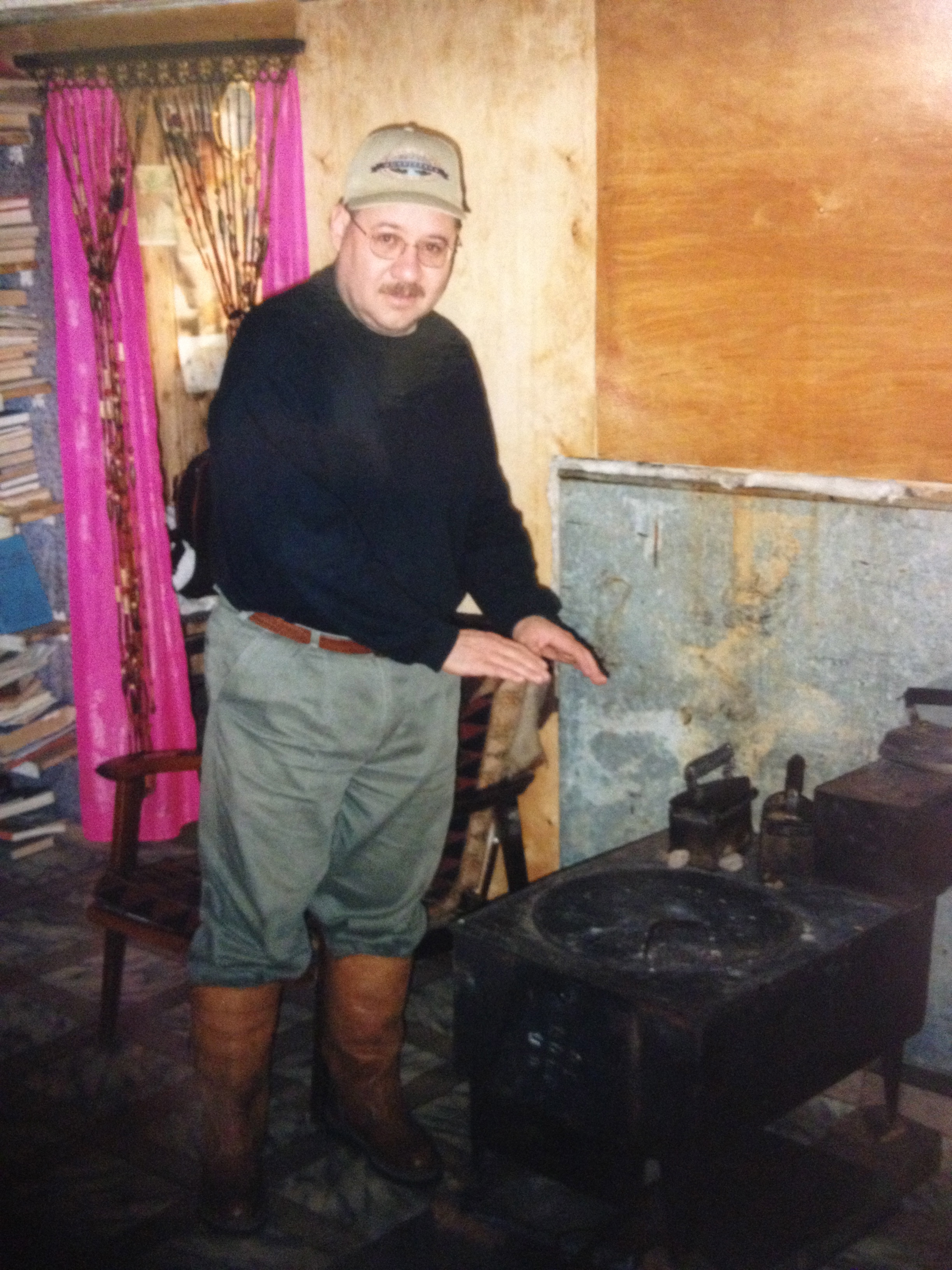
The night before we headed into the mountains.

Getting ready to cross a frozen lake on horseback.
Last week, my friend Doyle and I camped out at Palmetto State Park south of Luling, Texas. Although the temperature was in the mid-forties, it was still cold. I slept on an air mattress only because I had bought one for $10 at Academy and thought it would be a good idea. Big mistake. Sleeping on an air mattress in cold weather is like sleeping on a tray of ice cubes. The air mattress was more comfortable than the ground but the air in the mattress turned as cold as the outside air. I toughed it out nevertheless and refused the temptation to go sleep in my truck.
The term “cold” has worked its way into our vocabulary in a variety of negative ways. We refer to impersonal or cruel people as being cold as ice, having a cold heart, giving us the cold shoulder, or being cold and calculating. There is, however, also a more positive way to think about the cold. Cold is also invigorating and has a way of refreshing and reviving us, especially when it’s hot outside.
In the book of Revelation, God sent a message to the church at Laodicea, a wealthy city located in the Lycus Valley in ancient Asia Minor. He told the folks at this church that He wished they were hot or cold (Rev. 3:15)! The reference to being cold in this verse is actually good. The Laodiceans were familiar with the cold waters of the nearby city of Colossae. The waters there were fed by streams that flowed from the snow-covered heights of Mount Cadmus. On hot days, people enjoyed bathing in the invigorating waters of Colossae.
Our lives should have a quality akin to the cold waters of Colossae. People in need of help and who are despairing should find in us an invigorating and refreshing quality that gives them hope and makes them come alive again. Sometimes all it takes is a smile, a word, a look, or a little bit of personal interest to make someone feel that they are loved, valued, or appreciated. So, make it a point to be a little cold to the folks around you — those who have been beat down by the heat of their trials, troubles, and frustrations. May your interaction with them refresh them and renew their hope.
Posted in Devotional Thoughts, Mongolia | Tags: Camping, Inspiration, Mongolia, Travel, Weather
Television programming today is nothing like it was when I was a kid sitting in front of our black and white television. Getting good reception in those days depended on the orientation of the rabbit-ear antenna on top of the console. And programming was limited to only a few hours a day. At night, networks signed off for with the Star Spangled Banner before the screen went blank. In those earlier days of television I especially enjoyed Captain Kangaroo, Lassie, and the Lone Ranger. I spent the rest of my time outdoors having adventures of my own.
Today, I subscribe to a cable service that gives me round-the-clock access to more channels than I can possibly watch. Even so, my own television viewing is limited to just a few of those channels — mostly how-to, documentary, and some reality programs. I especially enjoy the History Channel. This season I have become hooked on Bamazon, a reality show about eight out-of-work construction workers from Alabama who have risked everything on the long-shot that they will find gold in the Amazon jungle.
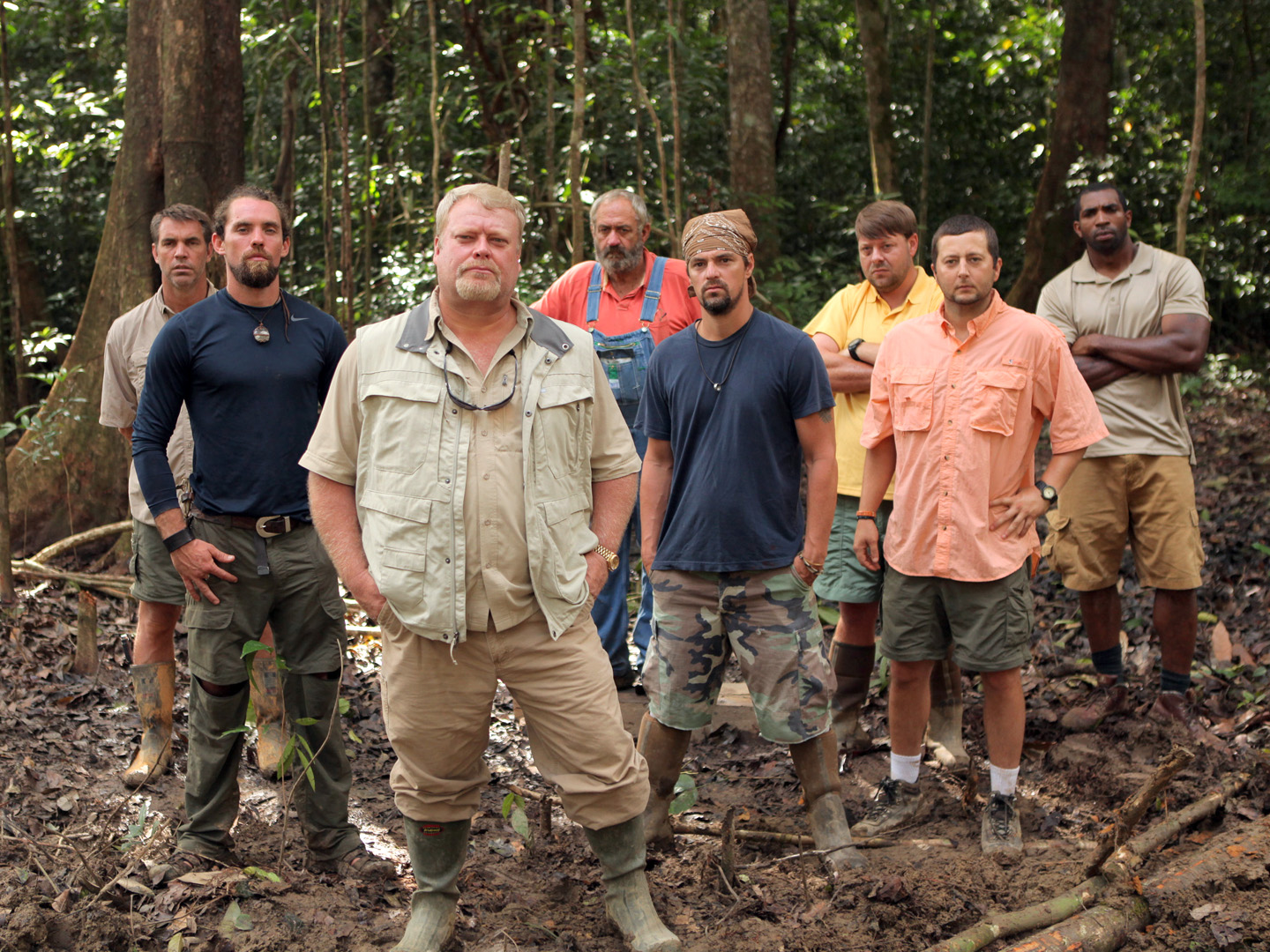
What intrigues me about Bamazon is how much these guys have on the line. Working in one of the most inhospitable places on the planet, the thought of finding gold motivates the Bama boys to press on in spite of the heat, humidity, malarial mosquitoes, venomous snakes, and a host of other threats and challenges. None of them had any mining experience when they started and most of them had never been out of the country before. Nevertheless, they are determined and are using every ounce of ingenuity to solve problems in order to keep their operation running.
One of the most obvious lessons from shows like Bamazon and the Discovery Channel’s Gold Rush Alaska is that you have to move tons of dirt in order to find an ounce of gold. And moving all that dirt means keeping lots of heavy machinery running smoothly and every man doing his part. Reality shows like Bamazon remind me that we should do the same thing — that is, to be willing to move tons of dirt in order to find that ounce of gold in the people we interact with daily. Sadly, for many people, it’s more tempting to focus on the dirt.
When asked about how he had helped so many people to become millionaires, Andrew Carnegie replied: “You develop millionaires the way you mine gold. You expect to move tons of dirt to find an ounce of gold, but you don’t go into the mine looking for the dirt — you go in looking for the gold.” That is a sensible observation and good advice. I’m rooting for the Bama boys and hope they strike it rich. But I am also on the search for gold. I’m looking for it in the people around me. I am already rich but hoping to become richer.
Posted in Devotional Thoughts | Tags: Adventure, Inspiration, Television, Travel
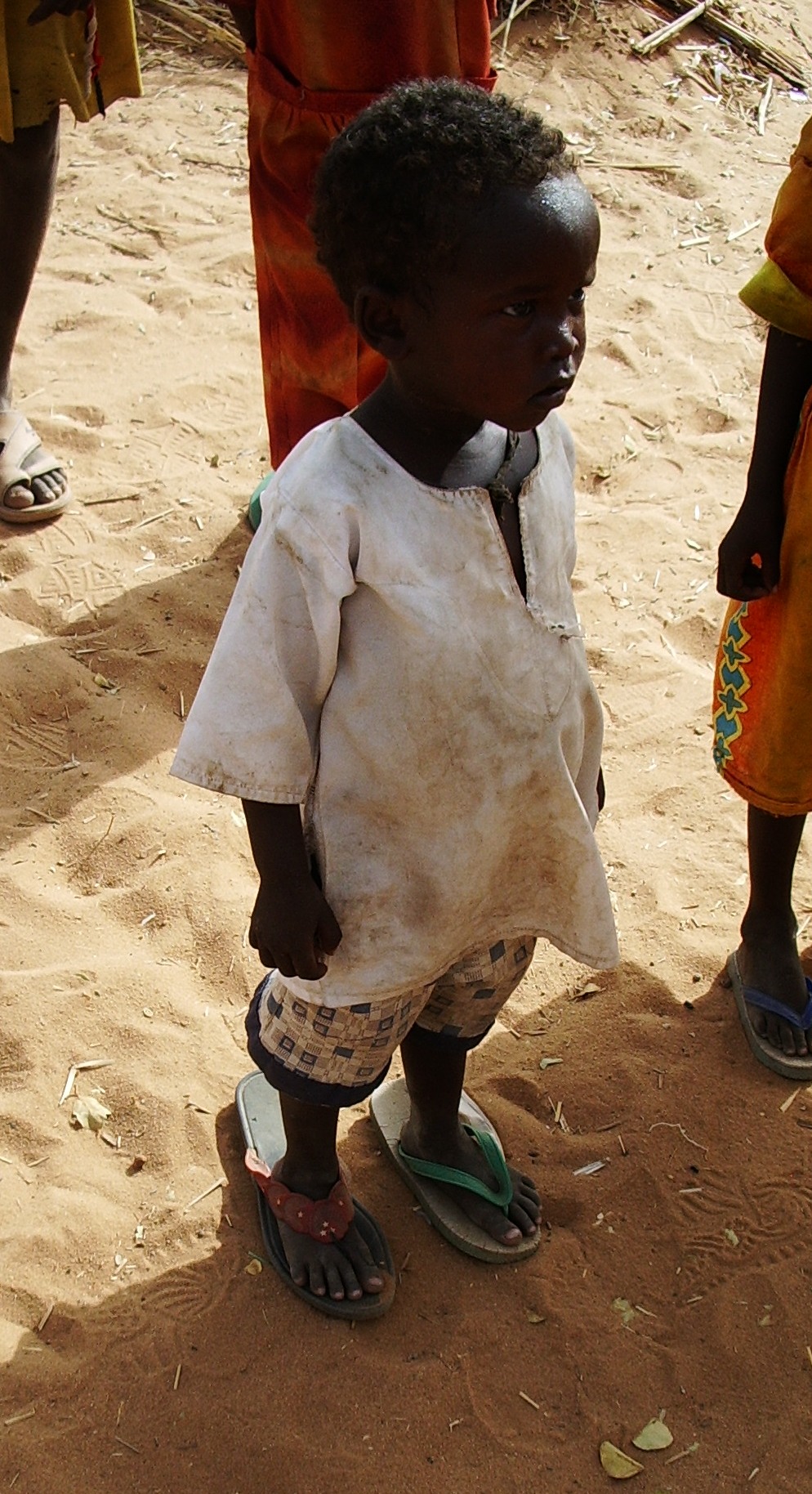
A curious little boy at Zam Zam IDP camp. | 2005 | Darfur, Sudan
Posted in Sudan | Darfur, Wordless Wednesday | Tags: Photography, Travel
One of the things I enjoy doing is following the exploits of present-day adventurers and explorers. I am especially interested in what makes them tick and why they take the kinds of risks they take. Whether some intrepid adventurer is trekking to the top of the world, slogging through snow at the bottom of the world, or rowing across an ocean, technology makes it possible for us to vicariously travel along. And because we live in a connected world, we are not likely to see again the kinds of sagas reminiscent of explorers like Sir Ernest Shackelton or Douglas Mawson. These two adventurers survived lengthy and life-threatening ordeals during the Heroic Age of Antarctic Exploration — the period from 1897–1922 during which sixteen major expeditions from eight countries focused on the Antarctic continent. These guys had no way to call for help.
 In recent days I have followed the adventures of Eric Larsen and his Cycle South Expedition 2012 — an attempt to ride 750 miles from Antarctica’s Hercules Inlet to the geographic south pole. Larsen has previously climbed Mount Everest and trekked across the planet’s frozen poles. Larsen’s Cycle South Expedition combined adventure with advocacy. He wanted to be the first person to ride a bicycle — yes, a bicycle — to the geographic South Pole. Why? Because he is passionate about demonstrating the many ways in which people can use bicycles to protect our environment and improve the quality of their lives. Sadly, hardly two weeks into his adventure, Larsen had to turn around because he was averaging less than ten miles a day, a pace too slow to make it to the pole with the food and supplies he carried with him. Rather than run out of food and risk not being rescued, Larsen turned around.
I applaud Larsen for his heroic attempt but also for knowing when to turn around so that he could live to ride another day. If Sir Ernest Shackelton was alive today, he would understand. In September 1909, Shackelton and three companions trudged to within 96-miles of the South Pole. However, finding themselves dangerously short of supplies, Shackleton made the most difficult decision of his life — he turned his men toward home. He later told Emily, his wife: “I thought you’d rather have a live donkey than a dead lion.” Shackelton returned to Antarctica in December 1914 in hope of being the first to complete a trans-Antarctic crossing. Instead he gave the world one of the greatest and most inspirational survival stories of all time. He is one of my historical mentors and heroes.
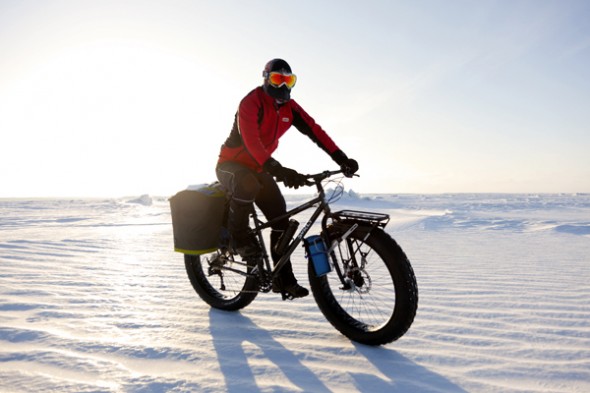 I hope that Larsen will return to Antarctica to try again. I am one who believes that our world needs more people like Larsen — folks who are not afraid to attempt hard things and who inspire others to do the same. Larsen’s recent attempt to cycle south is only a chapter in his story, but it is not the end of the story. The next time you attempt to do something hard, remember guys like Larsen and Shackelton. And if you don’t make it, then don’t let that be the end of your story. Pick yourself up and try again. It’s just like riding a bicycle!
Posted in Endurance Challenges | Tags: Adventure, Sports, Travel
The homeless are Houston’s hidden and hurting and most vulnerable inhabitants. According to a recent report in the Houston Chronicle, there are more than 7,300 homeless people in our city. However, if you expand the definition of homelessness to include those in shelters, other types of supportive housing, or in the Harris County jail, that number grows to almost 12,000. Even in our relatively mild winter weather, those homeless individuals who live on the streets are especially vulnerable to the cold.
In February 2011, we were privileged to meet Officer Jaime Giraldo who serves with the Houston Police Department’s Homeless Outreach Team. At that time, Kingsland supplied him with hundreds of coats, caps, gloves, and sleeping bags to distribute to folks living on the streets. Because many homeless people do not make it into warm shelters, the urgency of providing them with warm clothing was great. Since then, we have assisted the HPD Homeless Outreach Team with other needs.
Last week, Officer Giraldo stopped by to show us the new van that was donated to the Homeless Outreach Team by two philanthropic organizations. The van is equipped with a wheelchair lift and the latest computer technology to help officers connect the homeless with government services. The three HPD officers that are assigned to the Homeless Outreach Team go out daily to build relationships with the homeless. They also help them with practical needs and try to find out what it will take to help get them off the street.

Amy Granger (Missions Ministry Assistant), Officer Giraldo, and my son, Jonathan.
This week, Kingsland is giving the Homeless Outreach Team several thousand dollars worth of new coats, caps, gloves, blankets, and backpacks to distribute to the homeless. We have also given the team some funds to help them with their efforts to help those in need to be reunited with family living outside of Houston and, in some cases, outside of the state. We appreciate Officer Giraldo and those who serve on the Homeless Outreach Team and are thankful for our partnership in helping Houston’s homeless. As in previous years, the gifts that we give are sure to warm lots of hearts in the coming days.
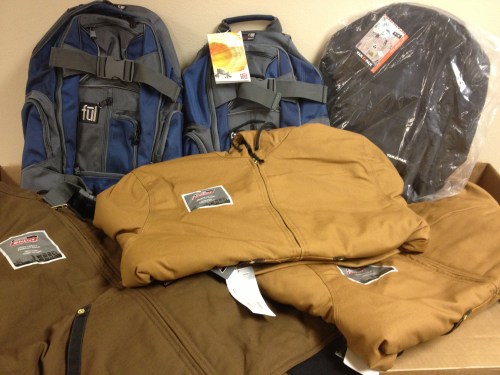
New coats and backpacks for the homeless.
Posted in Homelessness, Local Missions Initiatives | Tags: Christianity, Inspiration
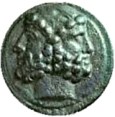 It has only been a few hours since we stepped across the threshold into the first day of the first month of the new year. The month of January is named for Janus, the Roman god of doors and gateways. Janus was usually depicted with two faces looking in opposite directions — one to the past and one to the future. January beckons us to look back and take inventory of the previous year and to look ahead to the opportunities of the coming year.
The start of a new year offers us the opportunity for fresh starts, second chances, and new beginnings. Fresh starts have a way of giving new meaning to life. Second chances can invigorate us with the resolve to do better and go farther than we ever have. And, new beginnings can infuse us with purpose, energy, and the determination to walk through doors and gateways that lead to exciting new challenges.
Although I am not a new year resolution-maker, I have developed my own list of guidelines that govern my decision-making throughout the year. Perhaps these could be considered resolutions, of sorts. That’s ok. The important thing is that these guidelines help me to make good choices, to take inventory of my life throughout the year, and to make course corrections along the journey. I offer them here for your consideration and wish you a Happy New Year.
Honor God. | To honor means to give weight or consideration to another. I don’t always get it right, but my intent is always to love and honor God — to take seriously His instructions and to walk in a way that pleases Him. I am thankful that He is patient with me and “merciful and gracious, slow to anger and abounding in steadfast love” (Ps. 103:8).
Love others. | Mother Teresa is one of my heroes. She modeled what it means to truly love others without condition. Serving at her homes in Kolkata has been one of the greatest privileges of my life. The best lesson I have learned from Mother Teresa’s example is the importance of looking for Jesus in the distressing disguise of the poor and, when I find Him, to do what Jesus would do to help that individual.
Take risks. | Helen Keller said, “Life is either a daring adventure or nothing.” She was right. We must keep in mind that we are always taking risks in life, no matter where we are. The late Dr. Rudy Hernandez, one of my mentors, often told me, “I am immortal until God is finished with me.” I often reflect on those words. They have given me the courage to walk down many roads less traveled.
Excuse the excuses. | I don’t like excuses. In fact, I hate them. Excuses may make us feel better but they do not change anything. When I fail I prefer to get up, evaluate, and move on. I would rather focus my energies on finding solutions than nursing excuses.
Don’t waste time. | I have reached that age when I can’t afford to kill time because time is killing me! So, I prefer to get things done. Henry Varley, a British revivalist, said: “The world has yet to see what God will do with and for and through and in and by the man who is fully devoted to Him.” I want to strive to be a man through whom God can accomplish great things.
Posted in New Year Reflections | Tags: Inspiration, New Year, Resolutions
 Like most bloggers, I monitor my blog stats daily. These stats help me to keep my finger on the pulse of what visitors to my blog are reading and where they are from. The information on my stats page also tells me things like what key words led folks to my site, how many subscribers I have, and other useful information. At the end of each year of blogging I receive an annual report from WordPress that summarizes my blog stats. I am encouraged by this year’s report and grateful to each of you who faithfully read my blog posts as well as those who stumbled onto my site or just visited once or twice. Here is a summary of the report I received from WordPress.
Busiest day of the year. | The busiest day of the year on my blog was December 15. That’s the day after I posted my blog entitled Shooting at Sandy Hook. Our nation continues to mourn the senseless loss of life at Sandy School Elementary School in Newtown, Connecticut. Like so many other bloggers, it was impossible for me to remain silent in the face of this national tragedy.
A consistently popular blog post. | For the third year in a row, my post on William Borden, heir to the famous Borden Dairy estate, is still one of my most popular blog posts. Borden’s untimely death in 1904 made headlines around the world. His life continues to challenge and inspire people today. If you have not read his story, I hope that you will take the time to do so.
Most commented on post. | Last year my most commented on post was Traveling With Women, a blog I posted from Phnom Penh, Cambodia. This year’s most commented on blog post was An Unexpected Finish, the story of doing the Neches River Wilderness Canoe Race with my son Jonathan, and finishing first in our class.
Number of views. | Last year my site was viewed 60,000 times. This year my site was viewed 76,000 times by folks from 163 countries. That boggles my mind. I never expected that my blogging adventure would reach so many people in so many countries around the world. This information keeps me grounded and reminds me that blogging is a great stewardship.
Top referring site. | For the second year in a row, Facebook is the top referring site to my blog. I do not have a Facebook account, but many of my readers do and they have been kind enough to post links to blog posts they liked on their Facebook accounts. This has generated lots of traffic to my site. Thanks Facebook users!
So, as 2012 comes to a close, I appreciate each of you who have made this a record-setting year for my little shop in the marketplace of ideas. I promise to continue doing my very best to post the kind of stories that will inspire, encourage, convict, and challenge us to go beyond in 2013.
Posted in Miscellaneous | Tags: Blogging, Writing
Preparing for the 2013 Texas Water Safari
Although the Texas Water Safari is still months away, Doyle and I continue to feel the pressure to step up our training. To date, we have trained only on the San Marcos River. However, today, we did a training run on the Brazos River. Early Spanish explorers named this wide and slow-moving river Rio de Los Brazos de Dios — translated “The Arms of God River.”
There are several legends about how the Brazos got its name. However, the common denominator among these stories is that thirsty explorers happened upon the river in the nick of time and were refreshed by its waters. These intrepid souls stumbled into the arms of God!
The Brazos is the longest river in the Lone Star State and one rich in history. Washington-on-the-Brazos, located a short drive from Houston, is recognized as the birthplace of Texas. It was at this location in 1836 that representatives of Texas settlements met to make a formal Declaration of Independence from Mexico and where the government of the Republic of Texas was created.
It was a cold 38-degrees this morning when Doyle and I headed toward the place where the Brazos River intersects Highway 290 west of Hempstead, Texas. We were excited about joining my son Jonathan, his friend Bob who will paddle the Safari with him, and our friends and multi-Safari finishers Ben and Jay. It’s always nice to have company on the river. Paddling with others keeps us all accountable for maintaining a good pace and makes the time go by faster.
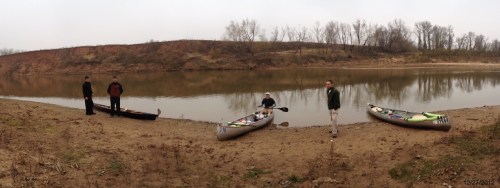
Taking a break along the route.
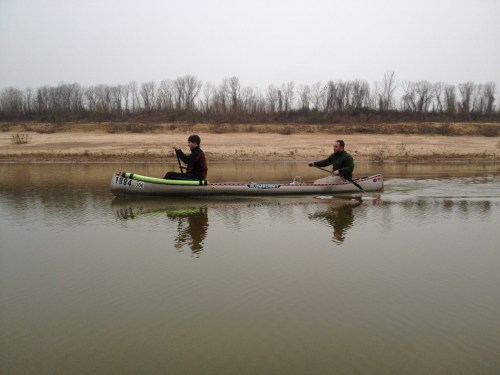
Bob and Jonathan in Jonathan’s canoe, Number 1984.
We had hoped that the weather might warm up a bit but it stayed cold all day. And to make things even more uncomfortable, the light but persistent mist combined with the wind kept us all shivering as we made our way down the river. But I am happy to say that we had a good 14-mile run. We all reached our stopping point within minutes of each other and then enjoyed a good time of fellowship on the bank before loading our boats and gear and heading home.
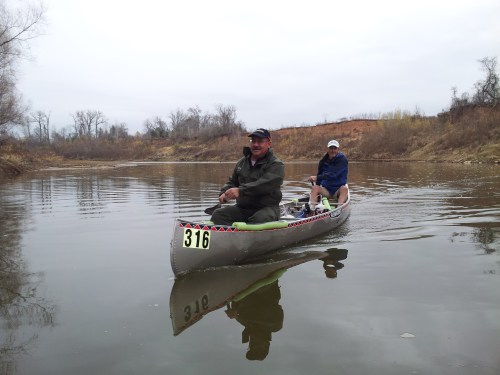
Doyle and me in our canoe, Number 316.
Today was a good reminder that we have to stay committed to our training regimen regardless of the weather. It was really cold sitting in an aluminum canoe and paddling for four hours on the Brazos. In a few months we will be paddling with 150 other folks on the Texas Water Safari in temperatures that are likely to reach over 100-degrees. And we still have at least a dozen more training runs to complete in all types of weather before the big race in June.
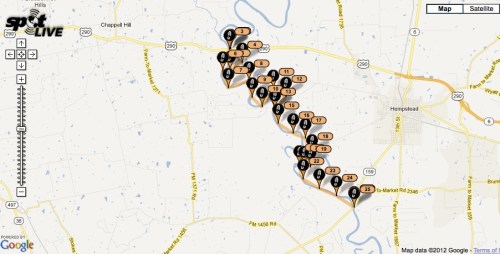
Our 14-mile training route on the Brazos River as recorded by our Spot Tracker.
I am not sure there is ever a good way to make hard things easy. Hard things are just hard! And the Texas Water Safari is one of those things that will always be hard. But I do know that hard things like the Safari can be accomplished one paddle stroke at a time. Our practice runs are necessary in order for us to be better prepared to paddle the estimated 250,000 paddle strokes between the start and finish of the race. So, this won’t be the last time we paddle in the cold!
Posted in Texas Rivers, Texas Water Safari | Tags: Adventure, Canoeing, Outdoors, Sports, texas water safari
Many years ago my mother planted a seed in the backyard of our family’s home in McAllen, Texas. She was especially excited about this particular seed — one she had taken from a gnarled brown seed pod produced by a Pata de Vaca tree. The Pata de Vaca is so named because its broad green leaves resemble a “cow’s hoof” (the literal translation of the name). Mom nurtured the seed and it grew into a beautiful tree that graced our backyard. Through the years my siblings and I always thought of this tree as Mom’s. After her death in 2009, the Pata de Vaca tree was just one more thing that reminded us all about our beautiful mother. And then earlier this year, a particularly strong storm hit the Rio Grande Valley and blew over hundreds of trees, including the Pata de Vaca in our backyard. We were all saddened by the news that the storm had uprooted Mom’s tree.

After the storm, my Dad and a neighbor spent a full day cleaning up the debris in his yard. Using a chainsaw, they cut the mesquite and oak limbs that littered the yard into manageable sizes, and also the trunk and branches of the Pata de Vaca tree. Laura, my youngest sister, had the presence of mind to keep the Pata de Vaca wood out of the debris pile on the curb. Instead, she kept the remnants of the tree in the backyard, not quite sure what she would do with them but certain that she did not want to send them to the dump. Time passed and the wood just sat and weathered in the backyard. We were all resigned to the fact that Mom’s tree was gone and that the only thing left was the stump and a few branches, sitting in a corner of the backyard.
Yesterday, after Christmas dinner at Dad’s home, Laura announced that she had a special surprise for each of us. She started off by talking about the Pata de Vaca seed that mom had planted and nurtured in the backyard and about the storm that had uprooted the tree. And then, the surprise! Laura told us that she had taken the trunk and branches to a local wood-carver. She commissioned him to make bowls from the trunk and spoons from the branches. Starting at the base and working upwards, the man had carved a bowl for Dad and also for each of us — three sisters and two brothers. When stacked in order, all of the pieces fit together perfectly, making our own unique family tree.

As Laura disassembled all of the pieces to give each of us our respective bowls, we were all especially pleased to see the shape of our brother’s bowl. When the wood-carver cut the slice that would become our little brother’s bowl, the trunk of the tree at that point was shaped like a heart. Perfect! When our brother Phillip went through a prodigal period in high school, Mom pursued him relentlessly and loved him back into the fold. Phillip always called Mom his special angel for saving his life and Mom always had a soft spot in her heart for Phillip, grateful that God had given him back to her … and to us.

So, each of us now have a piece of Mom’s tree in our homes. And each of us know that our respective pieces fit perfectly with the others to form our special family tree and to remind us that we really do need each other. We also talked about how the spoon that each of us received will remind us that our beautiful mother not only nurtured her Pata de Vaca tree in the backyard, but that she also nurtured, cared for, and encouraged each of us throughout the years. This Christmas was the first since Mom died that we have gathered at Dad’s home to celebrate Christmas. It has been too painful for us to be there without Mom so, in previous years, we have gathered elsewhere. That is why of all of the gifts we could have received this year, the bowls and spoons carved from Mom’s tree were the most appropriate and meaningful for each of us. Each of us will treasure them for years to come.
Posted in Christmas Reflections, Home and Family | Tags: Christmas, family, Holidays, home, Inspiration
 Go Beyond