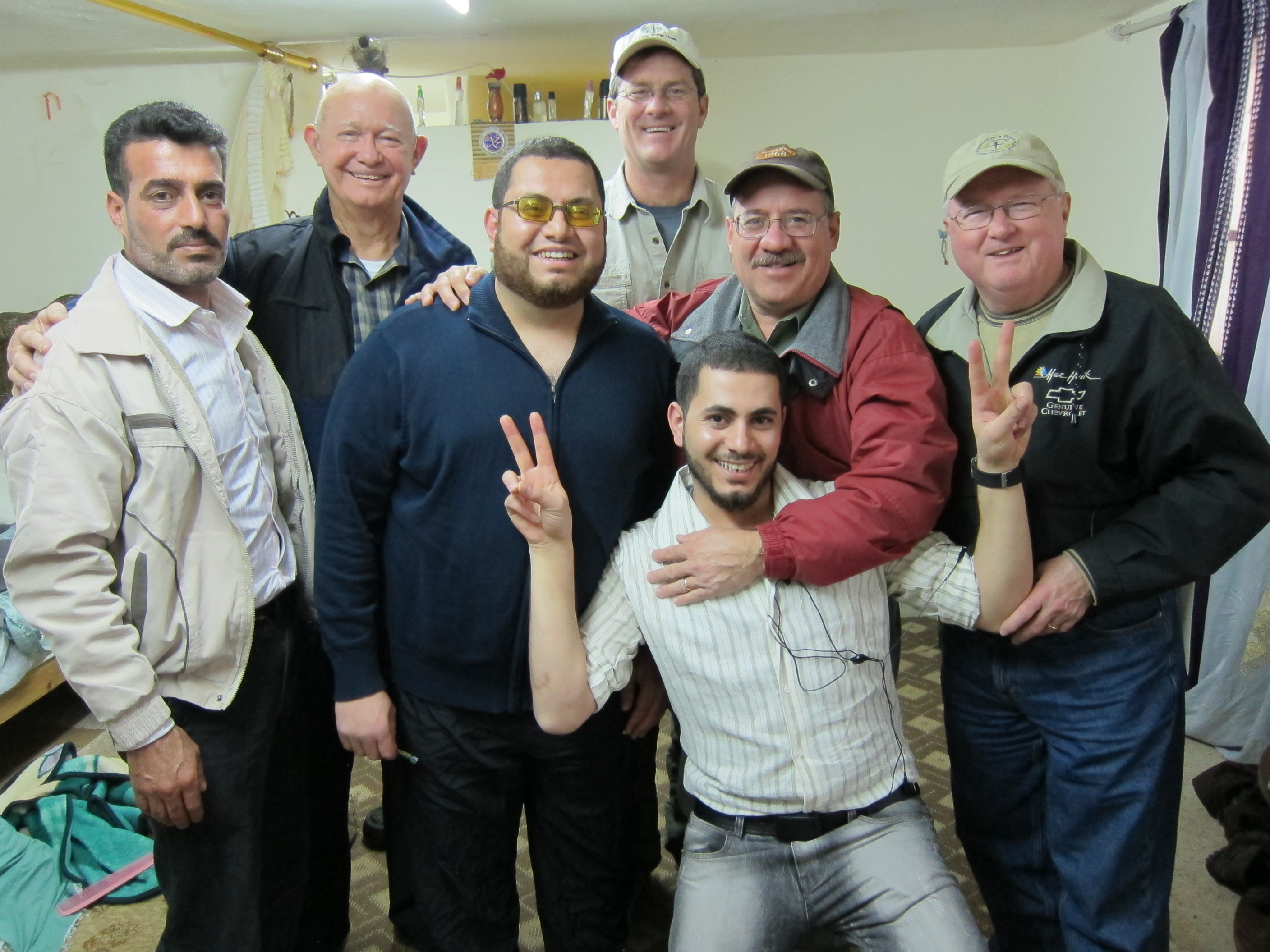
Posted by: Omar C. Garcia | February 1, 2013

20,754 Days of Life

Time FliesAs of today, I have been alive for 20,754 days. However, when it comes to measuring the length of our lives, we tend to do so in increments of years rather than days. When others ask us how old we are we reply by telling them the number of years we have been alive. Children, however, will often add months to the age-equation by saying, for example, that they are whatever “and a half” years old.

Adults don’t care as much about adding the number of months to their current year on the planet. They are content with simply rounding things off to the year and leaving it at that. It is, after all, easier to keep track of the number of years we have been alive than it is to remember the number of days we have been hanging out on the planet.

When it comes to the matter of living, we tend to measure our lives in terms of days rather than years. We tell others what we did today or ask them how they spent their day or look forward to what we will do tomorrow. Days provide a more manageable framework for speaking about the decisions we make, the things we do, or the progress or setbacks that we encounter along our journey.

In Psalm 90:12, Moses prayed, “So teach us to number our days, that we may present to Thee a heart of wisdom.” There is something potent about numbering our days or living with the awareness that our time on earth is brief, even if we live to be a ripe old age. David understood this when he wrote, “Surely every man at his best is a mere breath” (Ps. 39:5c). In other words, in the really big scheme of things our lifetimes amount to no more than a few seconds on the planet.

Understanding that our time on earth is brief should motivate us to live wisely and to make every day count. To do otherwise is to waste the most precious and irreplaceable resource we have — our time. Because we cannot know with any certainty how many days are still ahead of us, we should heed the mantra popularized by Robin Williams’ character in “Dead Poets Society” — Carpe Diem!

The Latin phrase “carpe diem” is popularly translated “seize the day.” More accurately it means to “pluck the day” in the same sense as one would pluck ripe fruit from a tree. The extended version of the quote is, “Carpe diem, quam minimum credula postero” — which means “Pluck the day, trusting as little as possible in the future.” It’s a warning to make the most of the time we have.

There is wisdom in reflecting on the number of days we have been alive. And, the realization that we are allotted a limited number of days should motivate us to make the most of every day we have. I personally like the advice of Stephen Grellet (1773-1855), a prominent Quaker missionary, who said: “I shall pass this way but once; any good that I can do or any kindness I can show to any human being; let me do it now. Let me not defer nor neglect it, for I shall not pass this way again.” That’s good advice for living wisely and making the most of every day.

Posted by: Omar C. Garcia | January 29, 2013

Mountaintops and Valleys

Amman, Jordan en route to Houston, Texas

Jordan is a country that is bulging at the seams with history — and all of it within easy driving distance from Amman. No matter where we ventured over the past week, we drove through or past places where the dust of the centuries continues to stir around the stories of the past. From the ancient columns of the Amman Citadel to the heights of Mount Nebo and from the site of Jesus’ baptism at the muddy Jordan River to the shores of the Dead Sea, it’s impossible to escape the past while in Jordan.

In many ways, scenes of the present can easily stir your imagination about what life must have been like in the past. You can catch glimpses of the centuries in the young boy herding his sheep and goats beside modern paved roads and in vistas of Bedouin tents clustered on barren and windswept plains. It seems that no matter where you look, history is alive and well in Jordan.

Yesterday, we set aside time to visit Petra, Jordan’s most valuable historic treasure and greatest attraction. Hidden away in the southwestern corner of the country, Petra was once a thriving trading center. With massive buildings carved into sheer sandstone cliffs by the Nabataeans, an industrious Arab civilization that settled in this area more than 2000 years ago, Petra continues to defy the efforts of the elements to erase its place in Jordan’s history.

At its height, Petra became an important junction for the silk and spice trade. Its strategic location made it a junction for the trade routes that linked China, India, and southern Arabia with Egypt, Syria, Greece, and Rome. It’s the kind of place where your footprints make only the slightest of impressions in the dust beneath architectural wonders that have inspired countless people through the centuries — a place that still takes your breath away.

Team Pic Entrance
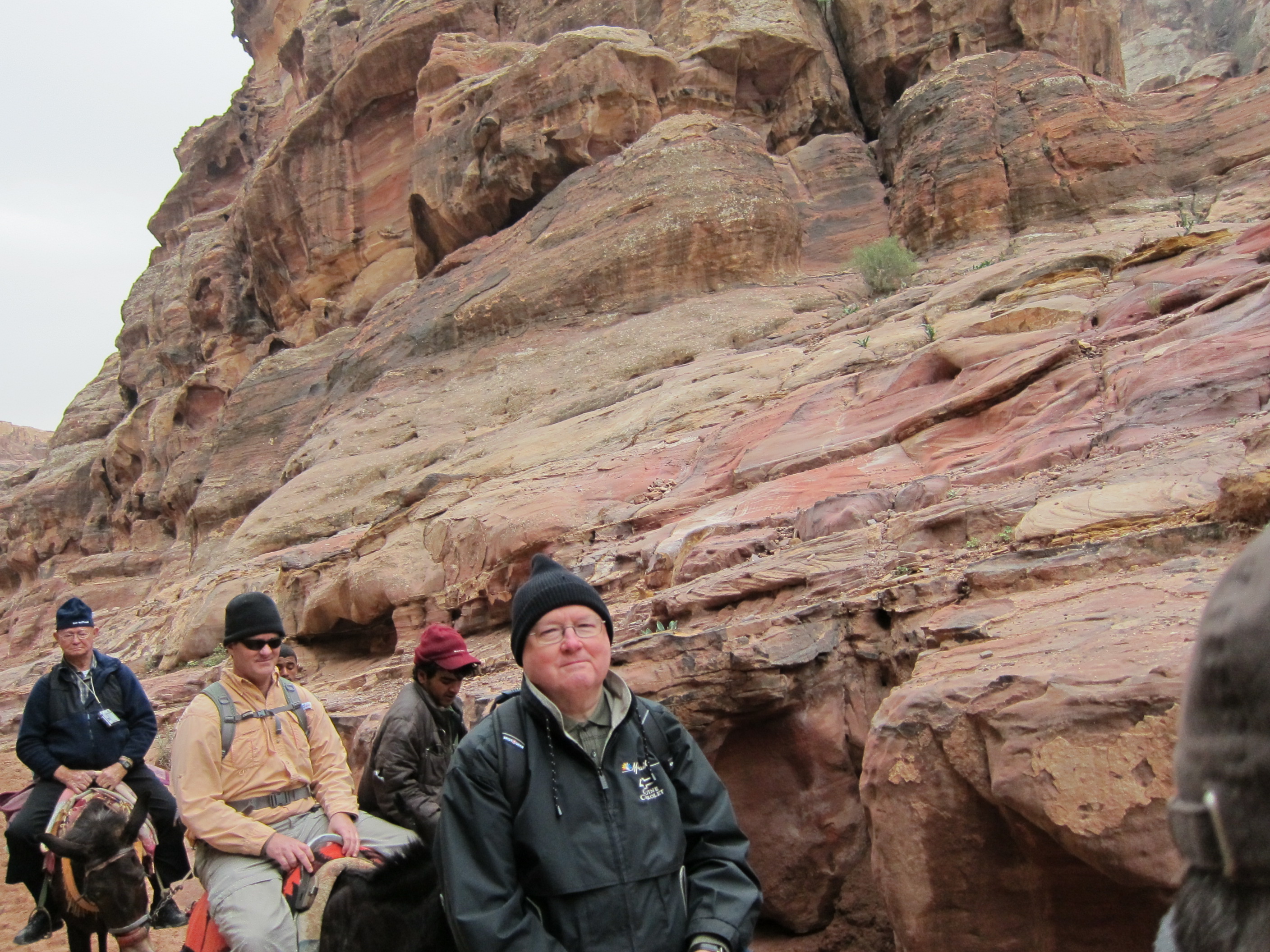
Perhaps the hardest to reach place in Petra is El-Deir or The Monastery, Petra’s second most famous attraction after The Treasury building that first greets visitors to the site. To reach El-Deir, visitors must climb or ride a donkey up a flight of some nine-hundred steps cut into the rock. But, whichever way you choose, it’s worth the effort to visit this magnificent site. El-Deir likely began as a temple and is believed to have been used as a church and a monastery by later societies.

Donkey Ride at Petra
As I stood before the magnificent El-Deir, I could not help but wonder about those who either worshiped there or who retreated to this site in obedience to monastic vows. I also wondered about all of the people who lived their daily lives in the regions far below this secluded mountaintop. While retreats can be good for refreshing the soul, retreating and living in isolation from others is not what God designed us for. We can be inspired on the mountaintop but we should always live out what we believe in the valley — in the places where ordinary people live their lives.

Omar at Monastery
As we head home, I can’t stop thinking about all of the people we have served this past week — Syrian refugees who have suffered great loss and who find themselves walking through the darkest of valleys. We made many meaningful connections because we intentionally walked slowly among these suffering people. We are all returning home a little weary but filled with gratitude for what we experienced among the Syrian refugees we served, certainly much more than the stories that I have had time to blog about. It was also good to visit El-Deir but even better to return to the valley below.

Monastery at Petra

Posted by: Omar C. Garcia | January 28, 2013

The Balm of Gilead

The Region of Gilead in northwest Jordan

Jordan is a land of mesmerizing beauty and contrasts. Yesterday we ventured to the northwestern part of the country to the region known as Gilead — a beautiful mountainous area situated to the east of the Jordan River. Gilead figures prominently in Old Testament history. Among other things, it was the place where King David fled during Absalom’s rebellion and also the birthplace of the prophet Elijah. The Bible also mentions a particular balm of Gilead, an ointment made from the resin of a tree and widely used for medicine, perfume, and as a body ointment.

Our team in Gilead.

Our team in Gilead.

The balm of Gilead first appears in Genesis 37 in the dramatic story of Joseph and his coat of many colors. Joseph’s jealous brothers sold him into slavery to Ishmaelite traders en route from Gilead to Egypt. These traders were carrying “gum, balm, and myrrh” (Gen. 37:25). Joseph later rose to prominence in Egypt, becoming the second-most powerful man in the country. When famine struck the entire region, Joseph’s brothers traveled to Egypt to buy grain — unknowingly from the brother they had sold into slavery.

When Joseph’s brothers returned to Egypt to buy grain, their father Jacob encouraged them to take, among other things, “a little balm” (Gen. 43:11) as a gift for the man in charge of the storehouses of grain, their own brother. The balm was likely from Gilead. I think it was brilliant of Jacob to tell his sons to take with them “a little balm.” We would all be wise to do the same every time we leave home.

I could not help but think about the balm of Gilead as we visited families in this region of Jordan. We visited one family that received a couple of goats from our friends at Global Hope Network. They now have several goats and a means of supporting themselves. When they were in desperate need, they received more than goats from Global Hope. They also received “a little balm” that soothed their anxious thoughts and emotions and gave them a brighter outlook.

Two goats have become many to help a family in need.

Two goats have become many to help a family in need.

We also visited a woman who had suffered a stroke but was determined to continue providing for her family. She did not have the luxury of allowing a stroke to slow her down. This sweet mother of three needed a micro-loan to start a little business. We were so impressed with her and all she has done to prepare to start her business that we felt it worth the risk to invest in her. Our willingness to visit her and listen to her story and invest in her was like a healing balm.

Mom and daughter with our new friend Pat (center) from New Zealand.

Mom and daughter with our new friend Pat (center) from New Zealand.

Every day you and I encounter people whose hearts are bruised, whose emotions are raw, whose shoulders ache under a load of care, and whose steps are faltering from exhaustion. Those are the times we need to offer a little balm. As Christ-followers we must be prepared to offer a prayer, to shed some tears, to listen to a story, to help carry a burden, and to walk beside weary travelers — all essential ingredients in making balm. So, when you get up in the morning and get all of your stuff together for the day, remember the balm of Gilead. Carry it with you and dispense it generously.

Posted by: Omar C. Garcia | January 27, 2013

The People You Love

Sahab, Jordan

This morning we traveled to Sahab, a city located southeast of Amman, to visit Syrian refugee families living in the area. Sahab has earned a reputation as a tough place and is called by some “the city of thieves.” Sheikh Abu Sultan, a friend of the royal family, joined us and personally connected us to families in need in this area. The sheikh loves our friends at Global Hope Network and their compassionate initiatives.

 We were grateful that he spent the morning with us.

The first family we visited was relatively better off than most we have met over the past week. The father, who has Bedouin roots, found a job caring for sheep and cattle. The owner of the herds provided him with a modest little one-room house in the middle of a rocky and barren hill in exchange for his services. The Syrian man was grateful to have this job and to be able to have an opportunity to rebuild his life after losing everything in Syria. Having employment gave him hope of surviving this tough transition from his homeland.

Omar-Syrian-Camels
We also visited a large family that had arrived two days ago. The father told us that after forty-two girls in his area were killed and his neighbors were beheaded, he had no choice but to try to escape with his wife and their two sons and four daughters. His sister and her family also joined them. After spending eleven days in the overcrowded Zaatari refugee camp, he was allowed to leave with his family. He told us that we had been sent by God. He wondered why Christians would come to help him. We explained that we had come because we love God and love people. He wept, embraced us, and kissed us.

After visiting several families in the area. We headed back to Amman to visit other Syrian refuge families. The final visit of the day was refreshing. We visited a blind young man and his family. Ten months ago this man’s younger brother had fled from the town of Daraa where the uprising against Assad erupted nearly two years ago. The younger brother found employment as a barber and then encouraged his brother to come to Jordan, not an easy thing for a blind man to do. But, in spite of the challenges, the blind brother made it from Daraa to the Zaatari refugee camp and then from there to Aman.

We had the most pleasant visit with the blind man and his brother. Although his home in Daraa had been destroyed and although he had to overcome numerous challenges and depend on the kindness of others to escape, he was alive and reunited with his younger brother. The brothers, whose love for one another was obvious, have been together for twenty-two days. Neither of them could keep from smiling. The things they had lost meant nothing because they had each other. These brothers reminded us that we should always regard people as more valuable and important than things. You can replace things, but you can’t replace the people you love.

Team w Blind Man

Posted by: Omar C. Garcia | January 25, 2013

Last Night, I Wept

Amman, Jordan

I could not sleep last night — and, I could not pray. Instead, all I could do was weep and sigh as I tossed and turned throughout the night. This morning, I am physically and emotionally tired. Last night it felt as though everything I have seen and heard this week as we have reached out to Syrian refugees decided to visit me like the ghosts that troubled Ebenezer Scrooge. They came in turns and sat on the edge of my bed and begged me not to forget them when I return home. They came, one after the other, pleading their case and their cause.

In the still of the night, I felt the presence and the pain of those we have helped this week. And, all I could do was to weep for them. I had no words. It started when I took the elevator to my third-floor room at the end of the day yesterday. I thought of the refugee family we had visited hours before, paying rent to sleep under the stairwell of a building. And, as I slept in the comfort of my hotel room, the fresh memory of our visit with a family of eleven crammed in to a hundred-square foot workroom in the basement of an apartment building kept me awake. The warmth of my room reminded me that they had no heat.

I know that we have limited resources to help and cannot do everything. I am, however, thankful that we have given a measure of relief and hope to every person that God has put in our way. I wish we could do more, but I have to trust that others will come after us to serve as the hands and feet of Jesus. I am determined to remember those who are suffering in Syria and the displaced who find themselves in crowded camps and cramped and cold little rooms in places like Jordan and Turkey. I will not forget their tears and I will not forget my own.

This morning I remembered something that I had read last week as I was studying Psalm 6. David said, “the Lord has heard my weeping” (Ps. 6:8). Think about that for a moment. God “hears” weeping. In a sense, tears are words. Charles Spurgeon said, “Weeping is the eloquence of sorrow. Let us learn to think of tears as liquid prayers.” I like that.

Syrian Text MessageYesterday, my friend Jamal Hashweh, Director of Global Hope Network received a text message from a Syrian refugee family we visited two days ago. The eldest son wrote: “Thank God. Thank God. Thank you God for the words we heard yesterday and for the prayer that drove my daughter to tears, and also my Dad. We all felt as though we were back home in Syria.” I am grateful that God hears our weeping and that He understands what we cannot put into words. The daughter who wept in her father’s arms as I prayed for her family is precious to God. He heard my prayer for her family but he also heard and understood her tender tears. I pray that one day soon He will answer our prayers and that this family and the others we have met will be able to return to their homes and live in peace.

Thank you for following our journey. In a few hours we will continue our work among the refugee families in Jordan. Please pray that God will continue to strengthen our hands for this good work.

Posted by: Omar C. Garcia | January 24, 2013

A Dangerous Unselfishness

In the vicinity of Mount Nebo in Jordan

We started our day at the top of Mount Nebo, the most revered holy site in Jordan. It was at this place that God had allowed Moses to see the Promised Land that he would not be permitted to enter. As I silently surveyed the magnificent panorama, I thought about Moses. He had risked everything for this moment — Pharaoh’s wrath, the hardships of the wilderness, the moods of a rebellious people, and so much more. And then Moses died but his people entered into the Promised Land.

IMG_1978

Our team atop Mount Nebo.

I also thought about the message that Martin Luther King, Jr. preached on April 3, 1968, the night before he was assassinated in Memphis, Tennessee. His message was entitled “I’ve Been to the Mountaintop.” That night, he spoke these prophetic words:

We’ve got some difficult days ahead. But it really doesn’t matter with me now, because I’ve been to the mountaintop. And I don’t mind. Like anybody, I would like to live a long life — longevity has its place. But I’m not concerned about that now. I just want to do God’s will. And He’s allowed me to go up to the mountain. And I’ve looked over, and I’ve seen the Promised Land. I may not get there with you. But I want you to know tonight, that we, as a people, will get to the Promised Land. And so I’m happy tonight; I’m not worried about anything; I’m not fearing any man. Mine eyes have seen the glory of the coming of the Lord.


Ten hours later, Martin Luther King, Jr. was dead. But his legacy lives on and has changed our world forever.

King said something else in that speech that I thought about as we left Mount Nebo to visit Syrian refugees living in the immediate vicinity of this historic site. He challenged his listeners to “develop a kind of dangerous unselfishness” — like that demonstrated by the Good Samaritan. “The Levite asked, ‘If I stop to help this man, what will happen to me?’ But the Good Samaritan reversed the question: ‘If I do not stop to help this man, what will happen to him?’ That’s the question before you tonight.” And that’s the question that I have not been able to get out of my mind as we have visited so many families in desperate need.

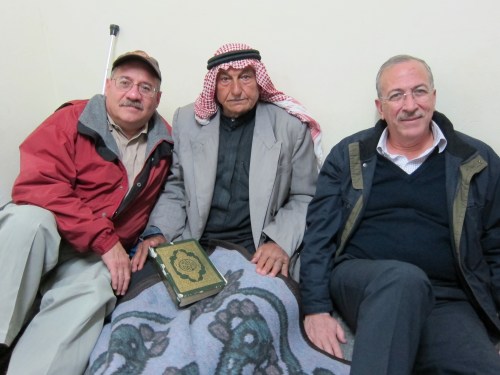
The most emotional visit for me was the last visit of the day. Three generations of one family welcomed us into their modest rented quarters. The patriarch of the family was reading his Qu’ran when we entered the room. We shared why we had come and then listened to their story of hardship. The elderly man talked about the bomb that had destroyed his neighbor’s home and killed his dear friend. “My son and I picked up the pieces of his body that had been blown apart,” he said, “and we put them together for burial.”

Omar - Syrian Refugee - Jamal

With the family patriarch and Jamal Hashweh, Director of Global Hope Network.

And then he talked about how the government forces had come to their home. The soldiers harvested all of his olives and then destroyed every tree he had planted as a young man. This orchard was the family’s livelihood. To add insult to injury, he continued, they blew up and destroyed what they had harvested and then proceeded to demolish their home until nothing was left standing.

At the conclusion of our time together I prayed for the family and for the peace of Syria. Afterward the old patriarch sat and wept. It was one of the most intense moments we have experienced in our time among the refugees. One of his granddaughters stood outside the room, crying in her father’s arms while telling him that she wanted for peace to come to Syria so that they could return home. Each of us wiped the tears from our own eyes as family members thanked us for coming to help.

As we walked toward our vehicles I looked in the direction of Mount Nebo and once again thought about King’s words. If we do not help these people, what will happen to them? That’s the question each of us must ask ourselves as God puts hurting people in our way. May we always respond to those in need with the kind of dangerous unselfishness demonstrated by the Good Samaritan.

Posted by: Omar C. Garcia | January 23, 2013

An Upside Down World

Amman, Jordan

Starting over is never easy, especially for those who have suffered so much loss. The Syrian refugees we have met over the past two days are bound together by painful cords woven with strands of loss, suffering, and uncertainty. They live in an upside down world where so many things do not make sense. Every day is a struggle to survive — not just by putting food on the table, but by trying to fit the pieces of their shattered lives back into some kind of sensible order. That’s not easy to do in a context where everything is drastically different and the odds are stacked against you. But somehow, those we have met are managing to put one foot in front of the other, painful as it may be, as they inch their way toward an uncertain future.

The recurring theme of today’s visits was gratitude, not just for the practical and measurable help we have offered, but for something much more important than that — our presence. Over and over throughout the day, we heard the familiar notes of the same chorus: Thank you for visiting with us. One father of four put it best. He told us that he has witnessed and also heard from others about the callous attitude on the part of some agencies that distribute aid. And then he continued to say that he has noticed something different on the part of the Christians who have come to help. “You have a trademark of love,” he said. “You take the time to listen and to drink a cup of tea and to pray for us.” He added, “And you come back to see how we are doing.”

Syrian Family in Jordan
At the end of the day our team worshiped at a small church in East Amman. My friend Bill Crenshaw shared his personal story of the difference that Jesus Christ has made in his life. And then, I talked about Jesus and how He loves and cares for each of us and how He demonstrated that love. Just moments after we started to worship, one of the families that we had visited today walked in through the door. It was the father of four, his wife, and their children. This was their first time to set foot in a Christian church. Moments later, his brother, with whom we had also visited, walked in with his family. They looked our way and acknowledged us with their smiles. We instantly felt the warmth of their gratitude once again.

What happened after the service was the best thing of all. The members of this small congregation lived up to the example of Jesus. They embraced each of the visiting family members, took time to speak to them and to look into their eyes and to offer words of encouragement. We lingered for what seemed the longest time, enjoying these precious moments of fellowship with our new friends. I have a strong feeling that this will not be the last time they come to this little church. They know now that they do not have to sail their rough seas alone. They have discovered a fleet willing to sail along with them to make certain that their journey is a safe one. As we parted company I sensed that the world was starting to look a little less upside down and a little more hopeful for our new friends. That alone was worth the travel to Jordan.

Posted by: Omar C. Garcia | January 22, 2013

Profiles in Pain

Amman, Jordan

God has a way of helping us keep our petty problems in proper perspective. After landing in Amman and finally making it to the luggage carousel, as usual, I was confident my luggage would be among the first on the carousel. One of the little perks of being a Gold member of Emirates Airlines Skyward program is that my luggage gets a Priority handling tag to ensure it makes it on and off the plane without incident. However, this morning I waited and waited for so long that I almost became hypnotized by watching the luggage carousel go round and round. My luggage was nowhere to be found.

I spoke with an airline representative who informed me that my bags were still in Houston! The young lady assured me that my bags will arrive tomorrow and will be delivered to my hotel. “Oh my soul,” I thought to myself. “We begin our work with Syrian refugees this afternoon and then I am speaking to 200+ Iraqi refugees in the evening. And all I have to wear is what I have traveled in for two days. I sure hope the folks I meet today will receive my smell.” And then, I was reminded that we will be visiting families that fled the conflict in Syria with only the clothes they were wearing. I have nothing to complain about.

The only way I can describe what it was like to meet with Syrian refugees is that it was beyond heartbreaking. Every story we heard was a profile in pain. I found it ironic that the first family we visited was from the Syrian town of Deraa, the place where this whole mess started almost two years ago. We sat on the floor and listened to the anguished story of a mother of seven whose twenty-four and twenty-six year old sons had been killed by government forces. She had an actual photograph of one of her sons and only a cell phone photo of the other. Her husband remained in Syria to fight with the resistance forces.

A Dead Syrian Son
Once a family of means, this woman and her surviving children now live in poverty. One daughter is an unemployed civil engineer and the other had just been accepted into medical school when all hell broke loose in Syria. We took a week’s worth of groceries to the family and also blankets. With barely enough to eat, this mother told us that if we knew of another family with greater needs we should take the food to them. “After months of waiting for things to get better,” she said, “just your visit is a great encouragement to us.” And then, she wept.

Every family we visited shared similar painful stories of loss. Many cried tears of relief not only because we had brought them food and blankets, but because we listened and shared the hope of Christ with them, and because we prayed with them. Dealing with delayed luggage is nothing compared to coping with the death of family members, the destruction of personal property, and the daily frustration of not knowing the welfare of family members and friends still trapped inside Syria’s bloody borders. Everyone we met today longs for the fighting and killing to stop. They just want to go home to rebuild their lives and live in peace. We should all pray for that day to come soon so that no more profiles in pain will be shared.

Posted by: Omar C. Garcia | January 21, 2013

In The Direction Of

Houston, Texas en route to Amman, Jordan

Even a cursory study of the life of Jesus will reveal that He moved toward people in need.

I like the word “toward” because it means “in the direction of.” For example, lepers were perhaps the most feared individuals in Jesus’ day — disfigured outcasts banished to a life of loneliness and desperation. Lepers had to announce their comings and goings in order to warn others to clear the way. In other words, so that others would have plenty of time to “move away from” them.

The presence of a leper always produced more than a little fear and anxiety. Jesus however, was not afraid. He did what others must have considered totally absurd. He moved in the direction of lepers.

Mark (1:40-45) records an occasion when Jesus reached out His hand and touched and healed a leper. In his book “Dirty God: Jesus in the Trenches,” author Johnnie Moore points out that touching others is a sign of intimacy. “It is a bridge not just from a hand to a shoulder,” he writes, “but also from a heart to a heart.”

There are many other examples in the Gospels of Jesus moving in the direction of those in need.

Whether it was a woman at a well, a despised tax-collector in a tree, an adulteress being dragged through the streets by her accusers, or a widow at the funeral of her only son, Jesus did not shy away from messy or painful situations. Instead, He moved in the direction of people tangled up in webs of sin, imprisoned behind bars of hopelessness, and struggling beneath the weight of heavy burdens. Grace and compassion moved Jesus in their direction.

I have been thinking much about Jesus as my team and I travel to Jordan to walk slowly among Syrian refugees — people who have been forced to flee their native land because of a bloody civil conflict that has claimed tens of thousands of lives.

Omar - Syrian Refugee - Jamal

I first visited with Syrian refugees when I was in Jordan last April. Their stories of suffering the loss of multiple family members at the hands of their own government troubled me and kept me up at night. Since that time, I have longed to return to them — to move in their direction in order to offer practical assistance along with the hope that Jesus still offers to the disenfranchised and the desperate.

If we want to become more like Jesus, then we must learn to consistently move in the direction of those in need. We must close the distance between ourselves and those who, like the lepers of Jesus’ day, are longing for the kind of touch that will build a bridge from heart to heart.

Demonstrating grace and kindness is one way to show people in need that God loves them, believes in them, and has not forgotten them. But in order for people in need to experience the benefits of grace we must move in their direction, slow down, look into their eyes, listen to their stories, and do what Jesus would do.

What about you? Wherever you are headed today, ask God to help you to be sensitive to the people He puts in your way. Ask Him to help you to see them clearly and to listen carefully to what they are saying. And if you discover someone in need or who is hurting, then move in their direction and offer them the healing balm of grace in the name of Jesus who was full of grace and truth.

I am thankful that Jesus willingly made Himself of no reputation, took the form of a servant, and moved in my direction (Phil. 2:7). For me, it has made all the difference.

Posted by: Omar C. Garcia | January 18, 2013

Dear Abby

Dear AbbyPauline Friedman Phillips aka Abigail Van Buren aka Dear Abby died this week at the age of 94. In the years when the world was connected by print media, Abby was a rock star. She reached millions of people through her syndicated advice column. Abby had so many followers that she received between 3,000 and 25,000 letters per week from folks seeking advice about almost every imaginable topic. Whether or not you agreed with her advice, the Dear Abby column gave Americans an intimate look into the lives of others. In the process, we learned that we are not all that different from one another. We all struggle with similar fears and frustrations and have similar longings to be loved, affirmed, or reassured.

The Dear Abby column was very much a part of my childhood. My Mom looked forward to reading Dear Abby’s daily post in our hometown newspaper, The McAllen Monitor. More than once, Mom clipped and reposted Abby’s sage advice on our refrigerator door. When Abby’s column actually made it to the refrigerator door, that was a clue that we all needed to read and give it consideration. On several occasions, Abby’s advice opened the door for conversations about everything from being honest, trying hard, forgiving others, and a variety of other things that my mother considered important. Abby’s column provided lots of teachable moments in our home.

Perhaps one reason why Abby was so popular is that she cared about people. Her advice ran the gamut from humorous to serious, but her responses gave us insight into the kind of person she was. If urgency dictated it, Abby took the time to call some who had written to her for advice. If someone wrote to her and included a stamped, self-addressed return envelope, she felt obligated to write a personal response. Abby never forgot the letter she had received from the landlady of a 91-year-old man whose children did not come to see him on his birthday. It broke her heart. Abby endeared herself to millions because, beyond the printed page, people felt she really cared.

I wonder if people sense the same thing about us — that we care, that we are accessible to those seeking advice, and that we will take the time to listen and to do what we can to help them. We still live in a world of people seeking wise counsel, longing for a little bit of balm to help heal their hurts, and a little bit of honey to refresh them. For years, millions of people seeking advice thought about and sought help from a woman who visited our homes daily in newsprint. We can all learn a lesson from Abby. She said, “Every day I get letters from people who say, ‘You changed my life.’” Abby added, “Now that’s important.” And, indeed it is.

« Newer Posts - Older Posts »

Categories