Posted by: Omar C. Garcia | August 6, 2010

My Corner of the Room

Bangladesh | From Dhaka to Dinajpur | 05 August 2010

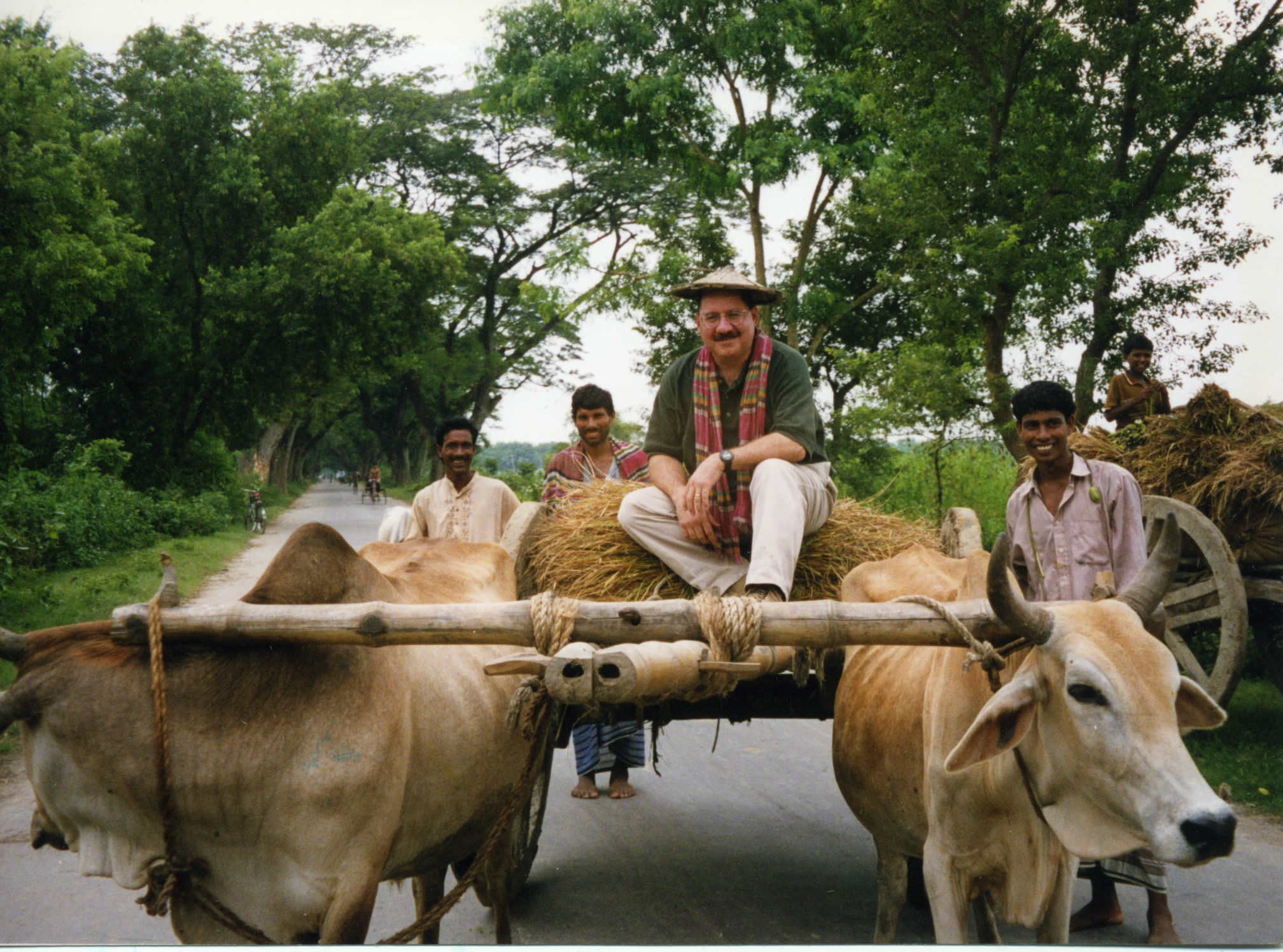
Traveling from anywhere to anywhere in Bangladesh is an adventure. This morning we hired a driver to take us from Dhaka to our guesthouse in Dinajpur — a city located less than one-hundred miles from the Himalayas. The distance is not long by Texas standards. However, getting from one place to another in this tiny country is a slow process. No matter where you go, drivers compete against one another to gain any advantage on narrow and congested roads. Traveling on these roads involves knowing how to play the game of chicken with on-coming traffic. The only rule is that drivers must default to their left — something they usually do at the last possible second. But somehow, the chaos works out with only occasional fender-benders. Our journey to Dinajpur took nine hours, including a short break for lunch followed by a lemon-flavored popsicle-type treat that was as green as the algae-covered pond next to the restaurant.

I have crisscrossed Bangladesh many times before but I never get tired of the scenery. And, although I am still jet-lagging a bit from my recent trip to India followed by the quick turn-around to Bangladesh, I did manage to stay awake for much of this road trip. The passing scenes are all very familiar to me – vistas of people working in rice fields, people hanging jute out to dry, goods and animals being transported on big trucks and bicycle rickshaws, markets choked with people purchasing ingredients for their next meal, busses and trains packed with passengers inside and out, and more. Bangladesh seems to always be in motion, like a giant ant hill or bee hive. The lack of so many creature comforts keeps people here on their toes. The ceaseless activity of Bangladesh is all about survival. In this country if you don’t work you are not likely to eat.

I still have a difficult time with the beggars and those whose physical deformities or illnesses have consigned them to living on the streets. When we stopped for fuel along the way, five beggars appeared out of nowhere. One young man approached us, pointed to his withered leg, and then stuck out his open hand with an expectant, almost entitled expression on his face. Over the years of traveling in South Asia I have heard all sorts of advice about what to do when approached by beggars. But, my heart tells me to look for Jesus in the distressing disguises of these broken human beings and then do something to help, even if I just offer a single taka (the name of Bangladesh’s currency). And, if I get it wrong some of the time, that’s ok. I would rather err on the side of helping. The answers are never black and white when you look into the eyes of the poor. I don’t live in their world and cannot comprehend the difference a few taka might make.
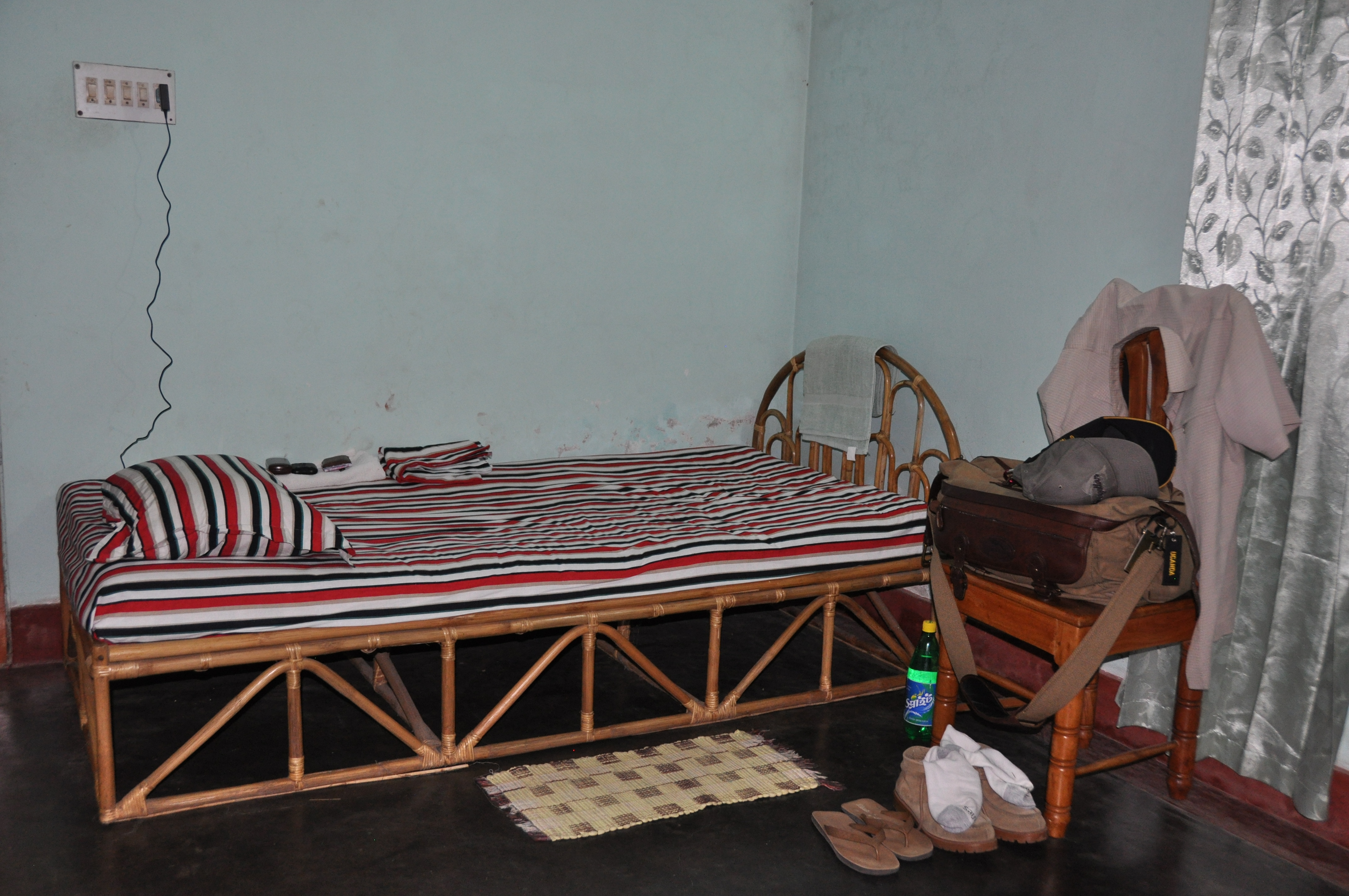
Finally, as the sun was rushing off to meet the distant horizon, we arrived at our guesthouse. Tired and hot, we unpacked our gear and went to our rooms. I spend lots of time living out of a suitcase and spend many nights in dingy and lonely little rooms in some of the most off-the-beaten-path kind of places on the planet. But for me, there is something strangely comforting about being able to settle in for the night in my corner of a room. I see these places as my temporary little pieces of home as I work to do my part to advance God’s purposes in the world. Today I feel fortunate that my corner of the room is in a guesthouse operated by Christians. Gil, my friend who is traveling with me, commented on how meeting Christians in other parts of the world can make any place feel more like home. He is right. Tonight we are staying with family members we have met for the first time in a guesthouse somewhere outside of Dinajpur.
Posted by: Omar C. Garcia | August 4, 2010

On Books and Beatings

Dhaka, Bangladesh

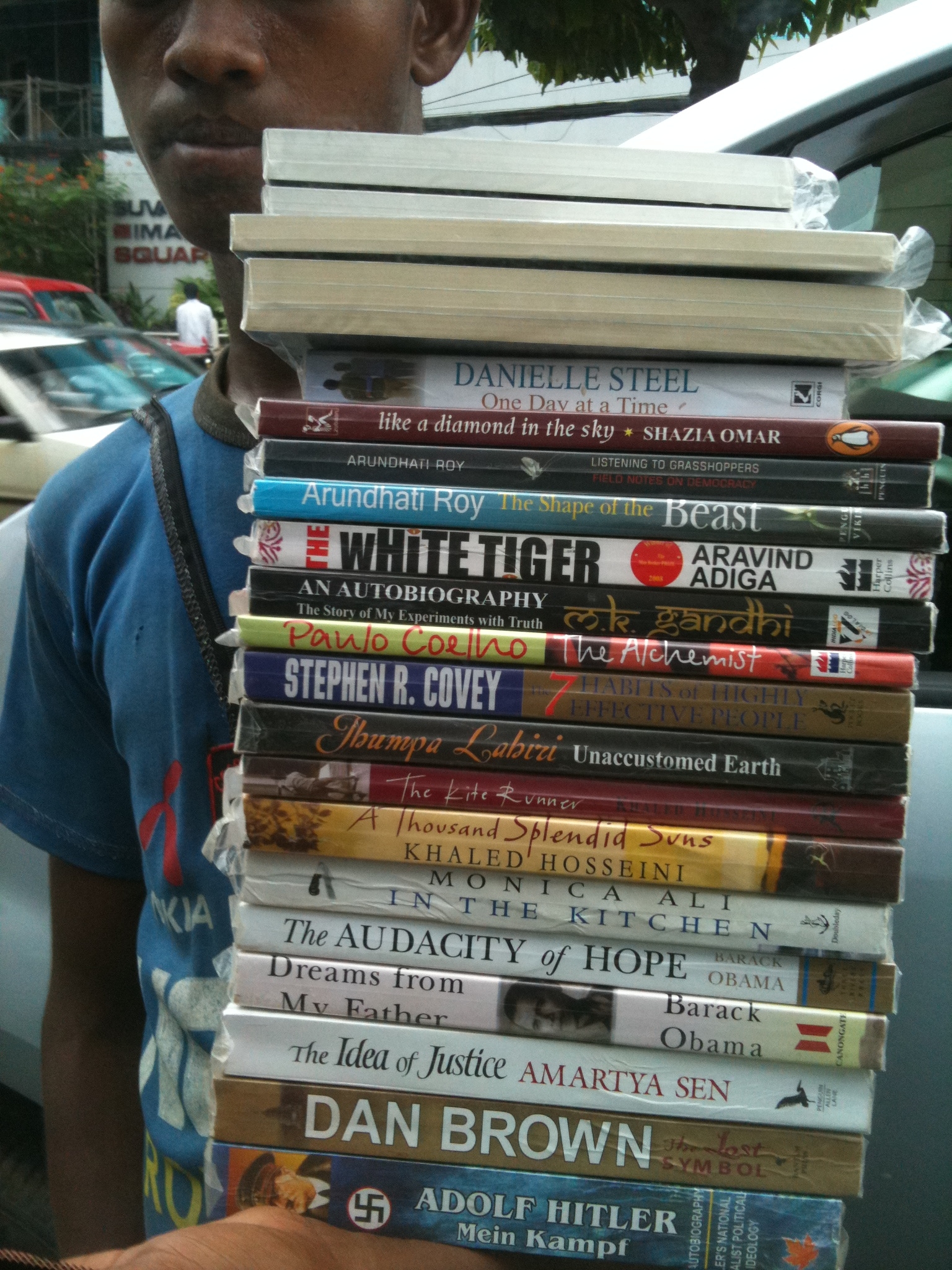
The congested streets of Dhaka provide a steady supply of customers for street vendors and hawkers. These individuals skillfully navigate through slow-moving traffic while balancing arms full of merchandise. The moment that traffic comes to a stop, these savvy vendors kick into aggressive sales mode and go from car to car. These guys offer everything from house-wares, maps, popcorn, varieties of candy, and books – lots of cheap knock-offs of famous and not so famous titles. If you enjoy reading and have plenty of room in your suitcase, you can buy books at better than bargain-basement prices on the streets of Dhaka. I took a photo of one of the many book hawkers who approached our vehicle. Every book hawker on every street corner was peddling the same titles, and every one of these guys that I spoke with was a skillful negotiator. Although the adult literacy rate is estimated to be about 54% of the population, these guys sell lots of books.

We met a young man named Zia yesterday who shared with us the story of how he became a Christian. His story begins with a book. When he was a teenager, a man offered him a free copy of the Gospel According to Luke. As a devout Muslim, Zia was offended and slapped the man in anger. But, Zia kept and later read the book. He was so moved by what he read that he decided to become a follower of Jesus. He eventually met other believers and began to grow in his faith. A few years later he decided that he would do for others what the Christian man had done for him – he decided to give copies of the book of Luke to others in his village. Now, if had Zia hawked any other books, things would have been fine. But, because he was giving away copies of Luke’s Gospel, the chairman of his village and an angry mob confronted Zia. And then, the worst happened. The village chairman, a man elected to keep the peace, struck Zia across the forehead with a machete.

Zia said that the last thing he remembered was falling to the ground and losing consciousness. When the mob dispersed, someone carried Zia to a hospital where he lay in a coma for one month. He spent an additional month recovering from the wound to his head as well as wounds to other parts of his body. The district newspaper reported the story of this young man who had been struck down because he was giving away free copies of a book about Jesus. No one held the village chairman accountable for assaulting Zia. It seemed that the chairman had acted with impunity. However, ironically, three months after the village chairman struck Zia with a machete, thieves broke into the chairman’s home and killed him in the process of the robbery. The local newspaper reported the story of the chairman’s death.

Samuel Zwemer was a missionary to the Muslim world who became known as the Apostle to Islam. Zwemer believed in the value of distributing copies of God’s Word in the Muslim world. Like the Psalmist, he believed that “The entrance of your words gives light” (Ps. 119:130). Zwemer wrote, “No agency can penetrate Islam so deeply, abide so persistently, witness so daringly and influence so irresistibly as the printed page.” The only thing that stopped Zwemer from distributing Arabic leaflets and Bibles was confiscation. Today, young Muslim-background believers like Zia continue to faithfully distribute copies of the book – God’s Book. They understand the power of the printed page. Zia is one among many Christ-followers in Bangladesh who has suffered persecution because of his faith in Christ. But, Zia is determined to continue distributing his free books. He understands better than most that the pen is indeed mightier than the sword.

Posted by: Omar C. Garcia | August 3, 2010

Take Off Your Shoes

Dhaka, Bangladesh 

Gil and I arrived in Dhaka a few minutes before nine o’clock this morning. Overcast skies concealed the fertile landscape as we began our descent into Bangladesh. But, once we broke through the cloud cover Dhaka’s sprawling and palm-tree accented vista came into view. We bounced once onto the tarmac and then rolled smoothly to the terminal building. My old friend Mortuza was there to meet us. Over the years, Mortuza and I have traveled together throughout the country. In 2003 we spent a week on a boat and visited remote villages along the Brahmaputra River. It was an unforgettable adventure and one that strengthened our friendship as we dealt with many difficult challenges along the river. Mortuza will once again serve as our guide as we visit with many of our friends here who are committed to advancing the interests of God’s kingdom. 

A couple of months before coming to Bangladesh I became interested in a new survival program on the Discovery Channel. The program is entitled “Dual Survival” and is co-hosted by Cody Lundin and Dave Canterbury – both of whom are survival experts. As with other programs in this genre, Cody and Dave show viewers how to survive in a variety of difficult and hostile environments. One thing that is especially interesting about this program is that Cody, a minimalist and primitive skills expert, does not wear shoes. In fact, he has not worn shoes in more than twenty years – a testimony to his indigenous self-reliant and minimalist philosophy. As a result, Cody has developed a set of very tough feet. In one episode he explained the benefit of not wearing shoes. Cody said that going barefoot has forced him to slow down and to look at and appreciate his surroundings a little more intentionally. 

Gil and Mortuza

 I am not suggesting that Gil or I intend on traveling in our bare feet over the coming days. But, we will be forced to slow down. Nothing moves fast in Bangladesh. Streets are so congested with traffic that whether you are in a vehicle or on foot, you are forced to look at the things around you a little more intentionally. This afternoon we set off for our first meeting on foot and then returned to our hotel by rickshaw. When you travel at a pace this slow you can’t help but notice what’s going on around you. The streets of Dhaka are as congested by humanity as by vehicles. As you walk or meander through the traffic on a rickshaw, every sense becomes engaged in the experience. Regardless of which way you look, the sights are stimulating. The smells are interesting and sometimes overpowering. The cacophony produced by horns and rickshaw bells and squealing brakes and people talking or bargaining on the sidewalks can leave your ears feeling a bit raw. And, when you travel slowly, you will feel the touch of beggars reaching out to you in the hope of receiving something to help them survive another day. 

Returning to places like Dhaka reminds me that we tend travel too fast. We are generally so focused on getting from point A to point B that we seldom notice the things that are happening around us. When we travel fast we usually just use the senses of sight and sound. We don’t have time to smell the roses much less anything else. And, our haste keeps us a safe distance from feeling the touch of people in need and from being able to touch people in need. It’s hard to embrace someone or to touch their heart with an encouraging word when we move through daily life so quickly. So, take off your shoes this week and wiggle your toes. Slow down a bit and ask God to help you engage and connect with those around you. Look at people more clearly, listen to them more intently, and respond to them more compassionately.

Posted by: Omar C. Garcia | August 2, 2010

Pastor Alex’s Challenge

Dubai en route to Dhaka, Bangladesh

Sunday was a great day at Kingsland as we celebrated how God used seven student mission teams to bless others from Houston’s inner city neighborhoods to the slums of Kolkata. Our student ministry pastors do an outstanding job of preparing our students to serve others around the world. This past month more than three-hundred and fifty Kingsland students and sponsors ventured out to connect with the homeless, the hurting, and those hungering for meaning in life. God did some wonderful things through our students. Our team members made a difference and returned home different – changed for the better as a result of having served others.

At the conclusion of each service, Pastor Alex challenged us to do more than give our students a courtesy handclap. He challenged us to follow their example by participating in a Sunday evening prayer walk. His challenge was simple. First, start at your own front door and pray for those nearest and dearest to you. Second, step out of your front door and pray for your neighbors. Walk the sidewalks of your neighborhood and pray for each home along your path. Prayer-walking is simply defined as praying on-site with insight. Walking slowly helps us to notice the things we easily overlook in our day to day haste. And, the things we see can give us clues or insight into how to pray for each home. Finally, Pastor Alex challenged us to conclude our prayer walk by praying for the nations.

We must become more intentional about praying for those who are nearest and dearest to us, our neighbors, and the nations. Dino Rizzo coined a phrase I like – “peripheral compassion.” In his book entitled “Servolution: Starting a Church Revolution through Serving,” Rizzo defines peripheral compassion as “the capacity to reach out and envelop the multitudes while noticing the tiniest need.” Peripheral compassion “is one of my favorite qualities I see in Jesus,” writes Rizzo, “and one I have always wanted to emulate.” Like Rizzo, we should all strive to emulate this quality. We need to intentionally work on sharpening our peripheral vision because unless we first see what’s there we will never be moved to respond compassionately. And, in order to see what’s there we must walk slowly among the people. When it comes to noticing what’s going on in the lives of those around us, haste indeed makes waste. So, we need to slow down and see things in focus.

Mark recorded an account of a miracle that Jesus performed in two stages (Mark 8:22-26). A blind man was brought to Jesus at Bethsaida. Jesus took the man aside, spit on his eyes and laid hands on him, and then asked him if he could see anything. The man replied that he could see men, but they looked like trees walking about — an indication that his sight was blurry. Jesus laid His hands on the man’s eyes a second time and, as a result, the man could see everything clearly. Jesus could have healed the blind man with one touch but chose to touch the man a second time. Perhaps He did so to remind us that insight often comes slowly. Most of us move through life so fast that the people around us look like trees walking about. That’s why we should slow down and ask Jesus to touch our eyes a second time. Only then will we see others clearly, gain greater insight, and sharpen our peripheral compassion.

My friend Gil and I will arrive in Dhaka tomorrow morning. We will meet with several of my good friends – all nationals who care deeply about their people. After our meetings in Dhaka, we will head for the villages and walk slowly among the people. I love the people of Bangladesh and I always enjoy walking slowly among the people in the villages. My prayer is that God will reveal specific needs that we can address through prayer and compassionate acts of kindness. And, I pray that each of us will accept Pastor Alex’s challenge to live with greater awareness about what is happening in our homes, our neighborhoods, and our world and then respond intentionally and compassionately as Jesus would. Gil and I are determined to do just that over the coming days in Bangladesh.

Posted by: Omar C. Garcia | July 31, 2010

Back to Bangladesh

I am headed back to Bangladesh on Sunday accompanied by my friend Gil. I first considered going to Bangladesh in 1998 while traveling by train from UlanBator, Mongolia to Beijing, China. As the train made its way south across the vast expanse of the Gobi Desert, my heart and mind were trekking across Asia Minor with the Apostle Paul and his companions. Absorbed in Luke’s account of the birth and expansion of the early church, I knew that God wanted me to join Him on mission in the Muslim world. My friend Lee Pullin and I spent considerable time talking about how such a conviction might become a reality. We both felt drawn to the 10/40 Window — home to the world’s least reached peoples. That night, as I listened to the wheels of the train marking time against the tracks, my heart arrived in Bangladesh. The next morning we arrived in Beijing.

Soon after returning home from Mongolia, I read about devastating floods in Bangladesh that had killed thousands and displaced millions. I found myself captivated by the haunting images of the dead and the living as I sat in the comfort of my home. What made these images even more haunting was the realization that out of the thousands who died in the flood waters, relatively few had the opportunity to hear and respond to the gospel of Jesus Christ. I could not help but reflect on the geography of it all. The geography of my birthplace made it possible for me to have access to the gospel — but, not so for those born in Bangladesh. Geography really is a matter of life and death in this overpopulated country — not only physically, but spiritually as well.

A year after my journey across the Gobi, I finally arrived in Bangladesh. This tiny country is nestled next to India at the very northern part of the Bay of Bengal — an area prone to natural disasters. Bangladesh is home to the third largest concentration of Muslims in the world. The majority of the Muslims in the country are Sunnis, although there is a small Shiite community. Bengali Muslims are the largest unreached people group in the world. On my first visit, I had the opportunity to story the Bible for six Muslim-background believers. Each of these new believers had experienced physical abuse and social alienation because of his faith in Christ. Yet, each of these men was determined to grow in his understanding of the Bible and to develop an apologetic that would enable him to more effectively share his new-found faith.

I returned to Bangladesh less than a year later to search of a man of peace — an approach to evangelism initiated by Jesus when He sent out the seventy-two to preach the good news. Jesus instructed them, “When you enter a house, first say, ‘Peace to this house.’ If a man of peace is there, your peace will rest on him; if not it will return to you. Stay in that house, eating and drinking whatever they give you…” (Luke 10:5-7, NIV). I must admit that it was a bit unnerving as we set out — not knowing where we would sleep and eat or what the day might hold. But, within the hour we had the opportunity to share the gospel with a Bengali man. Within minutes a large crowd gathered around to listen to the conversation. We spoke to people throughout the day and estimate that at least one hundred Bengalis heard the gospel for the very first time. A short time later we met a man of peace who invited us to his home.

The following day we met two men who had heard that we were in the area. Although these men had heard about Jesus, they told us that they had been waiting for four years for someone to come and explain to them more fully the story of Jesus. We had the wonderful opportunity of sharing the gospel with these men as well as with a larger audience of their relatives and friends. As a result of our visit to that village, more than one-hundred men and women placed their faith in Christ for salvation. In the days to follow we continued to meet and share with many people eager to learn more about Jesus Christ.

God loves the people of Bangladesh. And, because they are important to God, they are important to me. In the years since my first visit, I have mobilized teams to test water wells for arsenic content and to travel to remote villages by land and water. Kingsland has provided disaster relief funds as well as money for new water wells. The people of Bangladesh are good people deserving of practical demonstrations of God’s love and concern for them. I am looking forward to returning and reuniting with several of the good friends that I have met there on my many visits over the years. God is using these friends to make a big difference in this small country.

• • • • •
PS | Thank you to all of you who visited Go Beyond Blog in July — a record month with 9,296 guests. Thanks for your readership.

Posted by: Omar C. Garcia | July 29, 2010

The Right Stuff

Reflections on doing small tasks well and the selection of a king. | 1 Samuel 16:8-12

God always makes responsible choices that are best for all concerned. When it came time to select a new king for Israel, God sent the prophet Samuel to the home of Jesse. One by one, Samuel met all of Jesse’s sons. The Lord rejected Eliab, Jesse’s oldest son, as a candidate for king but not as an individual. God knows what we are best suited for. God did not see in Eliab’s heart the right stuff to lead a nation. Jesse then called his son “Abinadab and had him pass in front of Samuel” (1 Samuel 16:8). Abinadab, also a soldier in Saul’s army (17:13), was not chosen by God. Jesse’s third son Shammah, a soldier like his older brothers (17:13), passed in front of the prophet but was not chosen either. Jesse had all of his sons “pass before Samuel,” but none of them were chosen (1 Samuel 16:10).

Samuel, perhaps a little confused, asked Jesse, “Are these all the sons you have?” (1 Samuel 16:11). After all, God had told Samuel that He had chosen one of Jesse’s sons to be king (1 Samuel 16:1). Jesse replied that his “youngest” (perhaps smallest) son was “tending the sheep.” No one had thought of calling the youngest family member in from the fields. Perhaps no one thought he possessed any kingly qualities (1 Samuel 17:28). Samuel instructed Jesse to send for the youngest son. “We will not sit down,” said the prophet, “until he arrives.”

Jesse immediately sent for David, his youngest son, “and had him brought in” (1 Samuel 16:12). David had no idea that the journey from the sheep pens to his father’s house would change the course of his life (see Ps. 78:70-72). And, he had no idea that his heart had attracted the attention of God. The Bible describes David as having a reddish complexion, beautiful eyes, and “handsome features” (1 Samuel 16:12). More importantly, God saw in David’s heart the right stuff for the task of ruling a nation. When Samuel saw David, the Lord said, “Rise and anoint him; he is the one” (1 Samuel 16:12). The young shepherd boy had proven himself faithful in his service to his father. In the solitude of the sheep pens and grazing areas, David had quietly nurtured his relationship with God. When the time came to anoint a new king, David did not promote himself. Instead, God sought out and promoted the young shepherd boy.

God notices our service. I once heard someone say that those who feel they are too big to do a small job are too small to do a big job. Don’t underestimate the value of doing small jobs well. Sometimes God leads us into new kinds of service that involve changes in life direction because we have done small jobs well. Serving God faithfully in little things, perhaps mundane and unnoticed tasks, is a strong indication that God can count on us to serve Him well in new kinds of service. Like David, determine to be faithful in your present work. After all, you never know who is going to take notice or what new doors of opportunity God may open for you!

Posted by: Omar C. Garcia | July 27, 2010

Run for Justice

Although slavery is illegal, more than twenty-seven million people in the world today are held as slaves. Millions of these are forced to work in brothels — from Houston to the red light districts of South Asia. Millions of others are forced to work as laborers. Whether forced to work in brothels, brick kilns, or dangerous construction sites, all of these individuals are treated as a disposable commodity by their oppressors. At Kingsland, we are committed to addressing the issue of modern-day slavery and are willing to do something about it. We currently support the work of aftercare homes for girls rescued from prostitution in Central America, Africa, and South Asia. The girls in these homes have the opportunity to heal and to make a new start. We are also committed to partnering with organizations that work to liberate people trapped in the dark world of the commercial sex trade in our own community.

In order to raise awareness about human trafficking, Kingsland’s Justice Ministry is hosting a Just Run for a Just Cause on Saturday, September 18. Here are the details…

5K & 1 Mile Family Walk and Run will start and end at the Kingsland Baptist Church campus located at 20555 Kingsland Boulevard in Katy, TX

Cost is $20 before the run.

5K Start Time is 8:00 AM
Family Run/Walk Start Time is 8:15 AM

Packet Pickup Location and Time:
Thurs. & Fri. 12-7 PM at Luke’s Locker in La Centerra
Saturday, September 18 from 6:30-7:30 AM at Kingsland Baptist Church (before the start of the race)

We encourage you to participate in  our Just Run for a Just Cause, become more aware of the global injustice of modern-day slavery, and become a voice for those who have no voice.

Click on this link to register online: Just Run for a Just Cause Online Registration

“Speak up for those who have no voice, for the justice of all who are dispossessed. Speak up, judge righteously, and defend the cause of the oppressed and needy.”
Psalm 31:8-9

Posted by: Omar C. Garcia | July 23, 2010

Back to Kindergarten

I returned home from India a week ago and am scheduled to fly to Bangladesh at the end of next week. As crazy as things can get for me between trips, I did manage to carve out some time this week to drive to South Texas to spend time with my Dad. The six-hour drive to my childhood home gave me the opportunity to spend quality time with God. I am always happy to have undisturbed windshield time to pray and to reflect on all that is happening in my life. And, I am always glad to spend time with my Dad, the man God used to teach me my first lessons about the nations. Before leaving, I called my Dad and asked him if he could arrange a meeting with my Kindergarten teacher. My eighty-something year-old teacher still lives in the small town of Mission where I grew up. I told Dad that I wanted to reunite with my teacher in order to thank her for investing in my life. Dad agreed that this was a good idea and set things up.

This morning I had the wonderful privilege of reuniting with my Kindergarten teacher. Even though I graduated from her class in 1961, I have never forgotten her for two reasons. First, I have remembered her across the years because as a kid I had a tough time pronouncing her name — Mrs. Espericueta. Her name was a mouthful for me as a five-year old kid. In fact, all of my classmates had their own way of pronouncing her name. Second, I have never forgotten her because she was a very kind woman. In those years, hers was the only Kindergarten program available in our small town. Convicted by the lack of educational opportunities for pre-school kids in our dusty little South Texas town, she started a Kindergarten program in 1958. She found a one-room building with broken windows, saw the potential in the property, and converted it into a classroom. She read what was available about teaching, made her own teaching aids, and started teaching kids like me to learn the alphabet and how to count.

I have retained a few very clear memories about my year with Mrs. Espericueta. I distinctly remember crying on the first day of school. I had never been away from my parents or grandparents and was a bit frightened by the whole experience of being in the one-room school house. But, Mrs. Espericueta consoled and calmed me down. I also remember the strangeness of learning the alphabet and numbers. It was strange because, like my classmates, I spoke little English at the time. In fact, Mom would coach me in the afternoons about how to say and ask for things in English. And, I remember graduation day. Mrs. Espericueta made our graduation from Kindergarten a big deal. I’m glad she did because it was a big deal. We all wore little white caps and gowns (I still have the photo of my Kinder graduation). Mrs. Espericueta affirmed that we had accomplished something great. That’s a feeling you never forget.

The best thing about today was getting to say thank you to my first teacher. Every other teacher I ever had built on the foundation she laid in my life. Other teachers taught me how to write words and sentences, but Mrs. Espericueta taught me the letters that are used to write words and sentences. Others taught me how to add and subtract, but my Kindergarten teacher taught me the basics about numbers. She also taught our little student body lessons about how to get along with others, how to play fair, and how to share with others. And, because Mrs. Espericueta was a woman of faith, she also taught us how to pray. I am grateful for Mrs. Espericueta and for the opportunity I had today to hug her and to say thank you. It was nice to go back to Kindergarten today.

Posted by: Omar C. Garcia | July 21, 2010

Despicable Them

This past Sunday afternoon, my youngest daughter and I went to the theater to see “Despicable Me.” This is a delightful and witty tale about a super-villain named Gru who hatches a plot to steal the moon. Working from his laboratory hidden deep beneath his suburban home, Gru and his little yellow minions set their diabolical plan in motion. However, everything changes when Gru meets three orphaned girls named Margo, Edith, and Agnes. These three little girls see in Gru what no one else has ever seen: a potential Dad. I encourage you to see the movie to discover how the power of love transformed Gru’s despicable life. This is a movie with a great message and definitely worth seeing.

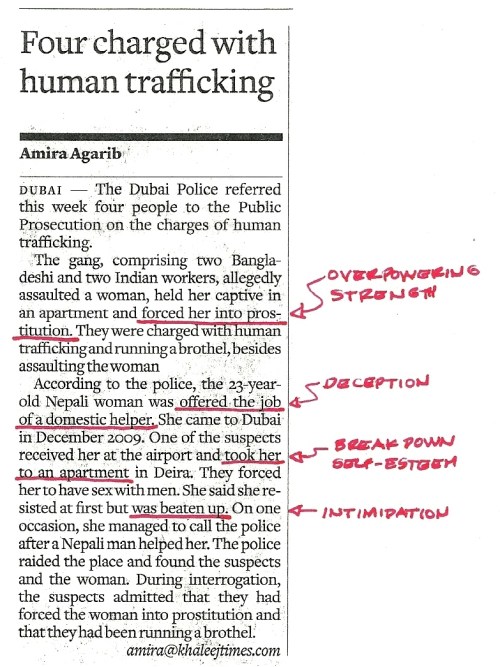
I wish that all stories about despicable people had a happy ending. Alas, that is not the case. While traveling home from Dubai last week, a friend showed me a story printed in the July 16 edition of the Khaleej Times — the English language newspaper published in Dubai, UAE. The story was entitled “Four Charged with Human Trafficking.” This brief story clearly illustrates the tactics used by the despicable people who plot to steal the innocence of young girls in order to make a profit. Here is my quick analysis of this article.


First, despicable people use strength to overpower the weak. Injustice is essentially the abuse of power by taking from others what God has given them. The news story says that a gang of four men “allegedly assaulted a woman, held her captive in an apartment and forced her into prostitution.” Psalm 10 describes how the strong prey on the weak: “He waits in ambush near the villages; he kills the innocent in secret places; his eyes are on the lookout for the helpless” (Ps. 10:8). Every day, people abuse power and strength in order to take advantage of the young, innocent, and helpless. God hates this despicable practice and calls us to “seek justice, rescue the oppressed, defend the orphan, plead for the widow” (Isa. 1:17).

Second, despicable people use deception to lure the innocent into their nets. The news article relates that the four men offered the young woman “the job of a domestic helper.” Many young girls are lured away from their impoverished families by false promises like this. Promised that they will be taken to do honest work that will enable them to help support their families, these innocent girls leave their homes with altruistic intentions. The writer of Psalm 10 had observed this kind of deception in his own day: “He lurks in secret like a lion in a thicket. He lurks in order to seize the afflicted. He seizes the afflicted and drags him in his net” (Ps. 10:9). God hates this despicable practice.

Third, despicable people rob the innocent of their self-esteem. The news article reports that the young woman’s captors “took her to an apartment in Deira. They forced her to have sex with men.” In most cases, abductors take their young victims to private residences where they repeatedly rape them. Every act of rape violently rips away one more layer of self-esteem and obscures any feelings of self-worth. And then, they tell these violated girls that they are not worth anything and that no one will ever want them. Thus begins their sad descent into a world where they are repeatedly raped for profit in filthy brothels. This kind of abuse is a despicable practice.

Finally, despicable people use violence and intimidation to keep their victims in line. The news article says that the young girl “resisted at first but was beaten up.” I have heard several accounts of young girls who were beaten because they refused to service a client or because they tried to escape. The strong will not hesitate to raise their arm against the weak — a despicable act. That’s why the Psalmist prayed, “Break the arm of the wicked and evil person; call his wickedness into account until nothing remains of it” (Ps. 10:15). Thankfully, the despicable men who abused the young girl were arrested. My prayer is that they will be locked up for a long time so that they “may terrify no more” (Ps. 10:18).

Posted by: Omar C. Garcia | July 19, 2010

Lord, We Went

John R. Mott believed in the potential of students to change the world. In the summer of 1886, Mott attended a conference and heard a speaker issue a missionary challenge followed by an appeal for personal commitment. Mott was among one-hundred students who signed a pledge at the conference that read, “We hold ourselves willing and desirous to do the Lord’s work wherever He may call us, even if it be in the foreign lands.” That meeting launched what would later become the Student Volunteer Movement for Foreign Missions. Mott led this movement for thirty years. In April 1901, Mott spoke on the responsibility of young people for the evangelization of the world. In this speech, he said, “The last command of Christ is operative until it is repealed. It is not optional, as some would assume, but obligatory. It awaits its fulfillment by a generation which shall have the requisite faith and courage, and audacity and the purpose of heart to do their duty to the whole world.” Mott’s words are still relevant today.

Every summer, multiplied thousands of Christian students from around the world serve on short-term mission teams. This month, more than three-hundred and fifty of our students and adult sponsors participated in missions initiatives to Houston’s inner-city neighborhoods, Galveston, Waco, Missouri, Montana, Nicaragua, and India. Our students worked with disadvantaged children, cleared littered and overgrown inner-city lots, painted homes, fed the homeless, served at food pantries, worked with women rescued from prostitution, taught in a slum school, cared for physically and mentally challenged children and adults, ministered to the elderly, and served in five of Mother Teresa’s homes for the destitute and dying. In order to participate in our summer missions initiatives, our students completed a year of mandatory discipleship training and attended meetings that prepared them for their respective assignments.

I am encouraged by students who leave the comforts of their homes to serve around the world every summer. There is value in traveling, seeing new places, meeting new people, and understanding the worldviews that shape the lives of others. St. Augustine said, “The world is a book. He who does not travel reads only a single page.” Those who go beyond read another page, broaden their vocabulary, become better informed, see the world through new eyes, and grow in their understanding of how to share the good news of Jesus Christ across cultural lines. Students who participate regularly in summer missions initiatives become adults who are more likely to see and respond to the needs of the least of these and the lost. And, students who serve in summer missions initiatives generally return home changed by their experiences. God uses those who go beyond to make a difference but also makes them different.

In the late Twentieth Century, archaeologists unearthed a stone tablet in Jerusalem that bears the image of a sailing ship. The words “Domine Ivimus” are inscribed beneath the outline of the ship. These words commemorate the pilgrimage of some unknown Christ-follower to Jerusalem. The translation: “Lord, we went.” I am grateful for the untold thousands of students who have traveled around the globe this summer to live out the message of the gospel. No other belief system in the world sends out their students to do the kinds of tasks that Christian students do. The students who venture out are not perfect and sometimes make mistakes. But, they have taken ownership of their responsibility to love God, love people, and take the good news of Jesus Christ to a world in need. I am proud of our students and the many others who go beyond every summer. Like the ancient pilgrim, they can say, “Lord, we went.”

« Newer Posts - Older Posts »

Categories