One of my favorite Christmas carols is O Little Town of Bethlehem, written by Phillips Brooks and set to music by Lewis Redner. Brooks, an Episcopalian priest, served as Rector of the Church of the Holy Trinity in Philadelphia. He visited Bethlehem in 1865 and wrote the words to the carol three years later for the children of his church to sing at their annual Christmas program. Brooks asked Redner, the organist at his church, to set his words to music. Redner struggled to compose a melody but was inspired with the tune the night before the program. The following day, thirty-six children accompanied by six Sunday School teachers premiered Brook’s carol for the first time.
I had the opportunity to visit Bethlehem earlier this year. As I stood inside the Basilica of the Nativity, I thought about Brook’s famous Christmas carol. As I stood outside of the church my thoughts turned to Herod who had built an impressive palace near where Jesus was born. Below is a portion of what I wrote and posted from Israel on March 15. It is a tale of two kings.
Bowing Low | The morning of March 15 greeted us with rain and a cold breeze. No matter — we boarded our bus and headed to the town of Bethlehem, “the city of David” (Luke 2:4). The name Bethlehem means “house of bread” and is located only a few miles from Jerusalem. Seven hundred years before Jesus was born, Micah prophesied that the Messiah, a descendant of David, would be born in Bethlehem (Micah 5:2).
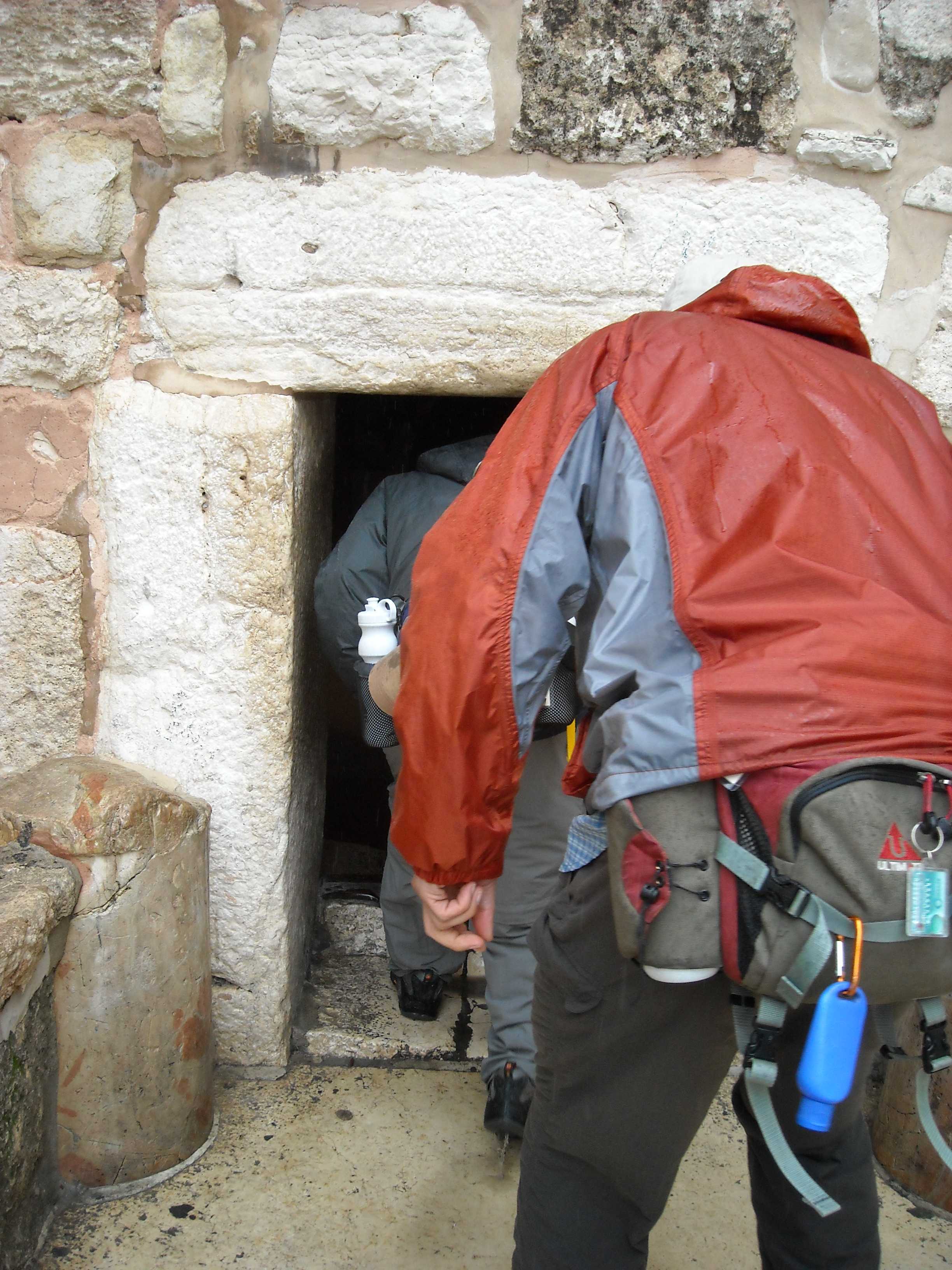
Door of Humility
Our first stop of the day was at The Basilica of the Nativity, built over the cave that tradition marks as the birthplace of Jesus. Guests must enter the basilica through a very low door called the Door of Humility. This door was created in Ottoman times to force even the most important visitor to bow low as he entered the holy place. We entered the basilica through the Door of Humility and stepped into the dimly-lit nave flanked by rows of columns. The smell of incense, the sounds of worship in progress, and paintings of biblical scenes and saints welcomed us into the old church. Our guide spoke in hushed tones as he reviewed the story of Jesus’ birth. He then escorted us to the traditional site of the Nativity enshrined in the grotto beneath the choir area of the basilica.
Looking down into the grotto I was reminded that Jesus was not born in this building but in the cave it enshrines, a place where animals were once kept. We have seen many such caves on our treks around the country. They are more common than I imagined and come complete with the filth and fragrance of the animals they house. At the time of Jesus’ birth there were no shortage of palaces and fortresses where He could have been born, including the imposing and impressive Herodium just a short distance away. “But when the fullness of time came, God sent forth His Son…” (Gal. 4:4) who “emptied Himself” (Phil. 2:7) and was born in the most unlikely of places and laid “in a manger,” a feeding trough for animals (Luke 2:7).
Building High | Just a short distance from the place where Jesus was born is the Herodium, a fortress-palace built by Herod on top of the highest real estate in the area. We hiked to the top of the hill to look at the ruins of this once-great palace. The Herodium is an active archaeological site. We took a moment to watch the painstaking work of those who continue to peel back the layers of history here. Josephus recorded that Herod was buried in the Herodium. His words were confirmed in 2007 when Israeli archaeologist Ehud Netzer and his team found Herod’s grave (see National Geographic, December 2008).
At the time of Jesus’ birth, the Herodium was one of the largest and most luxurious palaces in the world. Herod spared no expense to build the biggest and the best on the highest mountain so that the world would know there is a Herod. The Herodium was so imposing that the first rays of the sun painted its shadow across Bethlehem each morning. Imagine that! Jesus — the king of the universe — was born in an insignificant cave, probably amidst animals, in the shadow of Herod’s greatness.
Today, all of Herod’s palaces and fortresses lie in ruins. Herod is remembered as the megalomaniac who became paranoid and killed many people, including babies (Matt. 2:16-18), in an effort to maintain his power. Herod had wealth and lavish palaces in which to dine and sleep, but Jesus had “no place to lay His head” (Matt. 8:20). Jesus did not leave a legacy of palaces or architectural accomplishments. He left something much more lasting. And, what Herod the Great feared (Matt. 2:3) came to pass. The baby born in Bethlehem beneath the shadow of his palace became a greater king than him and changed the world forever.
 Go Beyond
Leave a comment