A Page from my Journal | 23 February 2005 | From Khartoum to Darfur
We arrived in Khartoum last night via London and Dubai. I have wanted to travel to Sudan for years, especially since first learning that Sudan has topped the list of the top ten countries that persecute Christians. The treatment of Christians who live in the southern part of the country by Muslims who live in the north accounts in part for the fact that more Christians were martyred in the twentieth-century than in the previous nineteen centuries combined.
 After a quick night’s sleep, we awoke early this morning and headed to the airport for our 8:00 AM flight to Darfur. The NGO we are working with was able to book seats aboard a twin-prop United Nations flight to Al-Fashir, the capital city of North Darfur. We quickly ascended to our modest cruising altitude above the barren, brown landscape below. The absence of anything green served as a sobering reminder that the odds are stacked against anything or anyone wanting to stake a claim on life here. I could see the burned-out remains of what once were villages whose inhabitants are either dead or struggling to survive in the displacement camps we will soon visit. As we started our descent, the intimidating landscape below came into sharper focus. We landed with a single bounce and rolled to a stop. No tarmac. When our pilot stepped into the cabin and opened the door, the searing heat of Darfur rushed in to greet us.
No modern airport here. We claimed our bags next to the plane and then walked in the searing dry heat to meet our hosts. We shoved our backpacks into their Range Rover and headed to our lodging — a simple house with no electricity or running water. After a quick orientation we attended a meeting with some UNICEF folks who briefed us on the desperate need for water in Darfur. We learned that a single well can service between 200 and 400 people. However, given the current humanitarian crisis and the influx of multiplied thousands of internally displaced peoples, there are not enough wells to meet the demand.
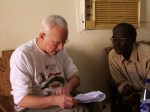
Dr. Tom Dickey reviews stats.
Our next briefing was with the local health director. At present, many NGO’s are in Darfur and providing much-needed medical care. Again, the need for water is great. Many people in Darfur, especially children, are dying of common diarrhea because they do not have enough water to rehydrate. And, many others are dying of “man-made” malaria in this place that is anything but tropical. Mosquitoes are breeding in water pots left uncovered and then infecting the people. The local hospital, which we are scheduled to visit during our time here, has only eight doctors to service a population almost as great as that in the Dallas–Fort Worth metroplex.
In addition to much-needed medical care, there is a need for psychological care. One Sudanese doctor said that if we were to give any child crayons and paper they would draw scenes of war and death because that is all they have ever known. Children whose parents have been killed remain vulnerable. Some are adopted and others are conscripted into the army. Girls of all ages are vulnerable to rape as they search the barren landscape outside the displacement camps for firewood. Life here is unimaginably hard.
It’s been a long and emotional day. The temperatures today soared to over one-hundred and twenty degrees. Thankfully, night ushered in cooler temperatures — in the nineties. We sat outside our modest little lodging and ate a stew of local beans and talked late into the night as the constellation of Orion kept vigil overhead. Tonight, Darfur is no longer just a place on a map. It’s always been a place on God’s heart and now has a place in my heart as well. My prayers for Darfur will never be the same.
 Go Beyond
Leave a comment